


Chapter 11 - Quality Assurance and Enhancement of the Core Curriculum, Science Education, and Music and Performing Arts Courses
| 11.1 | Introduction |
| 11.2 | Core Curriculum |
| 11.3 | Science Education at Lingnan University |
| 11.4 | Music and Performing Arts Courses |
| 11.1 | Introduction |
| The Wu Jieh Yee School of Interdisciplinary Studies (WJYSIS) houses interdisciplinary programmes and units providing general education, namely, the Office of the Core Curriculum (OCC), the Division of Science (DoS) and the Wong Bing Lai Music and Performing Arts Unit (WBLMP). The quality assurance and enhancement of programmes and units under the WJYSIS is overseen by the Wu Jieh Yee School of Interdisciplinary Studies Management Board (WJYSISMB), which comprises key personnel from the units/offices and the interdisciplinary programmes that are housed in the School. The terms of references and membership of WJYSISMB are detailed in Appendix A. | |
This chapter is dedicated to the quality assurance framework of the Core Curriculum, Science Education and Music and Performing Arts courses. The quality assurance and enhancement for interdisciplinary programmes under WJYSIS are included in other chapters of the AQA Manual about the quality assurance and enhancement for new and existing programmes. | |
| 11.2 | Core Curriculum |
| As an essential part of the undergraduate curriculum at Lingnan University, the Core Curriculum is a compulsory component for all undergraduate students irrespective of their Majors since the 2012 four-year intake. It aims to provide students with a broad, balanced foundation through exposure to cross-disciplinary subjects. The Core Curriculum has been constantly reviewed and revised. The current framework requires students to complete 27 credits in the Core Curriculum. Students from the 2024 Year 1 intake and 2026 Senior Year intake are required to take 5 compulsory courses in the Common Core and 4 courses in the Clusters. Students may choose four Clusters out of the five, and complete one course in each of them. Students from the 2018 to 2023 Year 1 intakes and the 2019 to 2025 Senior Year intakes are required to take 4 compulsory courses in the Common Core and one course from each of the five Clusters. | |
| Given its significance in the University curriculum, the Core Curriculum is conceived as a university-wide responsibility. All academic units and the Office of Service-Learning contribute to the offering of courses, while the OCC serves as the coordinator in managing and implementing the programme. | |
| 11.2.1 | Quality Assurance and Enhancement Structure |
| Reporting to AQAC, the Core Curriculum Committee (CCC) is a university-level committee which oversees the development, implementation and quality assurance of the Core Curriculum. Input and feedback are regularly sought from the Advisory Board and Staff-Student Consultation Committee (SSCC) for Core Curriculum to enhance the programme. The terms of references and memberships of these Committees/Board are detailed in Appendices B to D. | |
| 11.2.2 | Quality Assurance and Enhancement Mechanism |
| As presented in the Quality Assurance Mechanism for the Core Curriculum in Figure 1, each offering unit takes charge of the quality assurance and enhancement of its courses offered in the Core Curriculum. To maintain the quality of the programme, all units are to submit course-related proposals to CCC for consideration, and annual reports on courses offered to the Director of Core Curriculum via OCC for review. | |
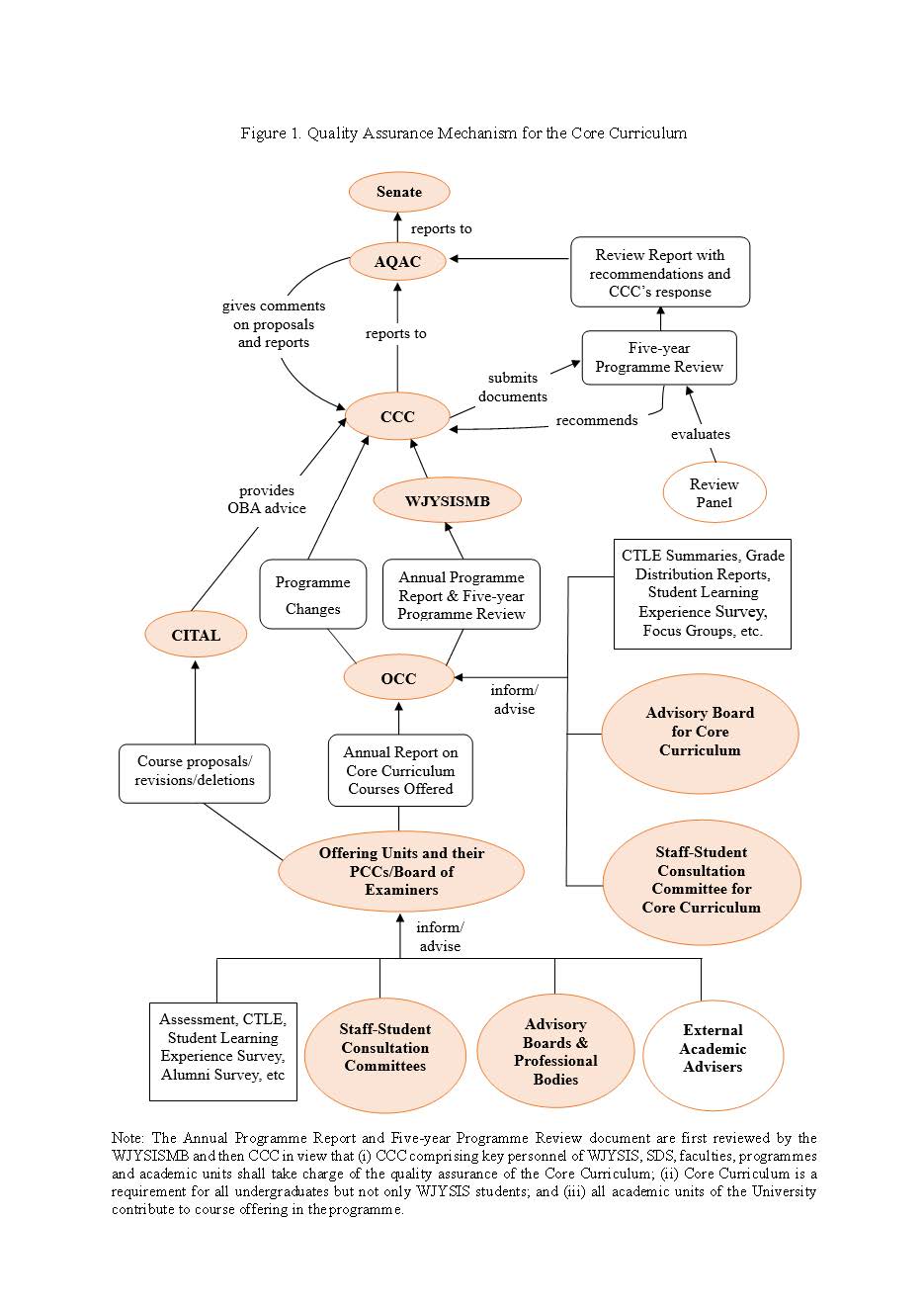 | |
Proposals of Courses and Modifications Proposals of Core Curriculum courses and modifications should be first endorsed by the relevant PCC/Unit Board. Advice from the Centre for Innovative Teaching and Learning (CITAL) should be sought on outcome-based element, wherever appropriate, before submission for deliberation of CCC. CCC ensures that the proposed courses and modifications adhere to the principles for Core Curriculum courses as adopted by the Senate and that they align with the relevant intended learning outcomes. All proposals endorsed by CCC are then further scrutinised or noted by AQAC. | |
Annual Report on Core Curriculum Courses Offered At the end of each academic year, each of the offering units is to review the offered Core Curriculum courses and to send out relevant materials of at least one of the courses to an External Academic Adviser (EAA) for review. All Cluster courses are subject to comments by EAAs within five years, and each Common Core course should be reviewed by an EAA every two years. Comments of EAAs and follow-up actions should be reported in the Annual Report on Core Curriculum Courses Offered, alongside other reporting items as shown in Appendix E, for submission to OCC. | |
Programme Reviews and Changes Similar to all undergraduate programmes of the University, the Core Curriculum is subject to regular reviews at the programme level. Other than the comprehensive review involving a panel consisting of mainly external reviewers during the Five-year Programme Review, the programme is evaluated annually by OCC and the WJYSISMB via the Annual Programme Reporting. Each year OCC works with CITAL in data analytics and qualitative assessment to measure students’ achievement of the programme intended learning outcomes. The findings together with input and feedback from offering units, students and the Advisory Board are highlighted in the Annual Programme Report for WJYSISMB and CCC’s review and submission to AQAC. In case programme-level modifications have to be made, OCC submits proposals to CCC directly for consideration. All proposals endorsed by CCC are then further scrutinised by AQAC. | |
| 11.3 | Science Education at Lingnan University |
As a liberal arts university, Lingnan University provides unique undergraduate experience by introducing Core Curriculum and Science Education to supplement the Major programmes offered by the three Faculties (Arts, Business and Social Sciences), the WJYSIS and the School of Data Science.
The DoS, formerly named as the Science Unit, was established in 2015 to develop and teach science courses designed for nonscience students at Lingnan to fulfill the “Science, Technology, Mathematics and Society” Cluster (CLD) requirements of the Core Curriculum. From 2018-19 onwards, CCC8013 The Process of Science was developed as one of the Common Core courses for undergraduate students.
From 2019, the DoS continues to develop new initiatives to promote both general and advanced science education in a broader spectrum. Programmes on environmental science and sustainability at undergraduate and postgraduate levels have been developed and approved for official launch since 2020. | |
| 11.3.1 | Quality Assurance and Enhancement Structure |
| Apart from the CCC which takes care of the QA for the Core Curriculum, the Board of Division of Science (BDoS) and the Advisory Board for Division of Science (ABDoS) were formed to ensure the academic standard of the Science education at Lingnan. | |
Board of Division of Science Board of Division of Science (BDoS) (similar to the structure and role of a Department Board; see Appendix F for the terms of reference and membership) is chaired by the Head of the DoS comprising all teaching members of the DoS. It oversees a wide range of academic and research activities in a comprehensive manner, including discussion and coordination about assessment related matters of the DoS.
Advisory Board for Division of Science In view of the expanded curriculum of the Science education at various levels, the Advisory Board was set up to obtain professional comments and insights from the industry and community to consistently review and improve the programmes and courses to ensure that they align with the expectations and needs of the industry and community. The terms of reference and membership of the Advisory Board are provided in Appendix G.
The detailed QA structure can be referred to Figure 2. | |
 | |
| 11.3.2 | Quality Assurance and Enhancement Procedures |
Proposals of Courses and Modifications New course proposals and modifications to Common Core and Cluster courses of the DoS continue to follow the overarching QA process of the Core Curriculum.
Additions and revisions of Science programmes and courses coded SCI designed for undergraduate students are directly reviewed by the BDoS and then submitted to the AQAC for further examination and approval. For matters in relation to research postgraduate programmes, BDoS informs/reports to the WJYSISMB and the WJYSISMB then submits the matters to the Postgraduate Studies Committee (PSC) for consideration and approval. For taught postgraduate programmes and courses, the quality assurance and enhancement structure/process for new and existing programmes as stipulated in other chapters of the AQA Manual shall apply.
Annual Report The DoS submits an Annual Report to the AQAC via the WJYSISMB for review and endorsement. The Report covers the major academic developments and achievements. Relevant extracts of statistics and feedback about the DoS courses from the Course Teaching and Learning Evaluation (CTLE), the External Academic Advisers and other channels are articulated and reflected in the report. Details can be referred to Chapter 6 of the AQA Manual.
Annual Report on Core Curriculum Courses The DoS also submits an annual report on Core Curriculum courses to account for the overall developments in teaching, learning, good practices, and assessment of the Common Core and Cluster courses offered by the DoS at the end of each academic year.
Internal Peer Review The Peer Teaching Evaluation process is established whereby each term both full-time and part-time instructors of the DoS sit in a course taught by the other teaching members to provide feedback and learn from their peers.
Staff-Student Consultation Committees The DoS participates regularly in the SSCC meetings for Core Curriculum to communicate with students and collect views and suggestions for enhancing academic quality and delivery of the science curriculum. Starting from 2020-21, the DoS is also involved in the SSCC for MPhil/PhD Programmes to receive students’ comments for betterment of the programmes. | |
| 11.3.3 | Teaching and Learning |
To deliver the science courses to non-major students at an accessible and rigorous level, the DoS collaborates closely with CITAL to collect and convert students’ feedback to ways that effectively address the learning needs of students. The DoS also participates in the Peers Observation Scheme which encourages exchange among peers for course improvement and cross-disciplinary course development.
Some of the science courses are integrated with Service-Learning components. The DoS participates in student focus groups and other programmes organised by the Office of Service-Learning (OSL) to collect useful information about the effectiveness of integrating experiential projects and activities for learning scientific processes and knowledge. | |
| 11.3.4 | Assessment Review |
The DoS discusses and coordinates assessment related matters of undergraduate and postgraduate courses through the BDoS. The BDoS reviews matters concerning assessments, including the development of rubrics, consistency of grading, grade distributions of DoS courses and effectiveness of teaching with a diversity of pedagogies, etc. at the end of each term.
A selection of assessment tasks and grading of courses is chosen for in-depth review. As all DoS courses are currently graded based on continuous assessment, examples of representative assessment items are chosen to be examined. This review process assesses the suitability of each assignment and the rubric developed to assess that assignment.
In accordance with the University guidelines, the DoS has appointed two External Academic Advisers, one local and one non-local (from one of the LU’s benchmarking institutions). At the end of each term, the EAAs review a selection of courses and assignments of the science courses offered by the DoS to assure that the instructors are marking according to local and international standards. The comments of the EAAs are channeled to the BDoS and reflected in the relevant annual programme reports, as appropriate. | |
| 11.4 | Music and Performing Arts Courses |
| The scope of courses offered by WBLMP has expanded since the Unit was established in 2017. A stand-alone course letter code “MPA”, i.e. “Music & Performing Arts”, has been used for discipline-specific courses accessible to undergraduate students. WBLMP has also begun to incorporate Service-Learning components into its courses. | |
| 11.4.1 | Quality Assurance and Enhancement Structure |
To assure the quality of MPA courses, the Board of WBLMP (BMP) and the Advisory Board for WBLMP were set up. WBLMP has started to appoint two External Academic Advisers, one local and one non-local, from 2021-22.
The QA mechanism for WBLMP is provided in Figure 3. | |
 | |
Board of Wong Bing Lai Music and Performing Arts Unit (BMP) The BMP is chaired by the Head of WBLMP and comprises academic staff members from relevant departments/units/offices. It oversees the quality assurance, operations, assessment results, offerings, and revision of WBLMP’s courses and academic curriculum. The terms of reference and membership of BMP are provided in Appendix H.
Advisory Board for Wong Bing Lai Music and Performing Arts Unit The Advisory Board acts as an interface between the industry/community and the music and performing arts courses/programmes. Including leaders and practitioners of the arts scene in Hong Kong, it provides professional comments and insights for the development of music and performing arts at Lingnan. The terms of reference and membership of the Board are provided in Appendix I.
External Academic Advisers At the end of each term, the EAAs review a selection of courses and assignments of WBLMP’s courses to assure that the instructors are marking according to local and international standards. Comments of the EAAs are channeled to the BMP and reflected in relevant reports. | |
| 11.4.2 | Quality Assurance and Enhancement Procedures |
New/revisions to MPA courses designed for undergraduate students must go through the following approval procedures:
1) Courses shall be reviewed and endorsed by the BMP. 2) The finalised and endorsed proposals will be submitted to the AQAC. Approval of AQAC is needed for new courses and major revisions. 3) Courses will be submitted to the Senate for noting. | |
| 11.4.3 | Evaluation and Development |
Throughout each term, WBLMP collects feedback on the courses from different stakeholders including students, instructors, internal and external partners and advisers, for identifying good practices and areas to improve.
WBLMP submits an Annual Brief Report to the BMP, WJYSISMB and AQAC every academic year for overall monitoring. The Report is prepared in accordance with guidelines provided in Chapter 6 of the AQA Manual.
Oversight of assessment matters are among the duties of the BMP. This includes the development of rubrics, consistency of grading, grade distributions and effectiveness of teaching pedagogies. |