



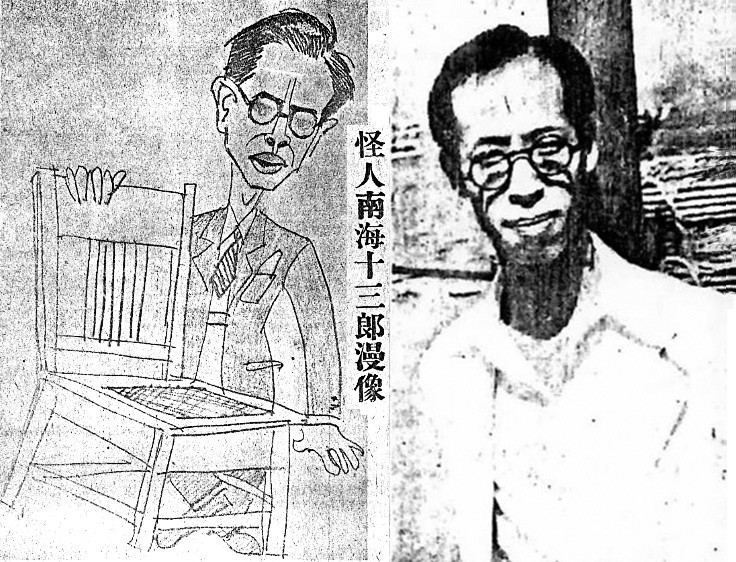
Nam Hoi Sup-sam Long’s comic portrait (Artland, no 18, 15 November 1937) and photograph (Artland, no 43, 1 December 1938)
Stephanie Ng Yuet-wah
The Mad Phoenix (1997) brings Nam Hoi Sup-sam Long to the attention of audiences in present times, introducing him as a talented Cantonese opera playwright and as a mentor to Tong Tik-sang, as well as his extraordinary family background and his aloof and straightforward nature. Nam Hoi Sup-sam Long was not only a famous Cantonese opera playwright, he was also a film director and screenwriter, and some of his films were adaptations of his famous Cantonese opera works. Unfortunately, after the war, Nam Hoi Sup-sam Long suffered from mental problems due to head injury[1], bringing his creative career to an abrupt end. All of his post-war films were adaptations of his pre-war plays. Thus, it was pre-war that marked the golden age of his film writing and directing. However, these film copies had long since disappeared into the flames of war. Therefore, in the following, we can only look at the themes and stories of his works to get a glimpse of his loving and noble spirit.
A Tale of Family Love on the Screen
Nam Hoi Sup-sam Long was born Kong Yu-kau, also known as Kong Yu Kau and Kong Fung, in the family of Jiang Kongyin, the former minister of the Qing Dynasty in the South China Sea. Sup-sam Long was born in Shanghai to a mother who was his father’s sixth wife. He was the 13th among his brothers, hence the name Nam Hoi Sup-sam Long. His mother passed away shortly after his birth and he was brought up by his nanny. He was an extremely intelligent boy, but having lost his mother at an early age and being the son of a concubine growing up in a complicated family environment, he developed a solitary character. Kong Yunjing, his elder sister, was a fan of Cantonese opera and was particularly fond of Sit Kok-sin. The bright and intelligent Sup-sam Long learned how to write plays from watching Cantonese opera. At the request of Sit Kok-sin, Sup-sam Long was invited to write a script for Sit Kok-sin’s Cantonese opera troupe, Kok Sin Sing Opera Troupe and eventually, the extraordinarily talented Sup-sam Long became famous for his play A Serenade starring Sit Kok-sin.[2]
In 1936, after gaining fame in the Cantonese opera world, he began his quest on the silver screen. The first film written and directed by Nam Hoi Sup-sam Long was the ethical drama Children’s Debts (1936), an adaptation of his Cantonese opera Silent Falling Flowers. It tells the story of a father (played by Lam Kwun-shan), a barrister, whose son (played by Ng Cho-fan) takes up his profession. However, the father leaves his daughter (played by Lam Suet Dip) in the care of her grandmother following her mother’s death and eventually, she becomes a dancing girl. The son meets his sister at the dancing club and they identify each other. However, the sister, in defence of her brother’s reputation, accidentally kills her rogue husband. Unaware of what has happened, the brother goes to court to defend his sister and the father is the judge in the murder trial. In the end, the father acts justly and convicts his daughter, who is sentenced to death.[3] It is rumoured that the story is based on the life of Nam Hoi Sup-sam Long, whose father, with numerous concubines and wives, met his mother in Shanghai and fathered a son and a daughter. When his father left Shanghai, he only brought Sup-sam Long with him, leaving his daughter behind in Shanghai. In the end, she came to Hong Kong to work as a dancing girl. Nam Hoi Sup-sam Long, unknowingly, met his sister at a club and fell in love with her, but legend has it that her sister was not involved in any murder. Sup-sam Long was apparently using this story to accuse his father of not fulfilling his fatherly responsibilities, thereby causing a social tragedy. His father is said to have seen the film and thought what his son did was right.[4] Whether the rumour is true or not, his harsh attitude towards the misdeeds of the powerful and his sympathy for women/the disadvantaged can be seen in this work, a feature that would appear in different forms in his later works.
The film Children’s Debts was as well received at the box office as the stage performances, and Nam Hoi Sup-sam Long went on to turn another Cantonese opera of his, The Same Night Last Year, into his second film, Sin and Law (aka Man of All Evil, 1937). [5]In the story, Chin Fong (played by Yee Chau-shui) is in love with Pak Bik (played by Leong Tim Tim) and he spends a lot of money on her but it is his younger brother Chin Sheung (played by Tse Tin) whom Bik loves. Fong kills Bik’s mother by mistake when he tries to discourage the Sheung and Bik from getting together and he is then sent to prison, while Bik also goes away from that heartbreaking place. A few years later, Fong dies in prison. Sheung still misses Bik and looks for her everywhere. The two of them eventually reunite.[6] The film is said to be tightly plotted, and the dialogues are “witty and brilliantly written”. [7]Another film that deals with class conflicts is his screenplay Born with a Silver Spoon (1937; directed by Wong Fook-hing), in which the protagonist of the film, a rich young man, works as a journalist and dedicates himself to reporting the ups and downs of the grassroots, and at last, he even sacrifices his own family to save a girl from a poor family. [8]These two films both deal with the conflict between the system and justice and human decency, in which justice is ultimately served and the unjust are brought to a bitter end.
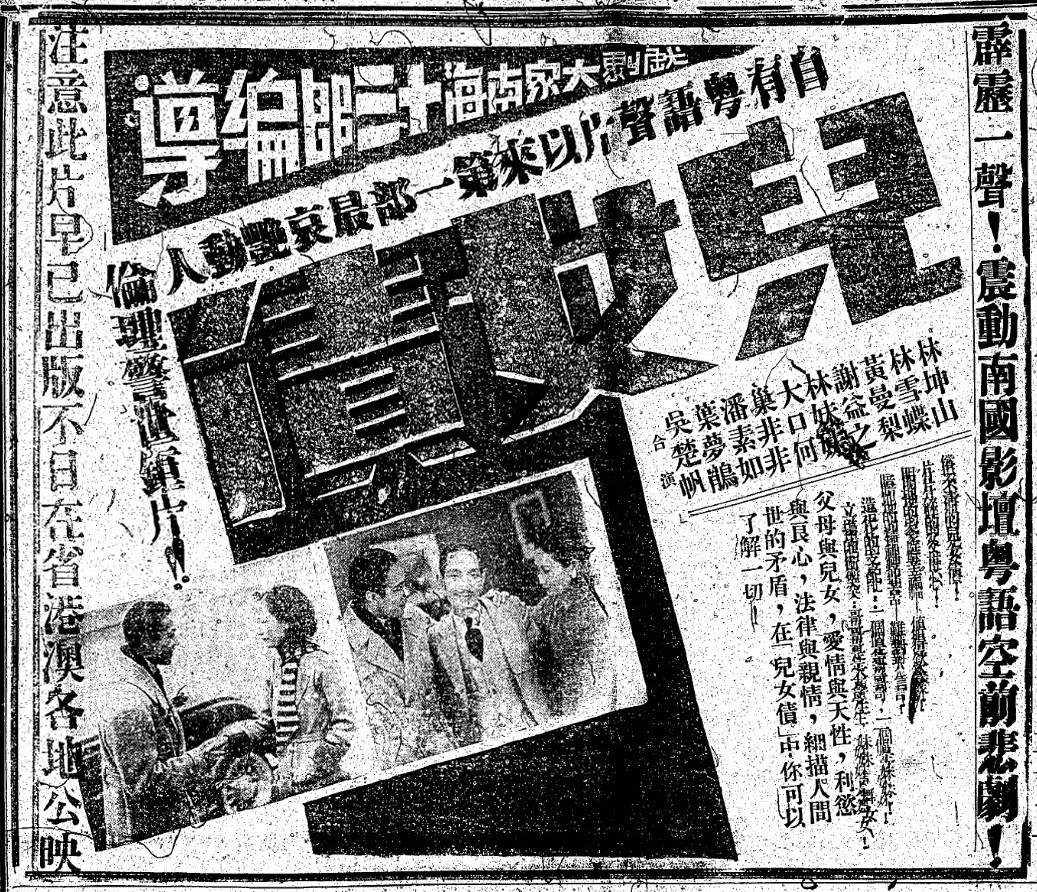
Figure 1: An advertisement for the public release of the film Children’s Debts (1936) in Hong Kong, Macao and Guangdong Province, written and directed by Nam Hoi Sup-sam Long, a prominent figure in the Cantonese opera industry. (The Industrial & Commercial Daily Press, 29 March 1936).
War Resistance Films
In 1937, Japan invaded China and the war of resistance began. The patriotic Nam Hoi Sup-sam Long responded immediately by writing and directing the war resistance film War and Survival (1937). Under the fire of war, the female protagonist (played by Mui Yee) has no choice but to become a dancing girl to cure her sick mother[9], while the male protagonist (played by Lee Mang) has to give up his literary job and join the army to protect the country.[10]The film was promoted with the theme of loyalty, filial piety and martyrdom[11], which in turn reflects Nam Hoi Sup-sam Long’s mission of war resistance. In 1938, the film industry in South China initiated the production of the national defence film The Last Stand to raise funds for the war, and Nam Hoi Sup-sam Long actively participated in the screenwriting and directing of the film and donated $50 to support the cause. The film consists of seven stories, the first six of which are about how people from six different sectors, namely university students, the industrial and commercial sector, the film industry, women, peasants and soldiers, resist the war. Each of these stories represents the process of social consciousness and enlightenment of a certain class of people, and finally, at the “last stand”, everyone is mobilised to fight bravely against the war and the film ends with the singing of a song called “The Chinese Nation Will Not Fall” in the front line. [12]The cast of the film involved three thousand actors. Nam Hoi Sup-sam Long was in charge of leading the production team of Chi Ming Motion Picture Co., Ltd., directing the women’s story and co-directing the final sequence of the film with five other directors. [13]The women’s story is about a female student, Lam Mei, who intends to set up a rescue team with her old classmates. However, those ladies only take the war as just some kind of news and are reluctant to go to the war front, whereas a group of dancing girls from disadvantaged families are ready to join the frontline rescue team.[14] The storyline shows Nam Hoi Sup-sam Long’s appreciation for the disadvantaged, especially the dancing girls.
Apart from participating in national defence film productions at the time, Nam Hoi Sup-sam Long also wrote and directed historical films with resistance concepts, such as The Valiant General and Theft of the Red Pongee (1940). The former is a story of loyalty about Zhao Zi Long’s rescue of A Dou, but with an emphasis on Liu Bei’s restoration of his kingdom by bringing his people across the river in which the message of resistance is highlighted; the latter is an adaptation of his own Cantonese opera masterpiece under the same title, which tells a story about a loyal man who sacrifices his love and fights for his country. The film also features the heroine Tsui Yan-sum singing “Warm Feelings of the Home Country”, “Bashful Singing of My Love”, Mak Bing-wing singing “Song of the Exile”, “Songs from the Northern-frontier”, as well as two other songs, “Ming Yue Liu” and “Theft of the Red Pongee”, and a short opera titled “The Squire’s Son”, indicating that both historical films contain a strong sense of resistance towards the war.[15] Apart from positively depicting the society and hearts of the people under the war of different times to promote the awareness of war resistance, Nam Hoi Sup-sam Long also portrayed the women at the time in a sympathetic and gentle manner.
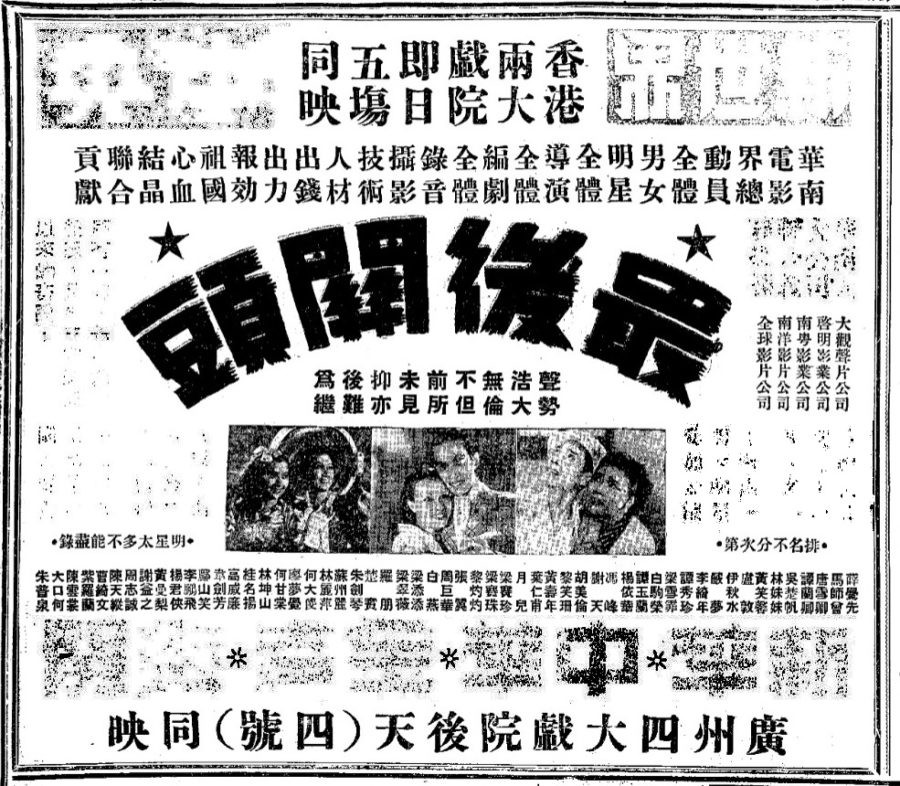
Figure 2: Advertisement for the Hong Kong and Guangzhou release of The Last Stand (1938), a war resistance film of Nam Hoi Sup-sam Long mobilising all actors of the South China film industry (The Industrial & Commercial Daily Press, 2 March 1938).
Women of the Times
In 1939, Nam Hoi Sup-sam Long himself brought his famous stage play Scant of a Woman (aka Sweet Girl) to the screen. The Cantonese opera version was originally set in a historical setting, telling the story of a talented and affectionate woman who falls in love with an unfaithful man, while the film version depicts a rich girl who admires the heroism of a revolutionist during the war against the Japanese, and in spite of the conflicting circumstances, they still get married, making it a love story with a strong sense of war resistance. The Cantonese opera version was originally performed by Sit Kok-sin, who played the role of the rich girl on stage for six consecutive years.[16] The famous actor Lo Hoi-tin had also performed in this play on stage and intended to turn it into a film, therefore with the consent of Tam Sau-zhen and Nam Hoi Sup-sam Long, they produced this film with Saam Yau Film Company.
After considering the fact that a female role played by a male actor may not necessarily bring satisfactory results in a film, thus it was changed to Tam Sau-zhen as the female lead, and Lo Hoi-tin also made his debut on the screen, with Siu Ming Sing being invited to perform three songs in the film, including the theme song “Scant of a Woman”. [17]The fact that Nam Hoi Sup-sam Long had refused to let other film companies make adaptations of the play due to the latter’s desire to delete or change the plot[18], together with the various considerations for the adaptation, shows that Nam Hoi Sup-sam Long did not rely on the reproduction of the famous theatre play to attract audiences, but instead, he valued his own works very much and had given careful consideration to the adaptation. After the war, the play was adapted into three film versions, making it the work that comes with the most film adaptations.
In addition to adapting Cantonese opera, Nam Hoi Sup-sam Long also adapted the story of a famous West Quarry song girl, Hua Yinghen, in the film A Beauty of One Generation (aka The Life of a Song Girl, 1940). Hua Yinghen was a patriotic female singer in West Quarry who actively participated in voluntary fundraising performances and was repeatedly the singer who raised the most money from her performances, and she even donated her savings for her home country’s relief work. However, in the end, with no hope of settling down and a sense of regret for her life, she committed suicide by taking poison on her birthday.[19] After the death of Hua Yinghen, film companies competed to produce films about her story. In the end, given that Nam Hoi Sup-sam Long had a close relationship with Hua Yinghen and was familiar with her thoughts and character, the family of Hua Yinghen decided to let him handle this important task. The film was co-directed by Nam Hoi Sup-sam Long and the experienced director Wong Toi, and Pak Yin, who had excellent character and acting skills, was chosen to play the role of Hua Yinghen. [20]In addition to the anecdotes of Hua Yinghen being a prostitute and raising funds for her patriotic cause, the film also takes her friendship with a writer (played by Cheung Ying) as its main focus and seeks to use their discussion on the blossoming and waning of flowers to show Hua Yinghen’s fear for her future, hence the reason why she took her own life. [21]In order to highlight the patriotic sentiments of Hua Yinghen, Nam Hoi Sup-sam Long added a play within a play, A Beauty of One Generation, to the film. This play within a play is based on the story of Chen Yuanyuan and Wu Sangui, with the former persuading the latter not to choose love over the country, starring Tsui Yan-sum, Mak Bing-wing, Lau Pak Lok, with guest participation of some of the members of Kok Sin Sing Opera Troupe.[22] The film was a great success and hit a record for over 30 consecutive days at the Central Theatre. However, Nam Hoi Sup-sam Long felt that the play within the play had overshadowed the main focus of the film and wanted to trim it, but the film company demanded to keep it as foreigners were fond of Cantonese opera. This prevented the film from presenting the touching story of Hua Yinghen in full, and therefore he rated the film as the most unsatisfactory work ever made.[23]
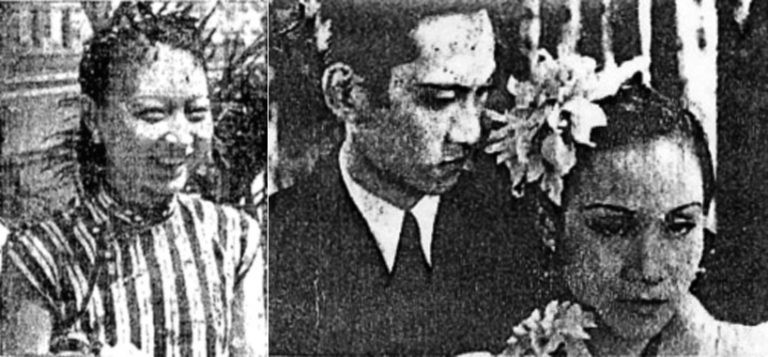
Figure 3: On the left is the portrait of Hua Yinghen (The Industrial & Commercial Daily Press, 22 November 1939); on the right is Pak Yin (right), who played Hua Yinghen in A Beauty of One Generation (1940), and Cheung Ying, who played Hua Yinghen’s intimate friend and writer (Artland, no 64, 15 December 1939).
Another film of Nam Hoi Sup-sam Long based on the theme of prostitutes was Wonderland (aka Goddess of the Streets, 1941), for which he wrote the screenplay. The story is about a young unemployed teacher, Cheung Wah (played by Cheung Ying), who meets a prostitute, Pak Suet (played by Lam Mui-mui). The latter learns to sing opera under the guidance of the former. However, when Cheung Wah falls ill, Pak Suet has to pick up her old profession again, and for this reason, she is arrested and sent to prison. Pak Suet’s disappearance leads Cheung Wah to believe that she has failed to live modestly and respect herself. When Pak Suet is released from prison, she joins Cheung Wah’s troupe, in which he is the playwright of the troupe. Cheung Wah treats Pak Suet harshly due to the misunderstanding, but eventually, as Pak Suet lives a disciplined life, the two of them break the ice, and Pak Suet becomes popular as a substitute of a disappearing singer. Thus, it is evident that in the eyes of Nam Hoi Sup-sam Long, women of the night have always had their own stories of hardships, and they have always been misunderstood and oppressed, and he had infinite sympathy for them.
Chivalrous and Tender-hearted
Although he was a man of slight build, Nam Hoi Sup-sam Long’s patriotism and generosity were no less than that of a tough man. Whenever people needed to borrow money from him to solve their problems, he was always ready to help them out. When it comes to art, Nam Hoi Sup-sam Long not only set extremely high standards for his own works but also showed no mercy in his criticism of others’ works. He once declared that he would defeat six opera troupe masters after criticising the feudalism and outdated nature of the Cantonese opera industry.[24] He was outspoken in his criticism of the people on top, but he actively supported the newcomers. He often employed newcomers as the main characters in his films. For instance, in Children’s Debts, he took on the novice Lam Suet Dip as the heroine; in Sin and Law and War and Survival, he re-employed newcomers Tse Tin and Wong Ang; in War and Survival, he promoted Lee Mang, Mui Yee, and Lun Dui, with the former two being the male and female leads; and he gave Lo Hoi-tin the opportunity to make his debut screen appearance in A Beauty of One Generation. All the newcomers he selected were well qualified, much to the admiration of the film industry. There is a fine line between a genius and a madman, but his wild and aloof character, daring to love and hate, has made his life and works a combination of righteousness and tenderness. The first production based on the legendary “flower kingdom” (the world of prostitution) in the silver screen also bore fruit from his film works, and at the same time, his legendary life was also accomplished.
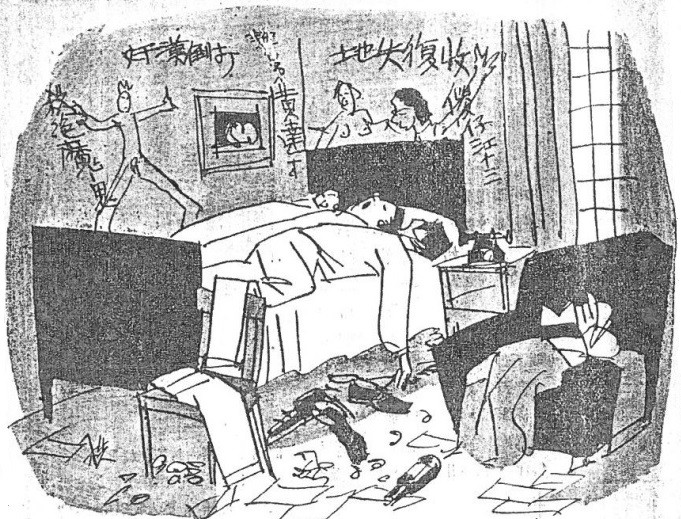
Figure 4: A caricature depicting the righteous Nam Hoi Sup-sam Long (the person sleeping on his back) with his friends Wong Tat-choi (the fat one in the middle) and Lam Kam in a hotel room they rented (Artland, no 35, 1 August 1938).