



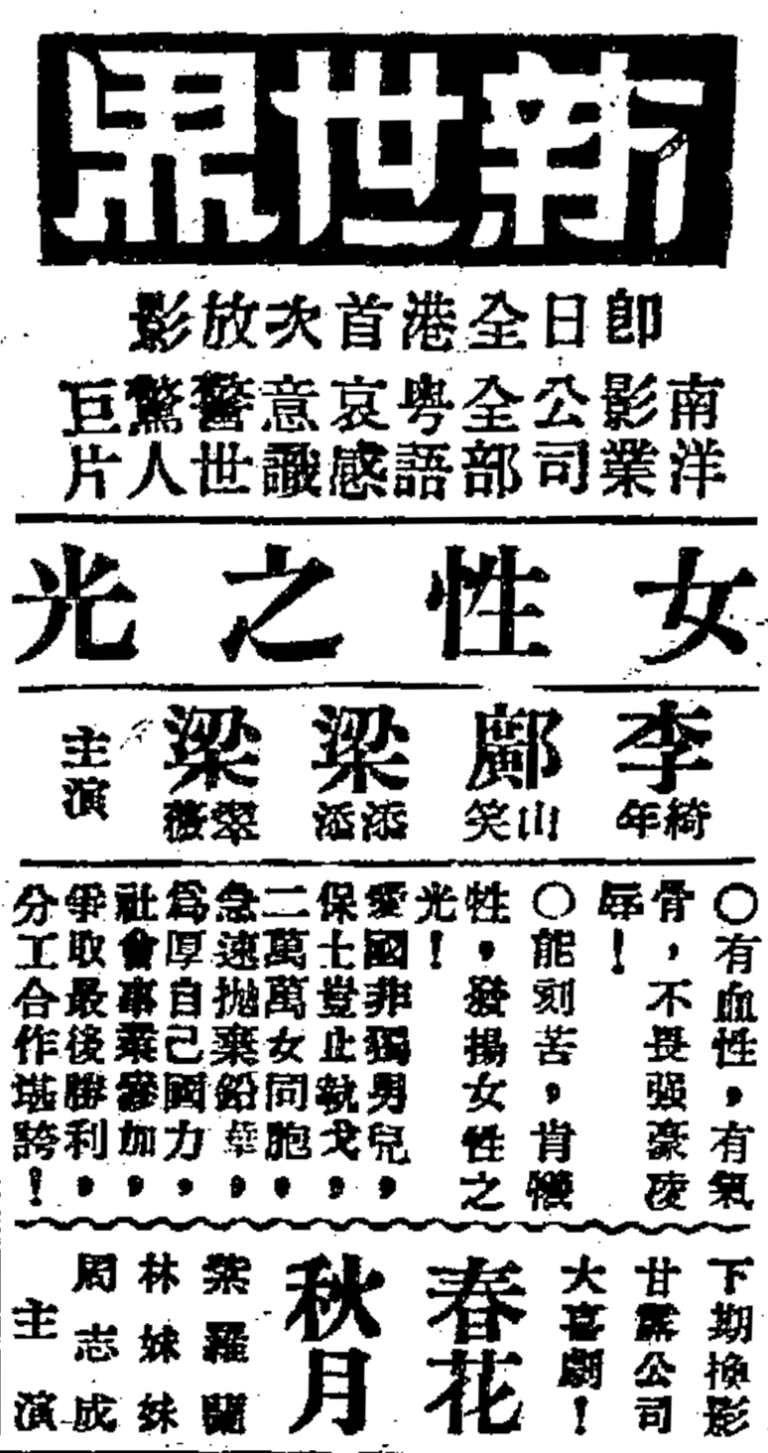
Author: Cheng Ho-Yan, Wong Tsun-Ling, Chan Ho-Sum, Tsang Sin-Mei, Cheng Si
Women’s Situation in the 1930s and Hong Kong Cinema
The “ideal woman” is not a permanent and objective image. Throughout history, this concept has transformed according to the changes over time, culture and community, and thus can hardly be generalised. As the Chinese society of the 1930s began to modernise, there was a great variety of ideas about the ideal woman. While there were voices urging women to value traditional customs, others advocated that women should break away from the traditional framework of marriage and family. Although the two hold different positions and may have conflicting concepts, they can also be compatible and coexist. Those who valued tradition may not necessarily deny women’s social status at the time and may even recognise the value of traditional concepts in a new era within the framework of social modernisation; those who encouraged women to fight against the feudal system may not necessarily reject some of the traditional values, and may even support certain virtues promoted by the traditional values, in the hope that women will be able to embody them in society or at the national level.
The above phenomena reflect the complexity and diversity of the image of the ideal woman in the 1930s, and this diversity indeed came from an ever-changing society. At the time, China was experiencing an intense clash of ideologies between the East and the West, between the old and the new. Calls for reforms were coming and going in the political, economic, social, academic, cultural and other sectors. Not even a half century after the collapse of the monarchy, the political, economic, educational and other systems were almost entirely westernised. With the intellectual influence of the New Culture Movement, society, particularly the intellectuals, began to have more modernised expectations for women. Women’s rights also began to receive more attention, and women’s liberation movements emerged one after another. More and more women were seeking education, freedom to love and financial independence, and resisting traditional oppression. Their status gradually increased.[1] However, the majority of ordinary people had not yet acknowledged the impact of Western thinking. They still believed that it was a woman’s natural duty to bear and raise children and that her place was in the home. They even regarded the liberation movements as immoral and urged women to return to traditional female virtues.[2] Furthermore, the oppression imposed on women in the traditional feudal society did not end with the abolition of the monarchy. Arranged marriages and women being trafficked as maids and concubines were rife.[3] It is evident that women still had many challenges in their journey to independence and autonomy. In such a complex social background, the public’s imagination of the ideal woman had become diverse and inconsistent, resulting in the coexistence of various conceptions of the ideal image in society, and the films of the time also adequately reflected this diversity of public imagination on female.
In the 1930s, Hong Kong films were mainly used for purposes such as to edify and entertain the public or to promote the idea of war resistance and encourage patriotic sentiments, etc. As the society at the time was generally not well-educated, the intellectuals’ discussions on politics, society and culture and other aspects could not reach the ordinary classes, and the grassroots were mostly ignorant. However, films could transcend the boundaries of words by means of sound, image and stories, convey moral teachings or ideologies, and replace complex textual theories with simplistic or entertaining forms to educate the grassroots. Thus, in the 1930s, many films were made to construct the ideal female image in order to educate the public and promote politics. With different stories, contexts and mentalities in the films, the projection of the female ideal changed accordingly, thus creating diversity. Based on the two major categories, social ethics film and national security film, in which the former serves to educate the public and the latter to promote ideologies, this article will explore how Hong Kong films of the 1930s made use of the diverse female images as a medium to express various messages, followed by demonstrating the link between these images and the reality and examining the characteristics, conflicts and compatibility of these images.
The Female Images in Social Ethics Films:
The Two Types of Women: Those Who Preserve Traditional Virtues or Those Who Resist the Feudal Oppression
The social ethics films aimed to convey the moral message that “the good will be rewarded and the bad will be punished” in order to guide people towards goodness and educate the audience.[4] This type of film was not exclusive to the 1930s. In fact, the first Hong Kong drama film, Zhuang Zi Tests His Wife (1914), was precisely a social ethics film.[5] This type of film was the mainstream in Hong Kong cinema in the 1930s, but even films of other types were more or less imbued with a sense of edification, and the concept of guiding people towards goodness was “always present in the films produced in Hong Kong before the 1960s”.[6] Women in social ethics films often encounter many difficulties, such as being abandoned by husbands and left alone with their children, single mothers trying to support their families alone, or facing oppression from fathers, brothers and their husbands’ families. The films portrayed the images of the ideal woman by depicting women’s reactions to these situations. The two most typical images are: the traditional woman who adheres to traditional female values while facing a tough life; and the new woman who fights to overcome patriarchal oppression to seek autonomy. In the following, we will focus on the analysis of these two aspects.
The Ideal Woman Who Embodies Traditional Female Values
In films promoting traditional female values, it is often through women’s stories that the audience is educated about the importance of family ethics. The ideal woman is portrayed as a virtuous wife and mother, and if she is to work, it is not to fulfil her own ambition but to care for her family. In other words, it “portrays the ideal woman of the time out of the traditional standards”[7], thus demonstrating the importance of traditional values in a modernised society. For example, in A Lady of Canton (aka A Woman of Guangzhou, 1936), the film shows that traditional female virtues demand women to put family first, follow the Three Obediences and Four Virtues, and that family integrity is their ultimate life plan.[8]
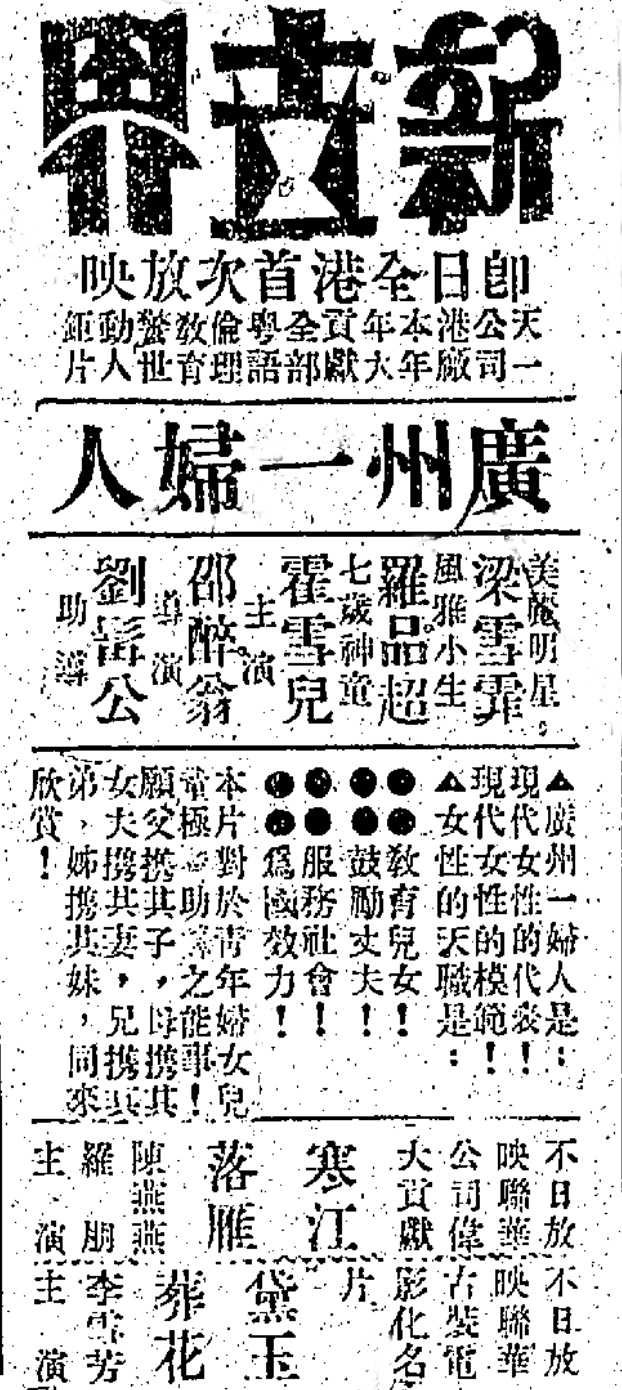
Meanwhile, the film also reveals women’s plight, for example, when their husbands abandon their families and spend the day out drinking and cheating, women are left to take on all the responsibilities, both internal and external. Not only does it show the virtues of hard-working women dedicating themselves to their families, but it also gives women a voice and draws sympathy from the public. The film also condemns husbands who fail to perform their duties and gives men a warning that they are responsible for contributing to their families and should not let their wives bear all the burden alone, thus implying that man and woman are both responsible for maintaining their family order.
Social ethics films often use the difficulties faced by the women at the time to highlight their resilience during times of difficulty, thereby inspiring women in the real world. By showing how women with such difficult lives cope with and eventually overcome all the difficulties through the spirit of female values, the film encourages women in the real world to uphold traditional values that will lead them toward a happy ending. In reality, the oppression of women by feudal families and society was never-ending, and women very often had to deal with them by themselves. This kind of film can serve as a channel to express and recognise the value of traditional female virtues in maintaining family ethics and shaping the ideal woman.
Women became a medium for edifying the audience because their sacrifices for the family had great inspirational power. “In traditional Chinese ethics and moral principles, it is the greatest virtue for a woman to sacrifice herself for her family.”[9] The audience was prone to the stereotype of “feeble and weak” while interpreting the role of women. When they saw women fighting to overcome the difficulties in reality and working hard to alter their tragic fate for the sake of their families, their total devotion to the cause would move the audience and give them a deep understanding of the importance of family ethics. Therefore, the women in the film reflect not only the attitude towards the family that women should have in reality but also the idea that people of all genders and classes should also value family ethics.
The value attached to family ethics and the idea that women should assist (or even replace) men in maintaining the internal order of the family are notions derived from the traditional Chinese Confucian concept of filial piety. Although Hong Kong was a colony, the public at the time was still very much attached to Chinese tradition. This type of film which celebrated traditional values in an increasingly westernised society, appealed to the general public and was more likely to be understood and accepted as a call for the importance of family. On the other hand, since society was not all in favour of the increasingly open relations between the two sexes, this traditional image of the ideal woman also matched the imagination of certain people about women. The family woman, who firmly adheres to traditional female values, naturally became the medium for social ethics films to edify the public and strengthen the concept of traditional family values in society.
The Woman Who Resists Feudal Oppression
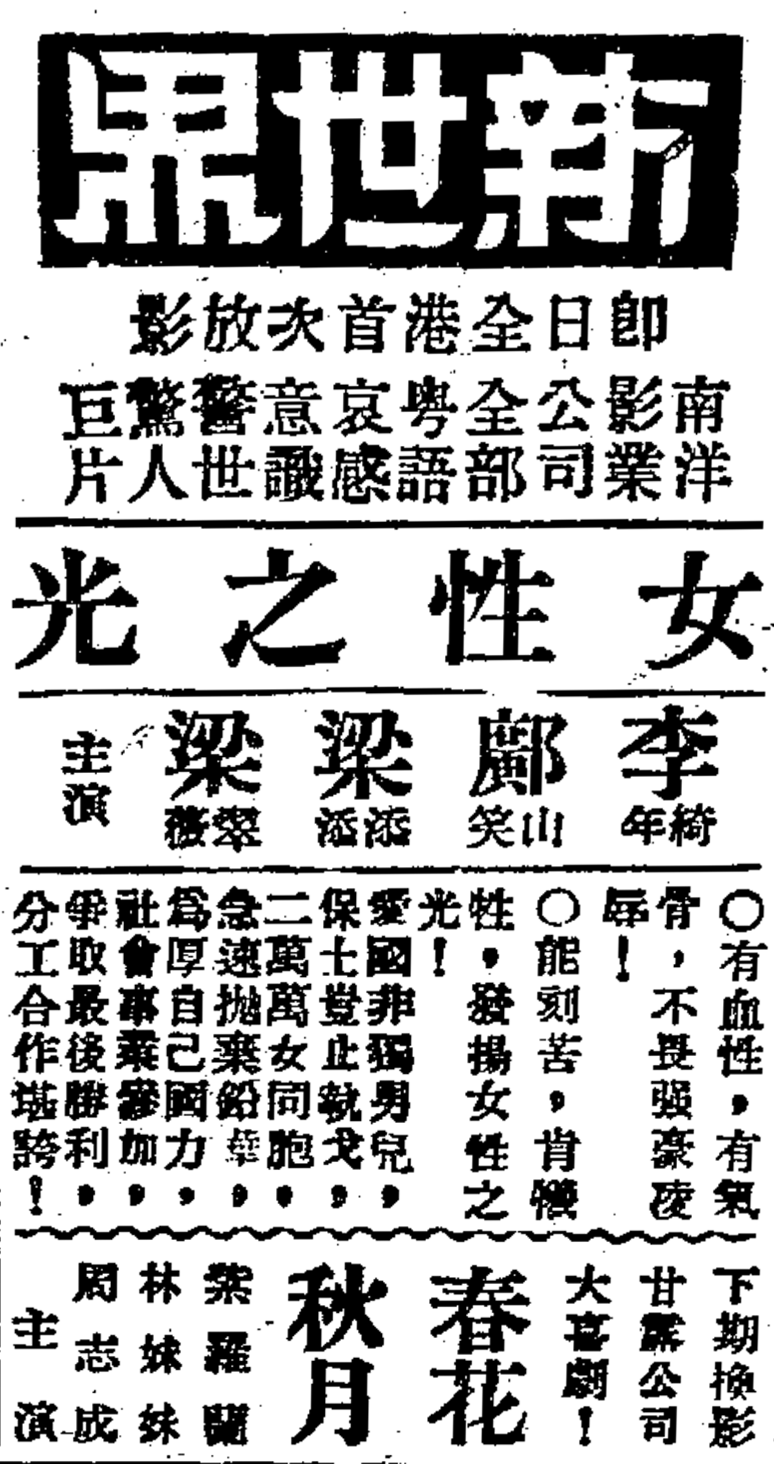
Another type of woman is presented in social ethics films through women’s tragedies in traditional feudal families as a contrast to highlight the courage of the women of that time to resist patriarchal control and repression, gain independence and autonomy, and fulfil themselves in society. The Light of Women (1937) is the perfect example of this type of film[10], portraying a noble woman who does not regard marriage as her ultimate life goal but devotes herself to education to enrich herself and contribute to society.
This image of the ideal differs from that of the woman with traditional female virtues, as mentioned above. Instead, it supported women of the time to fight for their independence and autonomy, advocated that women’s values should not be confined to only family and marriage, and criticised the traditional patriarchal society where women were considered inferior to men and should serve as their subordinates and birth-giving machines to carry on the family line. By depicting women’s resistance and reactions to the traditional society at the time, the film encourages the audience to reflect on the problems of the feudal system, implying that with the change of time, people should break away from the outdated values, be more open to accepting new ideas and take the courage to resist the oppression left behind by the feudal society – not only the oppression of women but also the oppression of the grassroots. While on the surface, the film points out that family and marriage are no longer women’s only sources of fulfilment and encourages them to explore their own lives, it urges the audience to stop being limited by conventional stereotypes and to truly live their own lives.
Similarly, the film uses women not only as a medium to express concerns for female issues but, more importantly, as a way to reflect on the meaning of “modernisation”.[11] At that time, both women and Chinese society were experiencing a massive change of era. Facing the dramatic clashes between Western ideologies and the traditional values, many intellectuals were critical of traditional Confucianism and regarded it as the root cause of the long-standing weakness of the country. They opposed ideas such as the feudal hierarchy and the supremacy of monarchs, embracing democracy and science. The changes in women’s circumstances were particularly radical at a time when the old meets the new. They suffered the most oppression in the old days, from being the most disadvantaged group, transformed into the new women who enjoyed economic independence and freedom to love. The process would require a great deal of effort to overthrow all kinds of oppression to truly embrace the new era, one that perfectly echoes the China’s path of transformation.
Therefore, the situation of the women in the film is indeed an allusion and a response to the problems faced by society. The encouragement for the women in The Light of Women was in fact an encouragement for all citizens, pointing out that in the course of modernisation, people cannot just progress in their methods but remain outdated in their thinking (correspond to the male character in the film who woos the female protagonist under the pretext of free love, but at the same time despises his daughter and offers to give her to the female protagonist as a ‘maid’). At the core of modernisation is the evolution of thinking. For instance, the film suggests that one way to contribute to society is to enrich oneself through education. More importantly, the path of resistance is never easy, and the future is never guaranteed (just like the mother and daughter who run away to escape the forced marriage imposed by the rich gentleman at the end of the film, they are adrift at sea, distantly looking at the other side of the shore, not knowing what the future holds). Yet if one holds on to hope and faith and refuses to give in to oppression, they shall succeed one day.
The Female Image in National Security Films: The Patriotic Woman of Independence and Self-Reliance
National security films are based on war resistance, a genre developed under the Japanese invasion of China. Unlike the women in social ethics films who live difficult lives or are oppressed by patriarchal authority, the film portrays female characters who dare to fight in the war. They are not the ones who need help but the ones who are inspired by patriotism to join the war and are not afraid to die. They are no longer tied to their families and prevented from fulfilling themselves, they are no longer abandoned by men and living a tough life, but instead, they are in control of their own lives. The women in national security films are mostly female spies who give sexual favours in exchange for secret information, lead missions, and even sacrifice their lives for their country. For example, The Shining Cup (aka The Luminescent Cup, 1939)[12] is a film based on war resistance, which presents the ideal image of women willing to sacrifice love and their lives to serve their country.
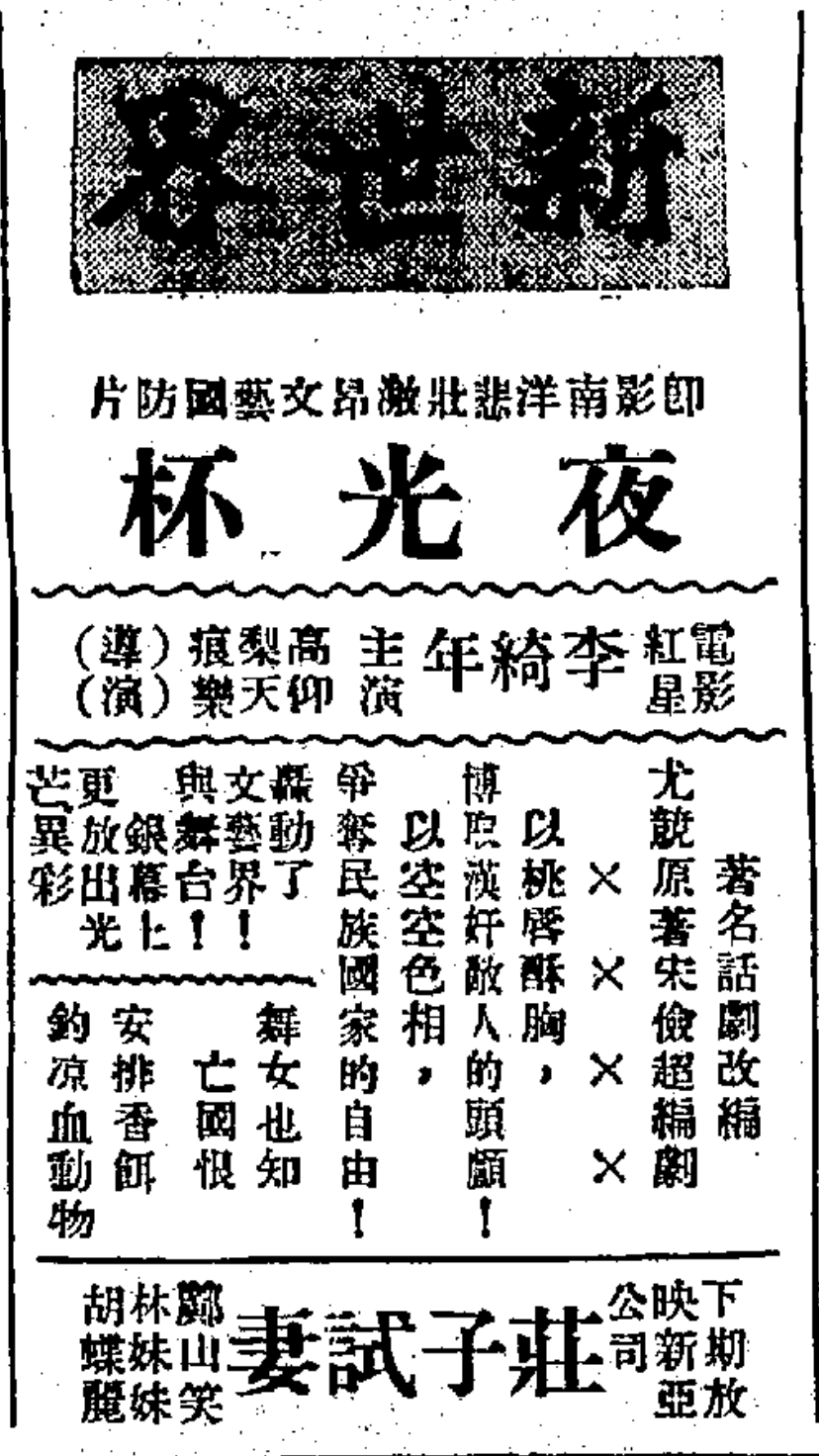
These female images reflected the progressive awareness about how women were imagined at the time. More than any other genre, national security films were particularly effective in portraying women as independent and self-reliant. From the traditional story of Mulan, in which women dress up as men to go to war, to a time when women can finally go to war as women, their values and abilities are recognised with the very identity of “woman” itself. Women willing to give their bodies in exchange for victory are praised. Sometimes even the entire film is dedicated to women, demonstrating how they overcome all kinds of difficulties. In The Heroine (aka National Heroine, 1937), women are even raised to a position equal to men on the war front and are no longer relegated to the rear of the battlefield, which is unprecedented. When women join the traditionally male-dominated battlefield and play a role as important as men, or even outperform them, dominating the battlefield, can effectively break the traditional conservative concept that their place is in the home. Not only does such an independent and self-reliant spirit impress the audience, but it also serves to convey to the public this growing female consciousness.
This kind of projection of ideal womanhood and growing consciousness was the product of the times under the Japanese invasion. In the midst of a national crisis, society no longer restricted women to the role of maintaining family order but expected women to contribute to the country outside of the family, thus creating images of independent and self-reliant women volunteering to fight in the war. The filmmakers used women’s images as an echo of the times to promote the ideology of nationalism, in contrast to the old stereotype of women being miserable and vulnerable. On the one hand, it showed that the war required the mobilisation of all citizens, including women, and on the other, it implied that the country could turn the tide of battle and defeat its enemies in the war, just like the women in the stories completing their mission at all costs, thus inspiring the audience to defend their country together regardless of their gender and emulate the spirit of the women fighting against the odds, conveying the message that only perseverance can lead to the final victory, promoting patriotism and national sentiment, encouraging more people to join the war effort, and thus serving the purpose of political propaganda.
However, the image of the ideal woman in national security films is not just the brave and courageous woman engaging in the war away from home. Still, some women are homemakers, taking care of the family while their husbands fight in the war. They still maintain the traditional image of the ideal woman who would stand behind her other half without a doubt while he is away fighting in the war. The film Lifeline released in 1935, is an example of this.[13] This type of film suggests that when the man is at war, the woman’s primary role is to take care of all domestic matters for him and to look after his parents and children until he returns from the battlefield. Although this differs from the idea of supporting women to fight alongside men in the war, it still reflects the diversity of social perceptions of women’s role in the war.
Conclusion: Reflection of the Times on the Diverse Images of the Ideal Woman – Conflict and Compatibility
The above examples all reflect a great diversity in the images of the ideal woman in different films. In social ethics films, the two main types of female images are the traditional and the modern ideal woman. In the national security films, the independent and self-empowered woman is the main focus, transforming from the family woman to the woman who voluntarily takes part in the war and even fights on the battlefield as an equal to men. Therefore it is evident that in a time of change, the diverse images of the ideal woman derived from the different aims and consciousnesses in society were reflected abundantly in cinema at the time, not only conveying different aspects of female consciousness but also using their stories and experiences as a medium to educate the public on ethics and promote the ideology.
These images have conflicting aspects, but deep down, they share a compatible spirit. Whereas the most traditional ideal woman is inevitably attached to her family, the modernised values suggest that the ideal woman must break away from such norms, fulfil herself, and be patriotic on a social and national level. But the core of the spirit is the same – behind the different ideal images are demands for women to be caring, loyal and willing to sacrifice. The films often present women’s noble characters through their devotion to a particular target, but the target extends from love for the family to love for the country, and women’s life planning, originally limited to the family, extends to the fulfilment of self within the framework of society and the country, allowing them to show more potentials based on the same qualities and spirit.
The above is just the tip of the iceberg in terms of the ideal female image reflected in the films of the 1930s. In fact, based on different periods, backgrounds, genres and filmmakers, the kind of female consciousness expressed in the film is different, and there may not be just one female image in a film, just as male and female filmmakers can have very different visual and approaching points about women’s stories. That being said, only Esther Eng and Wan Hoi-ling are among the relatively famous female filmmakers of the time, but since there is very little visual information left of them, it is difficult to make an in-depth comparison, thus the films selected in this article are all works of male filmmakers. The diversity of female images in Hong Kong cinema in the 1930s is inexhaustible and cannot be fully documented here, but after all, it is the diverse imaginations of women at different times that created such a great variety of female images and representations.
References
Yip, H. (葉漢明). (1999). Zhuti de zhuixun: Zhongguo funu shi yanjiu xilun (Searching the subjectivity: Research on the history of Chinese woman, 主體的追尋:中國婦女史硏究析論). Hong Kong: Hong Kong Educational Publishing Company Ltd (in Chinese).
Zhao, W. (趙衛防). (2007). Hong Kong film history (1897-2006) (香港電影史:1897-2006). Beijing: China Radio and Television Press (in Chinese).
Zhou, C. (周承人) & Li, Y. (李以莊). (2005). Early Hong Kong film history (1897-1945) (早期香港電影史(1897-1945)). Hong Kong: Joint Publishing (Hong Kong) Company Limited (in Chinese).
Yu, M. (余慕雲). (1996). Xianggang dianying shihua (juan er): Sanshi niandai (A Hong Kong film history (Vol. 2), 1930s, 香港電影史話(卷二):三十年代). Hong Kong: Sub-Culture Ltd. (in Chinese).
Wong, S. (黃淑嫻) & Kwok, C. (郭靜寧) (Eds.). (2020). Hong Kong filmography Vol I 1914–1941 (Rev. Ed.). Hong Kong: Hong Kong Film Archive (in Chinese).
Yau, C. (游靜). (2015). The difficulty of imagining southern women/China in modernity (現代(女)性之蜀道難). In W. Fu & M. Ng (Eds.), Early cinematic treasures rediscovered. Hong Kong: Hong Kong Film Archive, pp.4-11.
Chin, A. S. (2012). Bound to emancipate: Working women and urban citizenship in early Twentieth-century China and Hong Kong. London: Rowman & Littlefield Publishers.
[1] Chin, A. S. (2012). Bound to emancipate: Working women and urban citizenship in early Twentieth-century China and Hong Kong. London: Rowman & Littlefield Publishers.
[2] The public and the media were very critical of the new female profession at the time, for details: Chin, A. S. (2012). Bound to emancipate: Working women and urban citizenship in early Twentieth-century China and Hong Kong. London: Rowman & Littlefield Publishers.
[3] Yip, H. (葉漢明). (1999). Zhuti de zhuixun: Zhongguo funu shi yanjiu xilun (Searching the subjectivity: Research on the history of Chinese woman, 主體的追尋:中國婦女史硏究析論). Hong Kong: Hong Kong Educational Publishing Company Ltd., 118 (in Chinese).
[4] Zhao, W. (趙衛防). (2007). Hong Kong film history (1897-2006) (香港電影史:1897-2006). Beijing: China Radio and Television Press, 50 (in Chinese).
[5] Zhou, C. (周承人) & Li, Y. (李以莊). (2005). Early Hong Kong film history (1897-1945) (早期香港電影史(1897-1945)). Hong Kong: Joint Publishing, 37 (in Chinese).
[6] Yu, M. (余慕雲). (1996). Xianggang dianying shihua (juan er): Sanshi niandai (A Hong Kong film history (Vol. 2), 1930s, 香港電影史話(卷二):三十年代). Hong Kong: Sub-Culture Ltd., 126 (in Chinese).
[7] Zhao, W. (趙衛防). (2007). Hong Kong film history (1897-2006) (香港電影史:1897-2006). Beijing: China Radio and Television Press, 52 (in Chinese).
[8] The film tells the story of the female protagonist who, after being abandoned by her husband, replaces him as the leading role in the family, taking on the task of maintaining the family order and acting as the central force in bringing the broken family back together and making the husband return to the family. For details: Wong, S. (黃淑嫻) & Kwok, C. (郭靜寧) (Eds.). (2020). Hong Kong filmography Vol I 1914–1941 (Rev. Ed.). Hong Kong: Hong Kong Film Archive, 27 (in Chinese).
[9] Zhao, W. (趙衛防). (2007). Hong Kong film history (1897-2006) (香港電影史:1897-2006). Beijing: China Radio and Television Press, 52 (in Chinese).
[10] The film tells the story of the female protagonist who runs away after being forced by her brother to marry a rich man and is later wooed by a narrow-minded, remarried rich man. Recognising the lack of reliability of marriage, she decides to pursue her career in education and work hard to help oppressed women. For details: Wong, S. (黃淑嫻) & Kwok, C. (郭靜寧) (Eds.). (2020). Hong Kong filmography Vol I 1914–1941 (Rev. Ed.). Hong Kong: Hong Kong Film Archive, 62 (in Chinese).
[11] Yau, C. (游靜). (2015). The difficulty of imagining southern women/China in modernity (現代(女)性之蜀道難). In W. Fu & M. Ng (Eds.), Early cinematic treasures rediscovered. Hong Kong: Hong Kong Film Archive, 6 (in Chinese).
[12] The story is about the heroine attempting to get close to her ex-lover, who turns out to be a traitor, by means of a fake divorce, and killing him in the process of seduction. She is the mastermind behind who, facing her husband’s questioning at first, says that even though she is a woman, she can still serve her country, and in the process, she sacrifices her virtue to approach the traitor and his men, and eventually, her identity is exposed, and she dies with them. For details: Wong, S. (黃淑嫻) & Kwok, C. (郭靜寧) (Eds.). (2020). Hong Kong filmography Vol I 1914–1941 (Rev. Ed.). Hong Kong: Hong Kong Film Archive, 113 (in Chinese).
[13] The story is about the male protagonist who wants to save his country by building a railway, and his wife supports him without a doubt, taking care of his son and his mother. For details: Wong, S. (黃淑嫻) & Kwok, C. (郭靜寧) (Eds.). (2020). Hong Kong filmography Vol I 1914–1941 (Rev. Ed.). Hong Kong: Hong Kong Film Archive, 20 (in Chinese).