



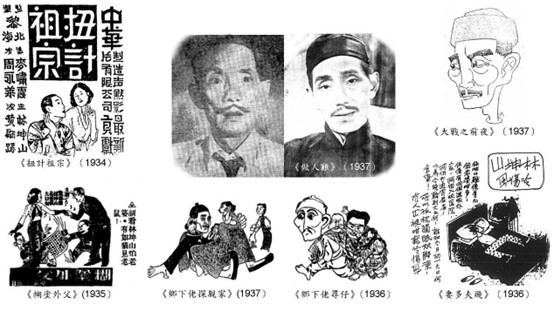
Figure 1: Lam Kwun-shan had a prominent contour, so his caricatures were often seen in advertisements for his films (especially for comedies).
Image source:
Upper row from left: Advertisement for A Cunning Fellow, The Industrial & Commercial Daily Press, 15 March 1934; “Veteran Actor Lam Kwun-shan”, Ta Kung Pao, 29 August 1959; Artland, no 39, 1 October 1938; advertisement for On the Eve of the Great Battle, Artland, no 1, February 1937.
Lower row from left: advertisement for The Incautious Father-in-law, The Industrial & Commercial Daily Press, 27 October 1935; advertisement for The Country Bumpkin Visits His In-Laws, The Tien Kwong Morning News, 1 January 1937; advertisement for The Farmer’s Son, The Tien Kwong Morning News, 13 December 1936; and advertisement for One Wife is Best, Nam Keung Yat Po, 5 December 1936.
Stephanie Ng Yuet-wah
When watching Cantonese films, we often find roles of the “stingy type” (i.e. misers) and the perverted ones who are intimidated by their wives. These roles are usually the subjects of mockery. There was this one actor who often played these roles, a thin, long-faced man with the iconic “double thin mustache” (i.e. a parted pencil mustache), which was so remarkable that his “son” hosted a “feast of a rich family” for his mustache (the plot of Feast of a Rich Family [1959])! This actor with such a distinctive look is Lam Kwun-shan. Before he hit the big screen, he was not exactly a funny little man, but rather a popular figure in the early days of Hong Kong’s drama industry. He grew popular after appearing in dramas featuring Cantonese opera music, and then later became a Cantonese opera buffoon (i.e. the male Chou role). His popularity and extensive performing experience, as well as his ability to sing and act, had allowed him to become the leading actor in the film A Cunning Fellow (aka The Mischief Makers, 1934), shortly after films with sound were available. Within two or three years he had established his own different comic images on the silver screen and became the “Master of Humour” in the film industry. In this article, we will discuss Lam Kwun-shan’s pioneering comic images and relevant comedy styles through the comedies he starred in during the pre-war period.
Starting from the Lam Long Wan King Society
Lam Kwun-shan had been a naughty boy ever since he was a child and had a passion for drama. After graduation, although he became an English teacher, he continued with his acting and joined the Lam Long Wan King Society (referred to as “Lam Long Wan King” below). He then became one of the pillars of the troupe. The Lam Long Wan King was an amateur drama troupe founded in the early 20th century by a group of young people working in foreign firms and was the earliest modern Cantonese drama troupe ever established in Hong Kong. The troupe initially set up the “patriots’ troupe” to advocate revolution, performing only about three times a year, featuring modern and civilised plays, with all the proceeds from the performances going to charitable purposes, including donations to hospitals and charity schools. Although the Lam Long Wan King was a troupe performing modern Cantonese dramas, given that Cantonese opera was the major public entertainment at the time, so in order to introduce the concept of revolution to an even wider audience, they incorporated Cantonese opera into their dramas and evolved them into “dramas featuring Cantonese opera music” to attract more audiences. The most famous play of the Lam Long Wan King is Tragedy of Stone Castle (aka The Imperial Appeal). This Cantonese folk tale was first adapted into a film under the same title by the Nanyue Film Company in 1935, featuring members of the Lam Long Wan King and the Chung Sing Benevolent Society. The film was a big hit. Another film adaptation of Tragedy of Stone Castle starring members of the Lam Long Wan King was A Stone House on Fire (1939, also known as Burning of the Stone Mansion or The Imperial Appeal), in which Lam Kwun-shan and Kwong Shan-siu played the leading roles. A Stone House on Fire was a founding production of the Shanchuan Film Company, founded by Kwong Shan-siu. When Lam Kwun-shan performed Tragedy of Stone Castle with the Lam Long Wan King, he took on the role of the protagonist Leung Tin-loi, hence earning him the nickname “Leung Tin-loi Reborn”. Kwong Shan-siu originally intended to play the protagonist himself, but out of respect for Lam Kwun-shan, he allowed Lam to play the role. Kwong himself took on the role of the villain Ling Kwai-hing, making it his first time playing the role of the villain. This clearly shows that Lam Kwun-shan had quite a significant status amongst those who came after him.
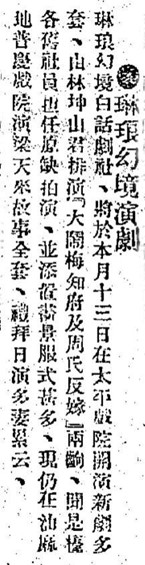
Figure 2: Lam Kwun-shan’s participation in two plays by the Lam Long Wan King Society, Telling Off Mui the Provincial Magistrate and The Second Marriage of Madam Chow; another theatre performance by the Lam Long Wan King Society playing Leung Tin-loi’s tale was also mentioned (Chinese Mail, 23 January 1926).
Lam Kwun-shan was not only given the opportunity to sharpen his acting skills, but he also learned how to sing Cantonese opera while he was in the Lam Long Wan King. Coupled with the fact that his performances were very well received, he gave up his teaching career in 1926 and founded the Yau Sing Lok Troupe, thereby becoming a full-time actor and a celebrity in the modern Cantonese drama industry. He also had the opportunity to join the major Cantonese opera troupes such as the Tai Law Tin, the Xin Jing Xiang, and the Xin Zhong Hua, etc., and eventually took on the Chou role for the troupe of the famous Ma Si Tsang, making him more widely known to the public, thus paving his way onto the silver screen to become a comedy star of his generation.

Figure 3: Lam Kwun-shan took part in the Xin Zhong Hua Cantonese opera troupe’s new play Li Ji Murders Shen Sheng, which was advertised as “the pioneer of the Cantonese opera revolution and a role model for social ethics” (The Industrial & Commercial Daily Press, 31 March 1934).
“The Cunning Fellow”
Lam Kwun-shan’s first appearance on the silver screen was in a film with a cautionary story, Argument (1933), which was shot in Guangzhou. Apart from Lam Kwun-shan, the film was also the first film starring several famous Cantonese opera stars, such as the leading role Tse Sing-nung. Its advertisement also boasted about its cast including some famous opera stars (see Fig. 4). At that time, Lam Kwun-shan only played a small role, and later he also appeared in a few Cantonese films. The first film in which Lam took a starring role was A Cunning Fellow (1934), produced by China Sound and Silent Movies Production Company (referred to as “China Sound and Silent Movies” below). China Sound and Silent Movies was the company that produced Hong Kong’s first full-length sound film, A Stupid Bridegroom (1933), and A Cunning Fellow was another Cantonese comedy produced following the former, featuring an intriguing tale about how the two genders fight against each other and how men outwit each other. The advertisement for the film listed several classic Chinese and foreign comedians known for their wisdom in comparison with “A Cunning Fellow” played by Lam Kwun-shan (see Fig. 5). Although there is not much information about the film, it can still be seen that Lam Kwun-shan’s comedy role is not a “low-level” grassroots character who relies on nonsense or being made fun of, but rather, a “high-level” intellectual full of insights, who uses a humorous and witty approach to bring out the problems of the society. Yet the film did not bring about a new comedy trend. Instead, his subsequent roles playing ordinary people were more appealing to the audience.
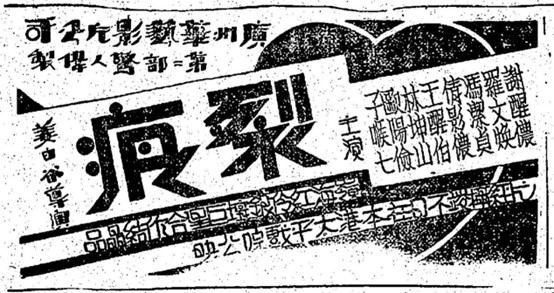
Figure 4: Lam Kwun-shan’s first film, Argument (1933), was also the first film in which Cantonese opera stars Tse Sing-nung, Sin Ying-nung and Lo Man Woon participated. (Advertisement for Argument, The Industrial & Commercial Daily Press, 13 October 1933; “News on Argument“, Yuet Wa Po, 16 September 1933).
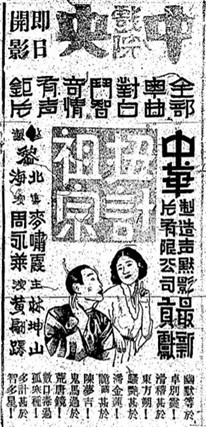
Figure 5: In the advertisement, classic comedy figures such as Charlie Chaplin, Dongfang Shuo, Chan Mong-gut, and Fang Tangjing, who were known for their wisdom, were quoted in comparison with Lam Kwun-shan’s role as the “Cunning Fellow” (The Industrial & Commercial Daily Press, 15 March 1934).
Image of “Country Bumpkin” Establishes His Status in the Cinema
Hong Kong was gradually urbanising from the 1920s to the 1930s, and the gap between the city and the countryside was widening. Films were products of the city. The urban audience felt particularly superior, especially when they learned that people from the countryside did not know about imported goods and new technological constructions. At the same time, the city was portrayed by literary figures as a hotbed of evil, with the aim of promoting traditional values of simplicity and honesty. The Hong Kong branch of the Unique Film Productions, knowing how to appeal to the tastes of the grassroots audience, seized the opportunity to capture this dichotomy of values between the city and the countryside and produced the entertaining and edifying film, The Country Bumpkin Tours the City (1935), in which Lam Kwun-shan plays the role of the village gentleman, Chow Shing Zau. He leaves for the city with his daughter, Chow So Lui, played by Tong Suet-hing, creating various hilarious scenes during their journey, in which Chow Shing Zau once indulges himself in chasing after women. Lam Kwun-shan’s humour and Tong Suet-hing’s performance as a village girl were excellent. The film also featured songs performed by various famous Cantonese opera singers, including “Pearl Curtain Upside Down” sung by Lam Kwun-shan, which was very well received by the audience. Lam Kwun-shan’s remuneration jumped from around $300 to $500 up to $3000 to $4000, and the film company subsequently approached Lam Kwun-shan and Tong Suet-hing to make other films related to the “Country Bumpkin”. Lam Kwun-shan starred in the films The Farmer’s Son (aka , 1936), Country Bumpkin Visits His In-Laws (co-starred with Tong Suet-hing once again and is the only film written and directed by Run Run Shaw), and A Stroke of Luck (aka The Country Bumpkin’s Stroke of Luck, 1937). Historically, only very few popular films would be remade, which means that the dramatic elements or characters in the film were constantly being remade due to their unique social and aesthetic qualities, and further transformed into formulas. Hong Kong was a city with a constant influx of new immigrants from the countryside, and “The Country Bumpkins Tours the City” had therefore become an everlasting comedy style, and comedians from different times had appeared in at least one or two “country bumpkin” films, such as Leung Sing Bo and Au Yeung Kim in Twelve Singing Beauties (1952), Sun Ma Sze Tsang in Country Boy Goes to Town (1965) and Tam Bing-man in The Country Bumpkin (1974), had participated in the “country bumpkin” stories at the time, bringing laughter to the audience.
Unassertive Family Man
There is only this one sentence in the advertisement for Country Bumpkin Visits His In-Laws: “Let me tell you in secret, Country Bumpkin Lam Kwun-shan is recklessly taking advantage of women, so please pay attention and see how he does it.” It clearly shows that the film used the Country Bumpkin’s behaviours of sexual harassment as its selling point, and undoubtedly, it is not only the men from the countryside but also the dream of men, in general, to get pleasure from women. However, there is always a difference between the ideal and the reality, and the elements of the comedy came precisely from such a difference. If a man fails to manage his wives well and wants to get the best out of all of them, then troubles are bound to come! In One Wife is Best (aka The Polygamist, 1936), Lam Kwun-shan played a wealthy husband with nine wives and concubines, who compete for his affection. He is overwhelmed by his wives’ jealousy, so he decides to take another concubine in an attempt to ease his sorrows, but in the end, he ends up getting into more trouble instead. The film was so popular that it was followed by The Polygamist, Part Two (aka Nine Sons, 1937). This time, the protagonist’s problems are no longer related to his wives and concubines, but to his nine sons, the best of whom dies young, and the rest of whom are each of bad characters, making a mockery of the protagonist’s problems which is precisely the source of amusement for the audiences. The plot of the two films is also replicated in The Home Revolution (aka Pillow Talk, 1939), in which Lam Kwun-shan played Lam Siu Kau, who is intimidated by his wives but has two wives and eight children. The wives compete for his affection and sometimes make complaints to him in private, whereas the children are ungrateful and try to get a share of the family property, and on top of it, their uncle sows discord among them, causing a mess in the Lam’s family. This formula in The Polygamist, like the “Country Bumpkin Tours the City”, had also become one of the most popular comedy styles in Cantonese films even in more recent times, as in Flirting Scholar (1993).
While the idea of multiple wives and concubines was typical of the times, the gap between the ideal and the reality was also typical of the concept of marriage between two generations. The father, played by Lam Kwun-shan, believes in blind marriages ordered by his parents, but his children, on the other hand, believe in free love, so they have to go against the wishes of their parents, thus creating comic situations. In The Modern Bride and The Modern Bride, Part II (1935), as well as The Wrong Couple (1938), Lam Kwun-shan played a father who arranges his children’s marriages. The former even tears his daughter and the person she loves apart and arranges for her to marry someone else, but in the end, his children manage to switch the situation and marry their lovers. In The Incautious Father-in-law (aka The Bumbling Father-in-Law, 1935), Lam Kwun-shan played a father who selects a suitable son-in-law that his daughter likes. Afterwards, he gets instigated to force his future son-in-law to leave, but he can’t bear to see his daughter get upset, so he finally lets the two of them get married. It shows that whether Lam Kwun-shan played the role of a husband or a father, it is always a family man who fails to assert his authority.
The Miser!
The skinflint mode in “Rich but Ungrateful” is another comedy style in Cantonese films, and Lam Kwun-shan was one of the best at playing this type of role. In An Indulgent Old Man (1937), Lam played a miser who, despite his old age, has a love affair, but ends up being cheated on. In A Stingy Fellow (aka The Miser, 1938), financed, directed and written by himself, Lam Kwun-shan played the roles of the two main characters, Lam Dok and Lam Fu, the miser father and son. Lam Dok dies in an attempt to save money on medical expenses, while Lam Fu hastily buries his father to save money on funeral expenses, and even places his children in the care of his wife’s sister to save money on raising them, thus maximising the stinginess of the two misers to the greatest extent, making the film ridiculously hilarious. The film is also one of the most memorable films made by Lam Kwun-shan.
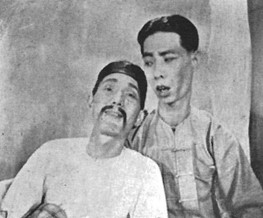
Figure 6: A Stingy Fellow (1938), financed, written, directed and played by Lam Kwun-shan (Artland, no 31, 1 June 1938.)
A Life Full of Mixed Emotions
Lam Kwun-shan’s comic images ranged from the grassroots “Country Bumpkin”, the bourgeois family man, to the “mean” intellectual, the “cunning fellow”, the ultimate “miser”, as well as those which had not been mentioned above such as the unemployed opera singer in Hard to be a Man (aka Life Is Hard!, 1937) and the ordinary man struggling to survive in the city in Old Master Ho (1941), which is based on the comic works of Li Fanfu, thus covering a very wide social spectrum. In addition, Lam Kwun-shan also played different types of characters in melodramas, such as the cowardly and paranoid husband in Jealousy and Suspicions (1940); the good father who is devoted to his children in Children’s Debts (1935) and Orphan (aka The Illegitimate Son, 1937); the wronged and good man Lui Mung Ching in A Poor Man’s Deliverance (1939); the nouveau riche in On the Eve of the Great Battle (1937); and the rich man who wishes to take a patriotic opera star as a concubine in The Blood-Stained Peach Blossom Fan (1940), etc. Before the war, Lam Kwun-shan performed in more than 40 films, reflecting not only the various social phenomena of the time, but also established diverse images on the silver screen and comedy styles. However, after the war, as young talents gradually emerged, in his later years, as someone who never stopped reading, Lam Kwun-shan turned to Radio Television Hong Kong as a broadcaster, hosting programmes involving Chinese and Western tales as well as arts and culture talks. He would only occasionally play supporting roles in films for fun.
As the distinctive “Cunning Little Man”, Lam Kwun-shan pioneered his own comedy styles, making the leap from the world of Cantonese opera to the big silver screen. Together with his witty interpretations, he had brought comedy to a whole new level. Although he only appeared occasionally as a supporting actor in films in his later years, his pioneering contribution to the comedy industry is indisputable.