


Research Sources in The Humanities

Because your research will rely on existing scholarship, it is very important to correctly identify scholarly sources which you should engage with. Because today everything is available online, there is a temptation to just cite the first thing that shows up on Google. However, not everything that is available online is worth engaging and citing. This page contains information on how to identify sources that you should and should not use.
Sources You Should Cite #
- BOOKS & EDITED COLLECTIONS PUBLISHED BY REPUTABLE PRESSES
- ARTICLES PUBLISHED IN GOOD JOURNALS
- SCHOLARLY DATABASES
Sources You Shouldn’t Cite #
- RANDOM WEBSITES
- BLOGS
- WIKIPEDIA
- UNDERGRADUATE PAPERS POSTED ONLINE
- ARTICLES PUBLISHED IN QUESTIONABLE JOURNALS
Academic Publishing 101: Peer Review #
The quality of academic books and articles is assessed through the process known as peer review. Simply put, before they decide whether to publish your book or essay, publishers will give your text to other scholars in the field who will say whether it should be published, revised or rejected.
This process is generally anonymous. When you want to publish a book, you don’t know who your reviewers are, and when you are publishing an article, the process is “double-blind”: in order to make the process as objective as possible, you don’t know who’s reading your work, and they don’t know whose work they are reading. As a rule, serious academic publications are peer-reviewed. However, because today almost everyone claim that they are doing peer review (even if they are not), you must be careful to make sure that a publication you are consulting is really serious.
Major Types of Research Publications #

Single-Authored Books #
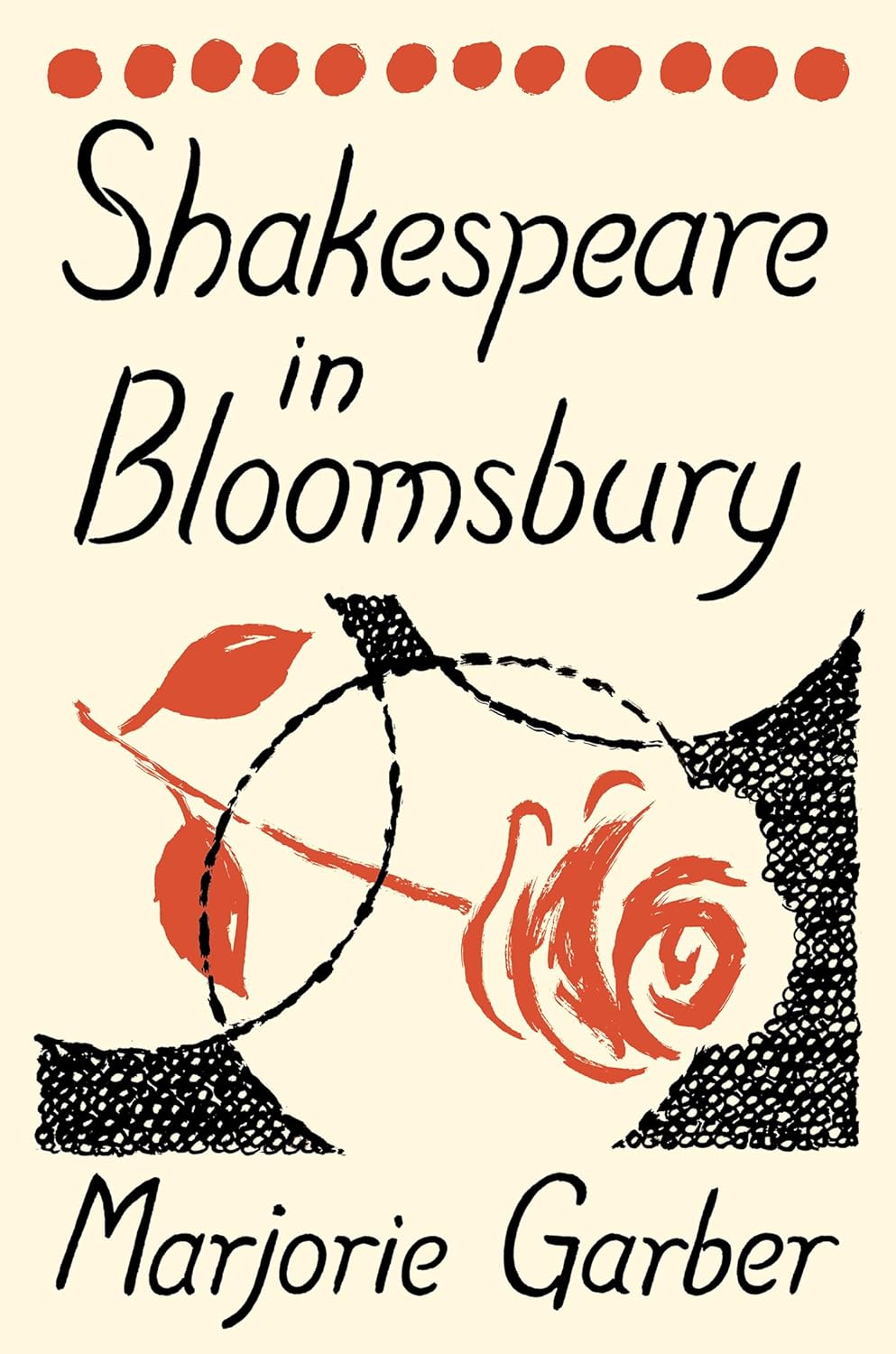
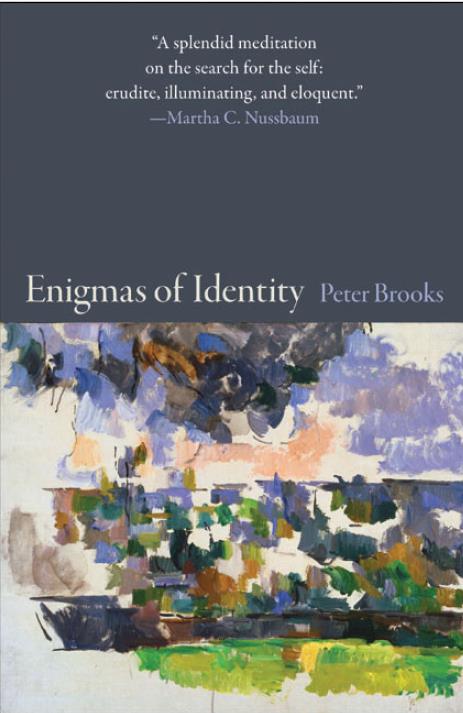
In order to identify a quality book, the main thing to keep in mind is who published it. Major academic publishers have a rigorous review process for all books. So, you will be looking for a book published by a major university press or a handful of commercial publishers.
Good university publishers (examples): #
- Oxford University Press
- University of Chicago Press
- Edinburgh University Press
- Duke University Press
- University of North Carolina Press
- University of Michigan Press
- University of Minnesota Press (…)
Reputable commercial publishers: #
- Routledge
- Palgrave
- Bloomsbury
- Wiley-Blackwell
Edited Books #
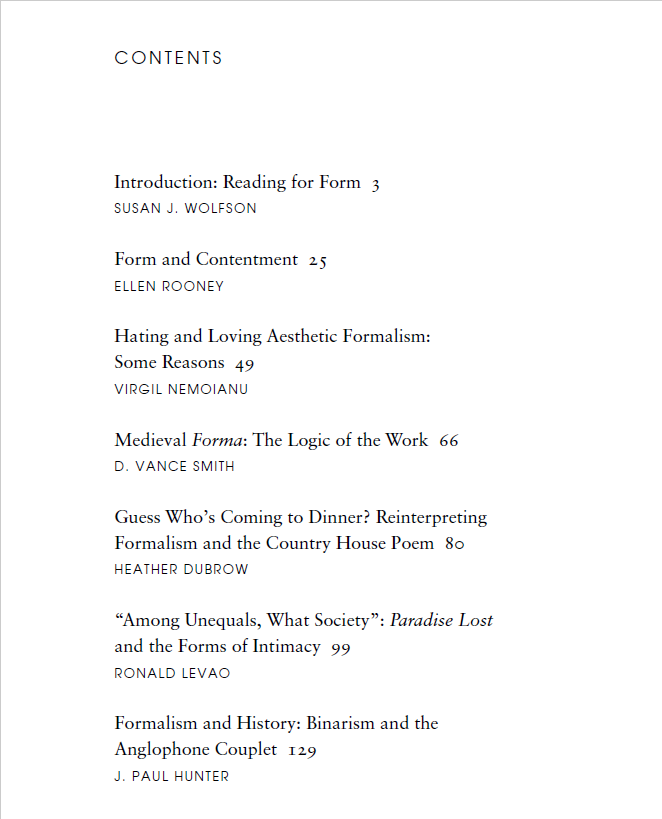
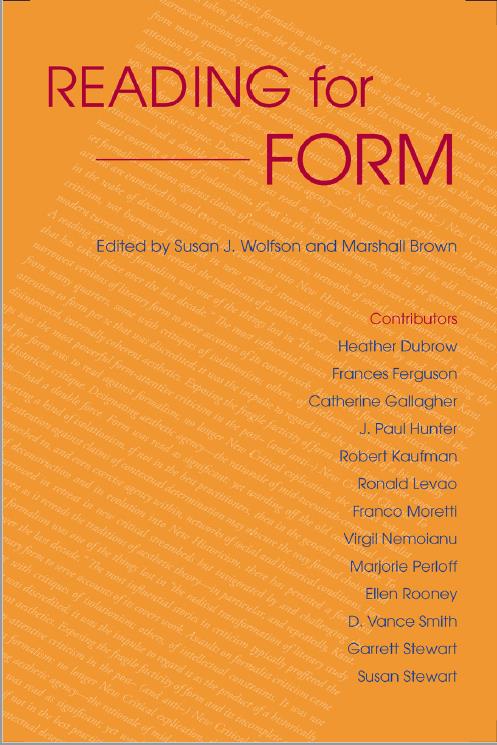
Edited books include essays by a number of different authors on a shared topic. Normally one or two people are the editors, which means that they chose the essays and wrote the introduction to the collection. The principles for evaluating edited collections are the same as for the single-authored books. Mainly, they should be published by reputable presses.
It also helps to know who the editors and contributors are – do they teach at reputable universities, have they published in other major venues?
Journal Articles #
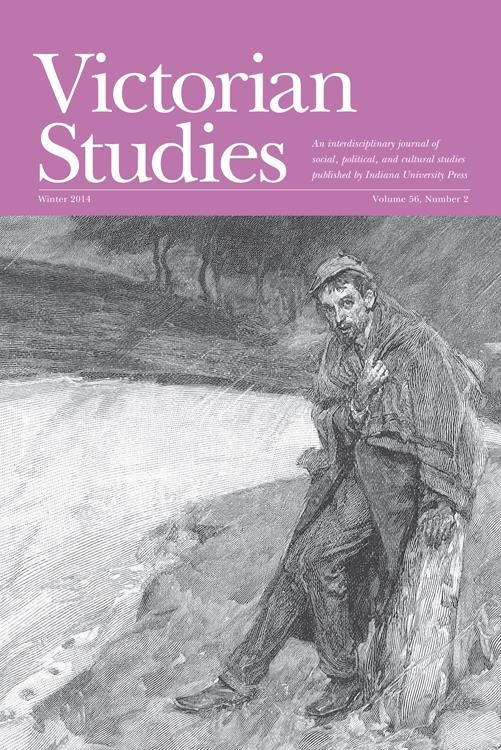
A journal is a serial publication, meaning that it is published in regular intervals, usually three or four times a year. Each edition includes a small number of carefully selected articles written by different authors.
Journals usually have a volume number and an issue number.
Volume is basically the year since the journal started the appear.
For example, if a journal started to appear in 1964, all issues that appeared in 1964 for will be a part of volume 1, and all issues that appeared in, say 1993 will be a part of volume 29. Usually there are about four issues per year, issue 1 appearing in winter, issue 2 in spring, etc.
So, if you have an article that appeared in Volume 32, No. 2 of some journal (sometimes written 32.2), that just means that it appeared in the second issue of the journal’s 32nd year.
Book Reviews #
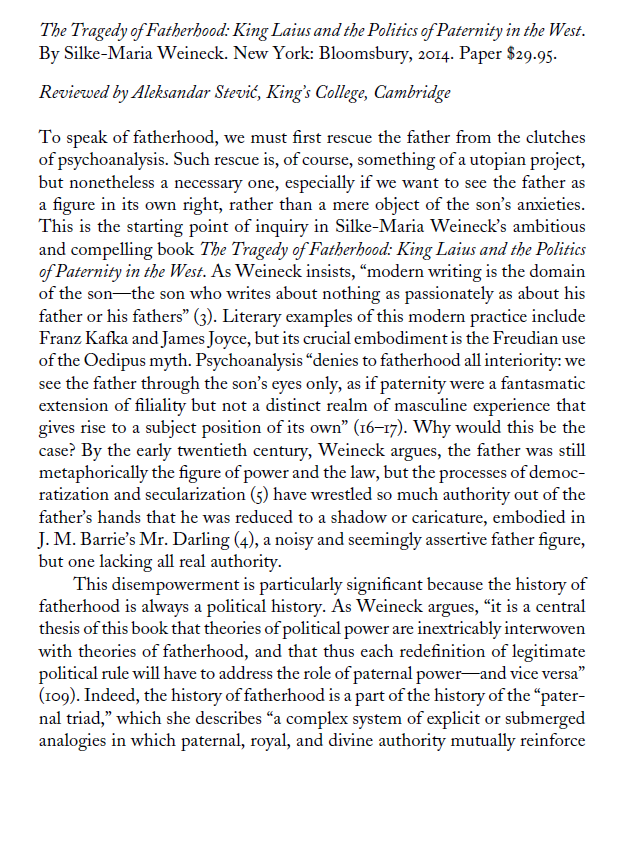
A book review is basically a short article (2-3 pages) that does not aim to be an original scholarly contribution but instead aims to summarize and critique a newly published book. The review normally gives an overview of the book and its major arguments (so that other scholars don’t need to read the whole book in order to find out what it’s about) and evaluates it – it says, for instance, is it original, well written, does it make a major contribution to scholarship, etc.
How to Recognize a Good Journal? #
- Is it peer-reviewed?
- Serious journals are peer-reviewed.
- Who is the publisher?
- Good literature journals will be published by major university presses (Cambridge, Johns Hopkins, Penn State, Indiana, Chicago…) and, occasionally, by a commercial publisher (Taylor & Francis, Sage…). Often, they are also affiliated with major professional associations, such as North American Victorian Studies Association (Victorian Studies) or MLA (PMLA), etc.
- Who are the editors?
- Good journals will normally be edited by senior scholars who work at reputable universities.
- How long does it exist?
- High-quality journals have often been published for a number of decades, often for forty or fifty years. Occasionally, of course, a new journal will appear, but most of the time, if you a see a journal that’s in their first or second year of existence, you should be very careful.
- Does it have a clear focus?
- Serious journals normally focus on a period, a genre, or certain types of issues, for example: Journal of Modern Literature, Victorian Poetry, Research in African Literatures. Sometimes they might have a somewhat broader focus (e.g., English Literary History), but if the title is very broad (e.g., Journal of Humanities and Social Sciences) something is not right.
- Is it indexed?
Because these days anyone can put anything on the Internet and call it a journal, there are databases that contain the lists of serious journals that will help you distinguish between serious and less serious stuff. The most important of these is Web of Science. If a journal is on their list, it should be OK.
You can search their journal list here: https://mjl.clarivate.com/home. Please just make sure that it says “Arts and Humanities Citation Index” under the journal name and not “Emerging Sources Citation Index,” because the latter are not as good.
For example: #
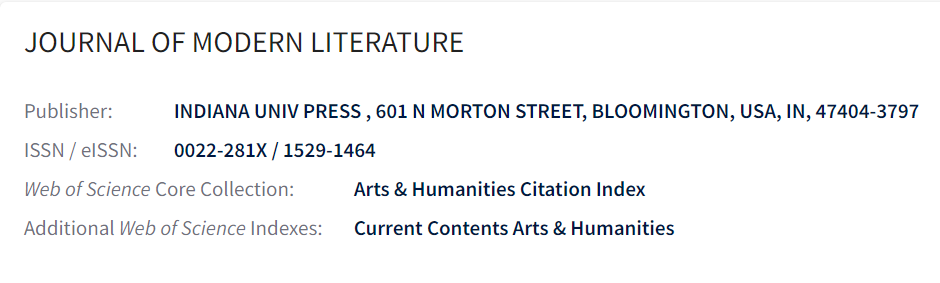
Unfortunately, not all articles listed in the library catalogue are from reputable journals. However, as a rule of thumb, if the journal is available through JSTOR or Project Muse, it should be OK.
Article Examples #
Here you can find some examples of articles that were published in reputable venues and some that were not.

As you can see, this article has appeared in a journal that is peer-reviewed, long-standing, and published by a major press.
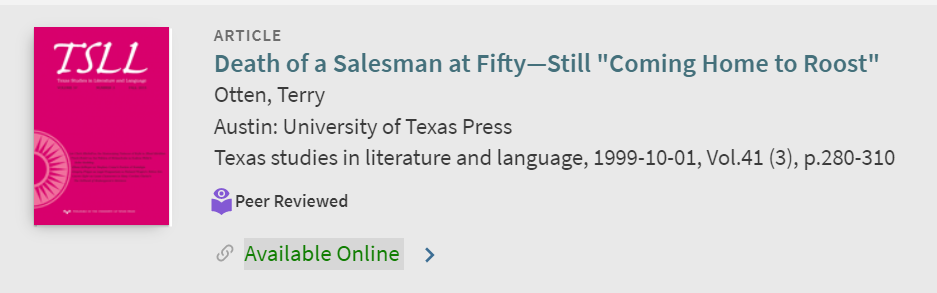
The journal is peer-reviewed, long-standing, and published by a major press. If you go to the journal’s website you will also see that its editors are professors at major institutions and that it’s indexed in AHCI.

It says that the journal is peer-reviewed, but there are several red flags:
- It’s published by an unfamiliar commercial publisher
- It doesn’t have a long history
- The journal title and the topic of the article don’t match
- When you visit the website you will see that it’s not very professional.
- Moreover, the journal says it focuses on language learning, but it also publishes articles about literature, and although it is published in English it has almost no editorial board members from English-speaking countries. It also publishes too many issues a year (one every month), and a very large number of articles in each issue, which means it’s not very selective.
- It is not indexed in AHCI.
Predatory Journals #
Predatory journals are the ones who have low quality standards and will publish almost anything for a fee.
Examples #


- https://www.socialstudiesjournal.com/
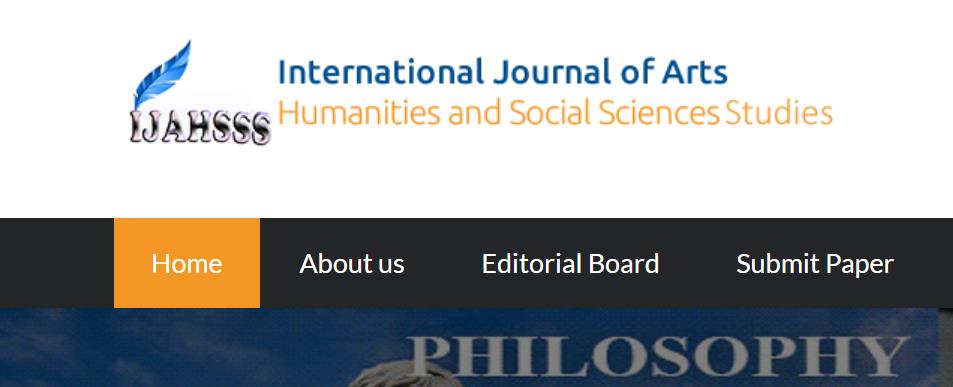
- http://www.ijahss.com/
- https://www.eajournals.org/journals/global-journal-of-arts-humanities-and-social-sciences-gjahss/
Warning signs #
- Very broad scope (e.g., all of the humanities and social sciences)
- A weird long acronym (e.g., GJAHSS)
- Poor English on the website
- Not published by a major publisher and usually based in a developing country
- No information/insufficient information about the editors
- Publication fee
- Not indexed in AHCI