


Book Launch | Writing to the Rhythm of Labor by Prof Benjamin Kindler
Date
3 May 2025 (Sat)
Time
5:00 – 7:00pm
Venue
MPL1201
Language
English
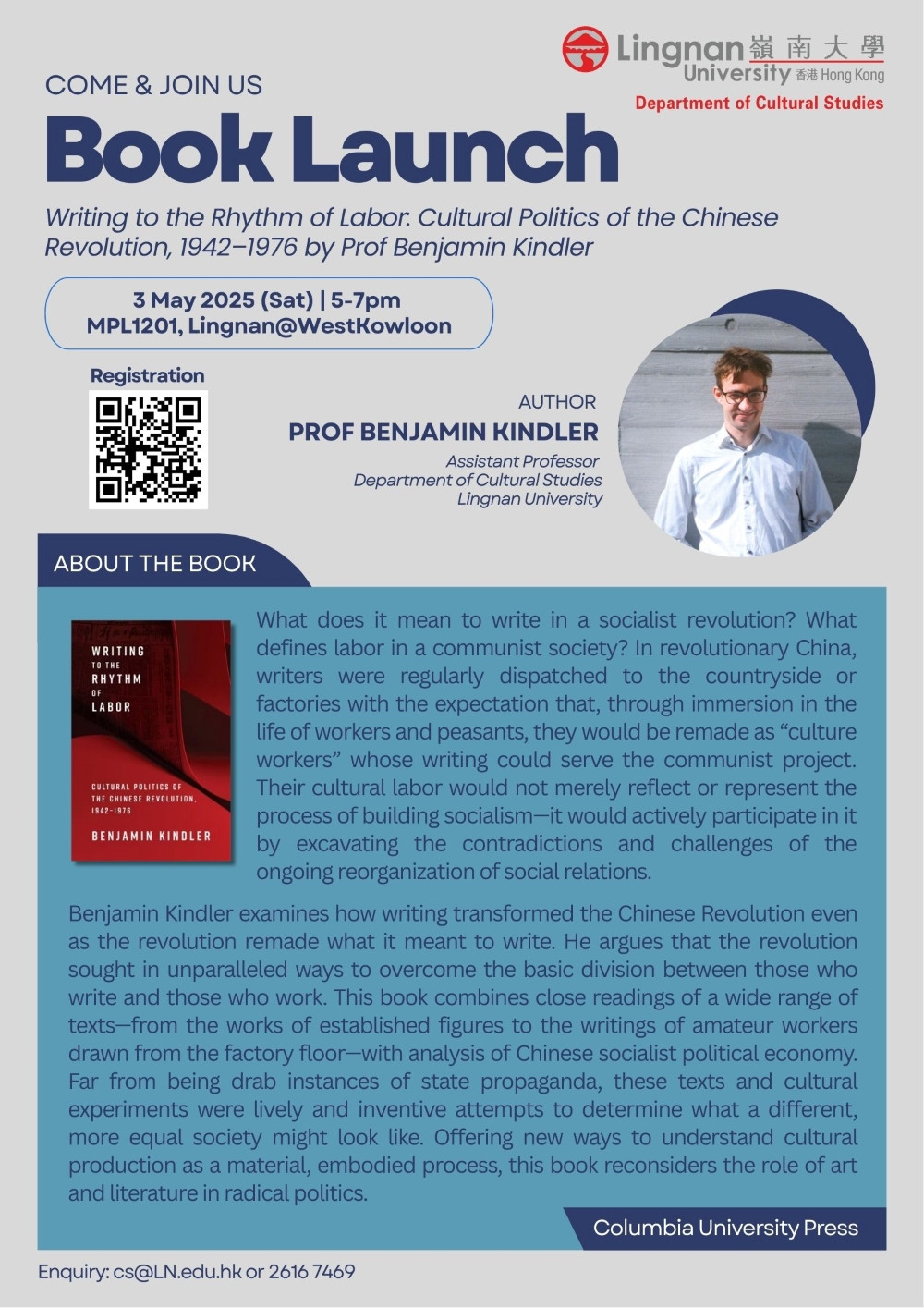
We warmly invite you to join us for an insightful event celebrating the launch of Prof Benjamin Kindler’s new book, Writing to the Rhythm of Labor: Cultural Politics of the Chinese Revolution, 1942–1976. Details are as follows:
Date: 3 May 2025 (Sat)
Time: 5:00 – 7:00pm
Venue: MPL1201, Lingnan@WestKowloon
Speaker: Prof Benjamin Kindler, Assistant Professor, Department of Cultural Studies, Lingnan University
Discussants:
Prof Pun Ngai, Chair Professor, Department of Cultural Studies, Lingnan University
Prof Rebecca Karl, Professor of History, New York University
Dr Harlan Chambers, Researcher, Department of East Asian Studies, University of Göttingen
Book Title: Writing to the Rhythm of Labor: Cultural Politics of the Chinese Revolution, 1942–1976
Publisher: Columbia University Press
Summary:
What does it mean to write in a socialist revolution? What defines labor in a communist society? In revolutionary China, writers were regularly dispatched to the countryside or factories with the expectation that, through immersion in the life of workers and peasants, they would be remade as “culture workers” whose writing could serve the communist project. Their cultural labor would not merely reflect or represent the process of building socialism—it would actively participate in it by excavating the contradictions and challenges of the ongoing reorganization of social relations.
Benjamin Kindler examines how writing transformed the Chinese Revolution even as the revolution remade what it meant to write. He argues that the revolution sought in unparalleled ways to overcome the basic division between those who write and those who work. This book combines close readings of a wide range of texts—from the works of established figures to the writings of amateur workers drawn from the factory floor—with analysis of Chinese socialist political economy. Far from being drab instances of state propaganda, these texts and cultural experiments were lively and inventive attempts to determine what a different, more equal society might look like. Offering new ways to understand cultural production as a material, embodied process, this book reconsiders the role of art and literature in radical politics.
Should you have any questions, feel free to contact Department of Cultural Studies ([email protected] or 2616 7469).
We look forward to your active participation in this stimulating event.
All are welcome!