


Tribute to Prof. Ackbar Abbas (1942-2026)
Encounters with Ackbar Abbas
Since the 2010s, Prof. Abbas has been appointed as Adjunct Distinguished Professor at our Department of Cultural Studies. His seminal 1997 book Hong Kong: Culture and the Politics of Disappearance, is a required text in many Cultural Studies courses at the undergraduate and postgraduate level. Prof Abbas gave lectures and taught for the Masters of Cultural Studies Programme. He was probably most remembered by his illuminating Distinguished Lecture on the 50th Anniversary of Lingnan University, on Posthumous Socialism:
https://www.youtube.com/watch?v=BSanEVI6g4M
In 2019, Prof. Abbas also brought to Lingnan University the collaboration with the University of California Humanities Research Institute (UCHRI) directed by David Theo Goldberg. We were able to organise an annual workshop in-person and later online with the participation of faculty members from both UCHRI and our Department. Former Professor and Head of Department, Tejaswini Niranjana cogently puts “Although Ackbar's first innings in Hong Kong was at HKU, it's heartwarming to think that his 'second coming' was at Lingnan University.”
Denise Tse-Shang Tang
Professor & Head of Department
Department of Cultural Studies, Lingnan University

In mourning the passing of Prof. Ackbar Abbas, we asked our dear friends and colleagues to write up a note on their encounters with Abbas.
Listening to Ackbar Abbas
My memory of first meeting Ackbar Abbas blurs like an urban noir film clip; I sense motion, darkness, neon streaks and a warm, hospitable voiceover. I remember nothing else except a feeling of bemusement. We would have been in a taxi to Kennedy Town, which friends wanted me to see as a new arrival from Sydney struggling with life in Tuen Mun. In the year 2000 I was too new to Hong Kong to grasp the contrast: still “remote” at the time, Tuen Mun with its layers of clashing historical debris was the most anarchic environment I’d ever experienced. A decade later, again nudged by friends, I had the good luck to live on the waterfront in Kennedy Town before the coming of the MTR. Ackbar was in the USA by then, but I thought of him daily on my early morning walks as the déjà disparu stirred vibrantly at dawn: mechanics sitting in workshops open to the street, smoking with their dogs; hawkers selling dim sum from huge bamboo steamers; and, often, one very old lady in samfu and slippers, hurrying away with her breakfast in its thin plastic bag.
Marginalia on my copy of Hong Kong: Culture and the Politics of Disappearance tell me that after that encounter I used Ackbar’s book to connect my new life to the one I had left behind. There are scribbles about Australia unintelligible to me now, although when Ackbar writes that the prevalence of speculation and consumption in politically blocked Hong Kong promoted a climate of “doom and boom” rather than one of doom and gloom, I noted: “Vs. Aus, boom and gloom?”. That’s still true. I was surprised to learn that Hong Kong, too, was once called a “cultural desert” and I still wonder how many British colonies instilled that phrase in subjects who believed its burden was uniquely their own. Celebrated now as a book that “changed the way people thought about Hong Kong”, (South China Morning Post, 13 August 2026), the subtitle once irritated local readers who would mutter: “Not disappearing. Still here.” Of course, the question of what “not” and “still”, the negative and the untimely, could come to mean in the “cultural self-invention” enabled by the space (not the fact) of Hong Kong disappearance was exactly what Ackbar had in mind. His own draft title, The Last Emporium, would have avoided that misunderstanding but, less catchy, might not have caught the future orientation that makes Hong Kong provocative to this day.
Rereading it almost thirty years later I am struck by the vocal quality of this fluently rigorous text. Studded with seemingly casual references to twentieth century French philosophy and German critical theory, each invocation precise and to the point being developed, Ackbar’s prose talks intimately to the reader. He is thinking, creating and explaining all at once and telling you why it matters. This quality is rare in scholarly writing today, and it must result partly from Ackbar’s mode of composition. He gave lectures to many different audiences globally, some of them still be to heard on YouTube. In these he develops core ideas (posthumous socialism, poor theory, faking, forgetting as remembering something else) and key examples (scenes from Wong Kar-wai, Ai Wei-wei’s caonima Muji shopping bag meme, the Beijing CCTV and Olympics opening ceremony) repeatedly over the years, cutting and pasting and rearranging elements as in a jigsaw puzzle representing an enigma (such as the “socialist market economy”) that he was working to understand. A spectral sense of those audiences inhabits the versions that he sometimes published.
Above all, though, I think this “voice” comes to us in the afterlife of criticism—true, classical criticism produced by the mergence of intellect and imagination in a sustained process of watching, reading and thinking. This is not neo-liberal “research” as humanities academics are forced to (often) fake it in the Humanities today. In an Ackbar Abbas text there is no pinging off recent refereed journal articles, no corralling of items produced by worthy social categories of authorship, and no shame at repeating paragraphs previously published if they suit a new purpose. Everything said is clear and relevant, and the interested reader, any reader, is cared for and respected. Criticism like this is largely dead in the academy, but in journalism and on-line platforms it has a precarious and vital afterlife if you can find some of its practitioners within the digital fog of opinion.
In “Adorno and the Weather” (2012), Ackbar admired the “lapidary aphorisms” that “leap off” Adorno’s pages of dense argumentation. Another feature of his own vocal style was a wicked turn of phrase with an orthodoxy-busting effect like that of a guest, otherwise polite, who says the unsayable in genteel company. Thus in Hong Kong he calls the discourse of marginality “a form of political isometrics” that exercises and strengthens the center. My favourite is his description in the Adorno essay of “radical pieties” (“all those hard-won truths learned from Nietzsche, Mark and Freud, or from Saussure and Derrida”) as “a kind of softening of the brain, a species of mad cow disease in the field of critical theory”. Shockingly accurate, this is all the more hilarious in that his own erudite use of such figures was never like that, never pious, never gratuitous. He would cite or allude to a particular point, then pass on. In this I hear the voice of a great teacher as well as a true critic. He sometimes gave longer expositions of difficult texts or arguments (Adorno’s Aesthetic Theory, Deleuze’s any-space-whatever in “Faking Globalization” from 2008), but this always showed what concepts in use could do in the context he was creating.
So it is fitting that my major encounter with him stretched across a collective, cross-institutional pedagogical initiative undertaken in the hard Hong Kong years of 2001-2003. The University Grants Committee was refusing to fund courses for our postgraduate research students, so teachers from six Hong Kong universities formed a volunteer consortium, the Hong Kong Institute for Cultural Criticism (a.k.a HICC) to deliver what was needed. Ackbar and Benjamin Lee hosted this through their Centre for the Study of Globalization and Cultures at HKU, bringing funds in later through the Center for Transcultural Studies in Chicago and the Ford Foundation. Looking through the files I still have reveals the generosity and commitment that brought people together. Over 50 students signed up for the first course on “Representations”, held at City University and taught not only by Ackbar (who lectured on “The Commodity”) but by Stephen Ching-kiu Chan, Chan Yuen-ying, Fred Y.L Chiu, John Erni, Leo Ou-fan Lee, myself, Wong Kin-yuen, Angelina Yee and Zhang Longxi, with the late Esther Cheung as Coordinator. Others including Markus Reisenleitner joined in over the next couple of years, with a Summer Institute on “Public Criticism and Visual Culture” in 2002 and a seminar series on “Globalism and Urban Cultures” led from Lingnan in 2003.
This deserves to be remembered, not least as an instance of Ackbar’s “Pied Piper” vocal quality of attraction and engagement. We teachers donated our time and the students dutifully came to lectures, wrote papers which we marked, and they earned certificates with no formal value whatsoever. We enjoyed the experiment until SARS interrupted and then a shift in government policy ended our run. None of this was meant to happen according to the rhetoric prevailing at the time about money-hungry Hong Kong people—the latter a perfect example of what Ackbar called the power of certain representations to “disappear” cultural realities that are actually there. But happen it did, through a shared act of faith, imagination, humorous risk and institutional craft, and for me this is part of the legacy of inspiration that is audible when listening to Ackbar Abbas as a writer and (thanks to video) as a teacher today.
My encounter with Abbas: inside and outside the classroom
It was in one of those small classrooms on the first floor of Loke Yew Hall, where the Department of Comparative Literature sat, as if perennially, that I’d always remember Mr Abbas’s class. Was it going to be Eugene Ionesco or Jorge Luis Borges today? Or were we back for another take of the endlessly complex structure and journey of James Joyce’s Ulysses? I had never read anything so incomprehensible and yet fascinating before this. His class was both mind-blowing and eye-opening. The image of Abbas speaking eloquently with a sheet of paper before him on the lectern stuck with me, never ready to disappear. I often wondered what’s on those handwritten notes that supplied him with such endlessly intriguing talking points. Fascinating — the class (mostly female) were probably fascinated more by the lecturer’s own fascination with whatever he’s getting at in his textual explication than by the text itself, with which the class would be trying hard to disentangle as the lecture unfolded. Then, before you knew it, the class would end. And you thought you’d just begun to have a taste of the fascination that had mesmerised the classroom, buried otherwise in the dreary colonial ambience of the HKU main building. It was 1976, the year when I was reading four papers in comparative literature at the university and Abbas’s classes were on the top of my list. Though, I was only to grab hold of the power of fascination as a concept and an endearing critical motif popularized by the master years later.
Likewise, I learnt decades later from him, in the new millennium, that Borges’s cosmopolitanism was to become the revealing mediation to appreciate the moving, if esoteric, “relation between style and situation,” between the aesthetic and the colonial, which had now become not so much the stylistic ambience that engulfed you, as the probing question some of us concerned with the Hong Kong situation were asking outside of the classroom. Long before the Hong Kong of old was said to have gone lost, Abbas had written insightfully about the politics of its culture of disappearance. That culture, in which many of my generation have grown up, was suddenly “a case of love at last sight,” as our changing existential situations reveal. Based possibly on some hand-written notes and scripts he had continued to use, Abbas published his take of the case as early as 1997 and kept developing that insight as things evolved. Change has never stopped him from exploring; it was the impetus for more eye-opening observations he would leave us with.
In an interview published in Ming Pao Daily I did with him when he visited Hong Kong briefly in 2017, a few years after the Umbrella Movement, he said: “Change has itself been changing … giving rise to what we call “anachronism.” As the grids change and the coordinates move constantly… [A]t any single instance, you would see the overlapping grids framing the same event.” He was talking about “failure as resistance” among Hongkongers and the China situation under what he referred to as “posthumous socialism.” At the time, these observations were mind-blowing. Rereading it today, I see Joyce’s Ulysses wandering to reach home amid his long meandering journeys to fathom the enigma of identity amid overlapping grids.
Our last close encounter, a most memorable one for me, took place on the campus of Lingnan University in the autumn of 2019, when Abbas, Ashish Rajadhyaksha and I taught a joint seminar on Wong Kar-wai in its Master of Cultural Studies programme. The class was scheduled for a weekly 3-hour session from 7pm to 10pm. Lingnan was located in Tuen Mun, in northwestern New Territories, to which students would need to commute via the mass transit rail. The subject matter itself was attractive enough for the students (which included both local students and those from mainland China), not to mention the opportunity to hear from a world-renowned expert like Abbas. For the three of us who taught, it was a rare encounter too and we enjoyed the experience thoroughly. There was a cosy atmosphere throughout the course; we would listen to each other’s lecture in different weeks and engage in intimate and spontaneous interaction in the mundane, well-lit classroom facing the quiet and motionless Wing On Plaza (not unusual during that time of the day) located right inside the school entrance. The fascinating thing was, and I believe Ackbar would have nodded here to my choice of word, as we moved deeper into the semester, the situation outside changed significantly and unpredictably. There were reports (or rumours) about local disturbances and anticipated alerts about the mass transit system having to close down temporarily before 9pm in light of the “volatile” situation on the streets. Our Wong Kar-wai discussions must continue, no doubt, but to allow students to catch the metro after class we had to tactically adjust the start and end time of each seminar according to the severity of the week’s rumours. The aesthetics and politics of fascination were certainly well registered during the changing time-space of the unexpectedly contingent learning experience. Many Wong Kar-wai stories were read, told, and remembered differently in that 2019 Tuen Mun classroom.
In the same 2017 interview Abbas went on to say: “Hence, in different contexts and from different perspectives you see things differently and you read stories differently. Things or events don’t actually change into something different, they just appear to have been moved and be moving erratically as a result of the changing grids.”
This is the instance in which I see the master showing and telling us with fascination many moving accounts of a lost soul seeking to mimic, if not seize hold of, the mesmerizing performance of the fascinated.
From 2017, Ackbar Abbas began to spend a few weeks every year as Adjunct Professor at the Department of Cultural Studies, Lingnan University. Each year, we planned a series of activities around his presence, starting with the Lingnan 50th Anniversary Distinguished Lecture he gave to a packed audience at the Hong Kong Arts Centre on October 23, 2017. Chatting with the attendees, I realised that a large number of them were his former Comp Lit students from HKU. They listened raptly to their teacher working his magic again, turning ordinary words into something that could shed light on major contemporary political and cultural phenomena. Here he re-introduced his concept of the posthumous, this time adding the term ‘socialism’ before it to describe present-day China, suggesting that China was neither capitalist or post-socialist in any simple way. Rather, the socialist past had a strong after-life, and might appear even more vibrant than before.
In my undergraduate core course at Lingnan on Culture and the Modern World, one of the first readings the students encountered was a chapter from Ackbar’s Hong Kong: Culture and the Politics of Disappearance. In this prescient book, which came out in 1997 at the time of the Handover to China, Ackbar introduced concepts like ‘disappearance’ which he used to tackle the elusive and fugitive nature of culture in the former British colony. He argued that it was precisely at the intense moment caused by imminent disappearance that something like a ‘Hong Kong culture’ emerged. He agreed very kindly to come and visit my class and talk to the students, who were struggling with the ideas of deja disparu and reverse hallucination. We came away with a better understanding what this thinker, who said he was born, brought up and corrupted in Hong Kong, was trying to articulate. And with a better understanding of Hong Kong too: how the rapidity of change in Hong Kong made one constantly battle with an anticipatory nostalgia (deja disparu - that something has already disappeared even as one is trying to grasp it), and with reverse hallucination, the inability to perceive what’s in front of you because of the overcrowded and rapidly changing space it inhabits. In this landmark book, Ackbar dwelt on cinema, architecture and literature, prefiguring his main preoccupations for the coming years. It was not that he set out to write about a film, an auteur, or an architect. These rich examples became for him a way of entering a thought-space and setting out concepts prompted by the material in front of him, concepts that could travel far beyond the film or the book.
Dear Ackbar, we miss your elegant solid brilliance, sprinkled with your wit, generosity, and charming laughter. I was so fortunate to have attended many of your talks, always mesmerized. Most of all, I treasure over many years our collaboration on putting together *Internationalizing Cultural Studies*. You were a coeditor but more like a mentor who respected our equal input. It was done through many conversations in your old office at HKU that I can still remember (from 20 years ago!). You left behind so much for all of us, in/for Hong Kong and elsewhere. We are in your debt. Goodbye, my friend.
So much happened in two years between 2017 and 2019 that it is startling to think that with the intense engagement with Ackbar and his work, so much had been crammed into such a brief period. But what a time that was. This was a time leading up to and then including the early days of the protests. The city was already in ferment. I had been invited in a visiting position at the University, as a professor of practice, to do several things, and the time absolutely coincided with Ackbar’s arrival on campus. We were outsiders, but so (it seemed at times) was Ackbar: ‘born, bred and corrupted in the city’ he might have been, author of Hong Kong: Culture and the Politics of Disappearance he may have written, but now he seemed distant to the events, as though belonging to a different Hong Kong.
We did several things together on the campus (when the Singaporean artist Ho Tzu Nyen first came); at the Parasite Art Gallery; at the Asia Art Archive’s Ha Bik Chuen collection. When I did the Docuthon with Sin Yi-Choi and Kelvin Wu, Ackbar was an interested observer. He and I then co-taught (with Stephen Chan) a full-on MCS course on Wong Kar-Wei. We saw – and memorably walked out of – Tsai-Min Liang’s live performance of music, part of the Art After Hours at the Tai Kwun Museum.
The protests were very much on when, soon after we completed the Wong Kar-Wai course, Stephen, Denise, Lisa and I met Ackbar for lunch. I had written a very long essay, ‘The Great Transition: Our Battles Over History’. It was a deeply convoluted effort to cast the events happening around us over a two-hundred-year time span, to think of Kashmir, Tibet and Hong Kong in the same breath, to explore colonialism thus. Ackbar seemed interested, eventually argued (in an afterword to that essay), that ‘history today is experienced more and more as a form of hysteria’.
We did meet again (he spoke at a panel I had convened at the Crossroads conference in Shanghai in 2018 (Back to the Future: Asian Imaginations), but by then the hysteria was over. Or so it had then seemed then: one wonders today, as we see cockroaches emerge all around us from the woodwork what he might have said.
To embrace radical hope: in remembrance of Ackbar Abbas
In 2021, during COVID-19, at the Eighth South South Forum on Sustainability, Ackbar Abbas and I co-moderated a lecture by Gayatri Spivak entitled “What is it to hope?” In this dialogue, Ackbar stated that “hope cannot mean pious confidence in a guaranteed outcome. Blind faith is one of critique’s most resistant objects because it forecloses misunderstanding, dislocation, and self-correction in advance.”
To this, Gayatri’s response was: “What is it to hope? It is to take full account of everything that stands in the way of hoping while still recognizing that without hope there is nothing. My hope against hope is that a permanent and persistent revolution can produce the will for social justice from one generation to the next, thereby sustaining the possibility of radical hope.”
Two days later, when Ackbar co-moderated with Wang Hui a lecture by Paul Bove on “The politics of hope and love”, he further discussed radical hope as “located neither in knowledge nor in ignorance, which takes the form of denial. Knowledge would mean the scientific attempts to mitigate the situation; ignorance would simply deny it. Radical hope may instead be found in what we could call fascination—not fascination as mystification, but as a relationship to what we do not know… Love is the notion of love's shadow. The shadow is the unknown within love—not merely sentimental love, but the substantial risk involved in encountering the unknown. One might therefore suggest that Love's Shadow could also be called Hope's Shadow.”
In this last dialogue with Ackbar, we were inspired with the importance to have the audacity to embrace the unknown in radical hope.
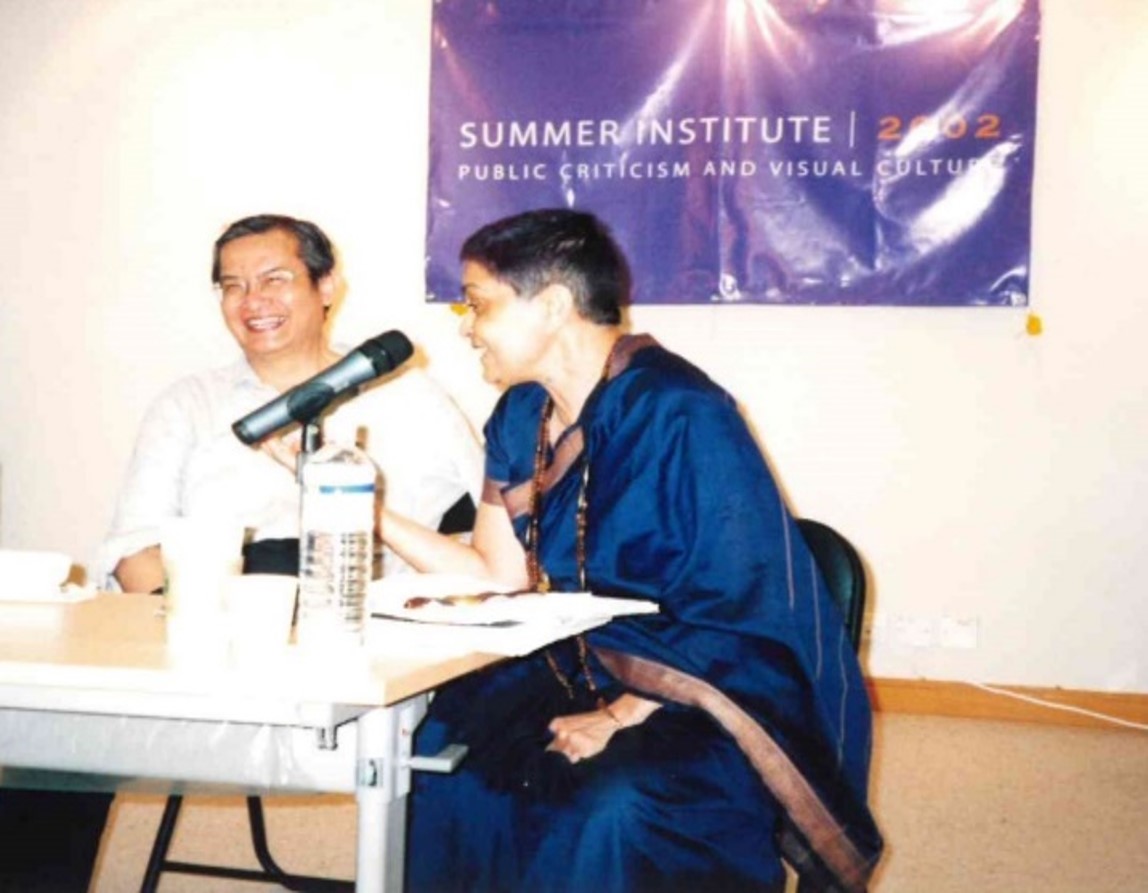
Ackbar Abbas and Gayatri Spivak, 2002, at HKU. Photo by Sit Tsui
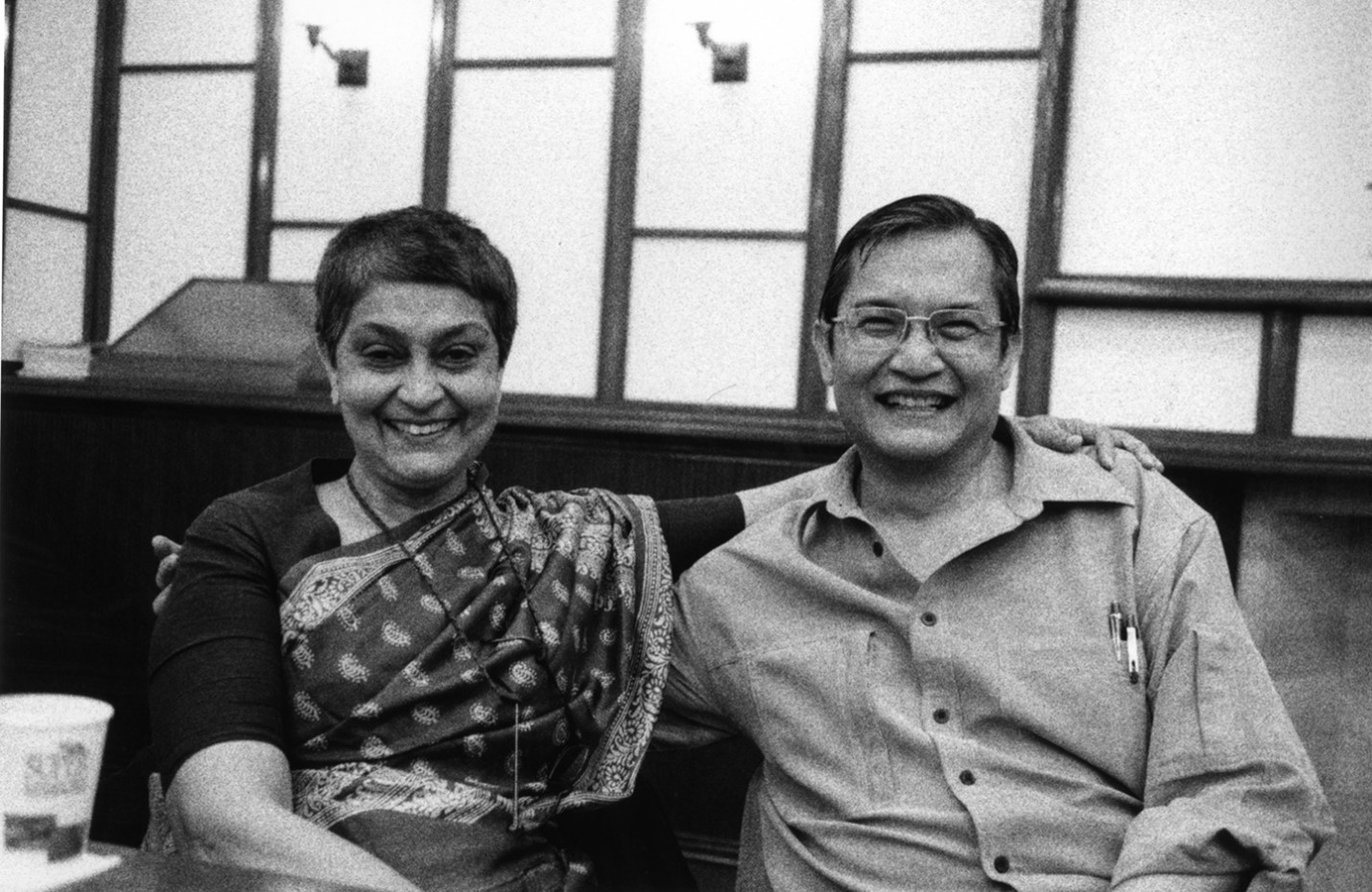
Gayatri Spivak and Ackbar Abbas, 2002, at HKU. Photo by David Clarke