


PhD/MPhil in Environmental Science
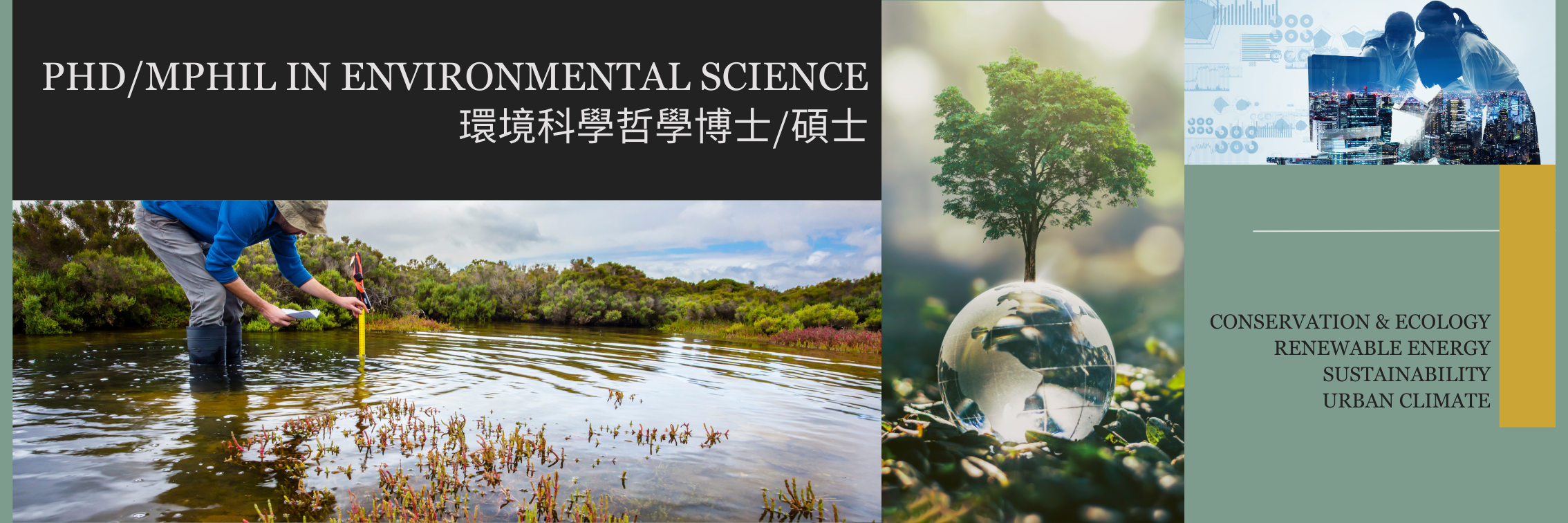

The Division of Science (DoS) at Lingnan University has eight members whose research and teaching interests cover core areas of environmental science including ecology, evolution, geology, geography, urban studies, and environmental education. Key areas of research interest are (1) Evolution, Ecology, and Conservation and (2) Geographical Information System (GIS), Urban Climate and Environmental Health (GUEH) and (3) Renewable Energy and Application (REA). As a liberal arts university, Lingnan University provides a unique postgraduate experience in Environmental Science by combining the expertise in the Division of Science with the three faculties (Arts, Social Sciences, and Business), as well as partnerships with local and international NGOs. This programme will equip students with a strong theoretical background in environmental sciences, as well as provide a diversity of hands-on, experiential experiences needed to be successful in this field.
1. Evolution, Ecology, and Conservation (EEC)
- Agriculture and food
- Behavioural ecology and eco-physiology
- Development of new technologies to aid in wildlife trade enforcement
- Freshwater and terrestrial ecology
- Functional and applied ecology
- Insect diversity and conservation
- Intertidal ecology
- Phylogenetics and population genetics
- Surveys of the wildlife trade in Asia
- Thermal biology
Urban ecology
2. Geographical Information System (GIS), Urban Climate and Environmental Health (GUEH)
- Environmental and social impact assessment (urban climate and air/noise pollution)
- Environmental epidemiology and health technologies
· ESG and Environmental Education
· Urban Sensing and GeoAI Application
3. Renewable Energy and Application (REA)
- Control, modelling, and monitoring of Lithium-ion battery systems
- Second-life utilisation of Lithium-ion batteries in renewable energy systems
- Hybrid power systems consist of Lithium-ion batteries and other devices
Required Courses
- RWTS510 Academic Writing & Research Methodology across Disciplines
- Other courses as/if required by their advisory committee
Informal Intellectual Development
- Attend seminars, journal clubs, scientific meetings, etc. in topics such as EEC, CPEH, Sustainability, Environmental Communication & Education. Students' participation and intellectual development will be documented in an e-portfolio (e.g, presentations, notes and reflections about learning experiences, etc.), and evaluated by fellow students and faculty members.
Research Thesis
- Conduct independent research in students' chosen field, prepare a written thesis, and successfully defend the thesis in the presence of the examiners.
Practical Experience
- Demonstrate scientific communication/education skills by working on a significant science project in collaboration with the DoS, NGOs, Government partners, etc. Student work and project advisors’ evaluations of the effectiveness of students work will be presented in the e-portfolio.
University admission requirements
Candidates to be admitted to this MPhil programme should normally:
- hold a relevant bachelor's degree with first or second class honours or at an equivalent standard awarded by a tertiary education institution recognised by the University; or
- have obtained an equivalent qualification; or
- have provided satisfactory evidence of academic and professional attainment.
In addition to the above, an applicant whose degree is not from a tertiary institution in Hong Kong or an English-speaking country should obtain:
- TOEFL: a minimum score of 79 (internet-based test); or
- IELTS: a band score of 6.5 or above; or
- An equivalent score in a recognised test, or an equivalent qualification to prove his/her language proficiency which will be considered on a case-by-case basis.
[Note: University only accepts results that are within the validity period, viz. 2 years, from the time of submission of an admission application for the specific intake cohort.]
Additional admission requirements set by the Programme
- Relevant majors include a variety of majors from the environmental sciences. Students who do not meet this requirement but show potential to integrate ideas across a variety of disciplines to advance environmental sciences may be considered.
- Will accept Grade C or above in the Cambridge Test of Proficiency in English Language; or grade C or above in English Language in the Overseas General Certificate of Education (GCE)


