


Beyond Monty Hall: The Enduring Enigma of Probability
Beyond Monty Hall: The Enduring Enigma of Probability
We invite you to explore a fascinating puzzle that has perplexed and inspired both statisticians and philosophers. Originally brought to the public's attention and later discussed in academic circles.
The Classic Conundrum
Picture yourself as a contestant on a TV show. Before you stand three closed doors. Behind one door gleams a sports car; behind the other two lurk goats. You choose Door #1, dreaming of what might be behind it. Instead of immediately revealing the answers, the MC—who knows the secret behind every door—opens Door #3, exposing a goat. He then gives you a choice: Stick with Door #1 or switch to the remaining unopened Door #2.
What would you do?
Many, including numerous mathematicians when Marilyn vos Savant first presented this puzzle in Parade magazine in 1990, assumed that after one door is opened the odds would be 50/50. Yet, the mathematically sound strategy is to “always switch”. Initially, the chance of picking the car is 1/3, while the chance of picking a goat is 2/3. Monty’s deliberate reveal shifts that 2/3 probability to the other unopened door, making switching the superior strategy.
The puzzle’s simplicity belies its profundity — it ignited a storm of debate, with even experts sending furious letters insisting that the mathematics were wrong. In truth, this very phenomenon highlights the psychological pitfalls of our intuition.
Cognitive Blind Spots: Why Our Intuition Fails?
Why does this puzzle confound so many brilliant minds? Several cognitive pitfalls conspire to fool us:
- Equiprobability Bias: We tend to assume that with two remaining options, each has an equal chance of being correct, ignoring the critical information revealed by the MC.
- Information Neglect: The fact that the MC, aware of what is behind each door, deliberately avoids the prize and reveals a goat is vital. This intentional choice dramatically alters the odds.
- Conditional Probability Complexity: Your initial selection categorizes the outcome: a 1/3 chance of having chosen the car and a 2/3 chance of having chosen a goat. When the goat is revealed, these probabilities do not simply split evenly; instead, the 2/3 probability consolidates on the remaining unopened door.
This puzzle illustrates the gap between intuitive reasoning and mathematical reality. Even when simulations unequivocally demonstrate the benefits of switching, many remain unconvinced — a reminder of how deeply ingrained misconceptions can be.
The Expanded Challenge: The Four-Door Mystery
Now, let’s venture beyond the classic scenario into uncharted territory. Imagine a game with four doors instead of three. Behind one stands a luxury car, behind another a motorcycle, and behind the remaining two, goats.
You select Door #1. The MC, fully aware of what lies behind each door, then opens Door #3 to reveal a goat. He now offers you three choices: stick with Door #1, switch to Door #2, or switch to Door #4.
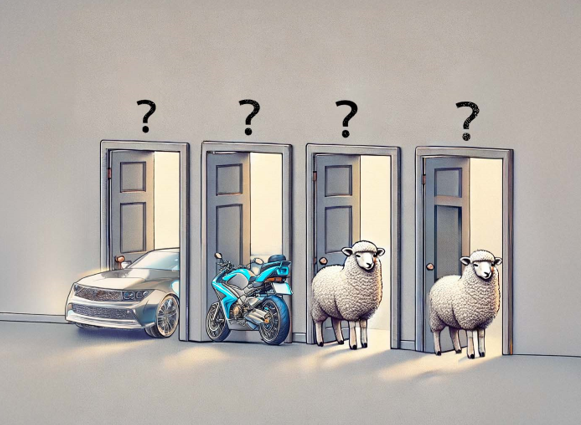
Here’s the twist: The MC will not disclose his strategy for choosing which door to open. Consider the possibilities:
1. He might always reveal a goat, selecting randomly if there are multiple eligible doors.
2. Perhaps he only reveals a goat if you initially chose the car.
3. Or he could be following an entirely different set of rules.
Your challenge: What is your optimal strategy? Should you stick with Door #1 or switch to one of the other doors? How do the probabilities shift based on the MC's undisclosed rules? Is there a dominant strategy regardless of his approach?
This variation introduces elements of game theory and incomplete information, demanding not only calculation but also creative insights into probability, strategy, and metacognition.
Put Your Reasoning to the Test!
Can you unravel the mystery of the four-door challenge? This is your opportunity to demonstrate human ingenuity against the limitations of pure algorithmic reasoning.
Send your solution—including your detailed reasoning—to [email protected] with the subject line "Four-Door Monty Hall Challenge." The best 10 responses, judged for their mathematical correctness, clarity, originality, and consideration of alternate scenarios, will each receive a modest gift. Select entries will be featured on the SERC website of Lingnan University.
Submission Deadline: 31 March 2025
Winners Announced: 30 April 2025
In this battle of wits, may the creative power of human thought and the courage to question assumptions prevail over the limits of conventional computation!