



Author: Stephanie Ng Yuet-wah
Wong Hok-sing—A film director whose name appears on the credits of many Cantonese films—but before the war, he began his career performing on stage as a xiaowu (young military male role) in Cantonese opera. He later made his way to the big screen, with a reputation comparable to that of his contemporary, Sun Ma Si-tsang, who also began his career in the film industry with martial arts films. His works are mostly black-and-white costume films with many Cantonese opera action scenes. However, he was one of the few Cantonese film directors who could shoot colour films. He did not learn his colour-shooting skills in Hong Kong but in the United States, where he made colour films about Chinese people living overseas for local audiences, which were screened in Hong Kong after the war. This article will give an overview of the development of early Hong Kong cinema through the trajectory of Wong Hok-sing’s early performances and travels.
Xiaowu in Cantonese Opera
Wong’s grandfather was one of the shareholders of Qing Ping Theatre in Foshan, so he often spent time at the theatre in his childhood. Gradually he developed an interest in Cantonese Opera and thought about learning it. When he found out that Guangdong Drama Research Centre was admitting students, the 14-year-old Wong applied for it without his parent’s awareness and was admitted to the institute to study Cantonese opera and Kunqu. When the centre ceased its operation, he continued his studies at the Cantonese opera talent training centre, The Chinese Artists Association of Guangzhou, where he became classmates with Lau Hark-suen, Cheung Wood-yau, and Luo Pinchao. After 20 months of training, the young, hard-working Wong excelled in his studies. Upon graduation, under the arrangement of The Chinese Artists Association, he was assigned to Sit Kok-Sin’s Kok Sin Sing Opera Troupe to practise stage performance and became the seventh xiaowu of the troupe. However, it didn’t last very long because Sit left for Shanghai and the troupe was disbanded. Wong could only turn to other troupes, such as Po Chai Tin Opera Troupe, Tong Tin Bo Opera Troupe, the Shing Sou Lin Opera Troupe and the Tai Law Tin Opera Troupe. After a few years of stage training with countryside troupes, Wong gained support from the boss of the Zhuhai Theatre in Guangzhou and finally became the lead wenwusheng (civil and military male role) in the Forever Green Opera Troupe formed by emerging talents. The film One Hundred Thousand Children’s Corpses, in which he played a leading role, was very well received.[1] Unfortunately, affected by the war, Forever Green, like the other troupes, had to move to Hong Kong to perform and, later on, to places like An Nam (Vietnam) and Singapore. However, the local Chinese had shifted their focus on the war in China and lost interest in the old-style Cantonese opera. Coupled with discord among troupe members, the troupe struggled to sell out, and Wong was stranded in Southeast Asia.[2]As luck would have it, in 1938, he was invited by Ma Si-Tsang to return to Hong Kong and join the Tai Ping Opera Troupe as their lead xiaowu.[3] At that time, famous Cantonese opera performers had the power to boost box office sales. The Tai Ping Opera Troupe was one of the most popular troupes in Hong Kong, and Wong ranked second only to the pillars of the troupe, Ma Si-tsang and Tam Lan-hing. Representing a new generation with talent and audience, Wong was naturally in demand by many filmmakers.
The Backbone of Martial Arts Films
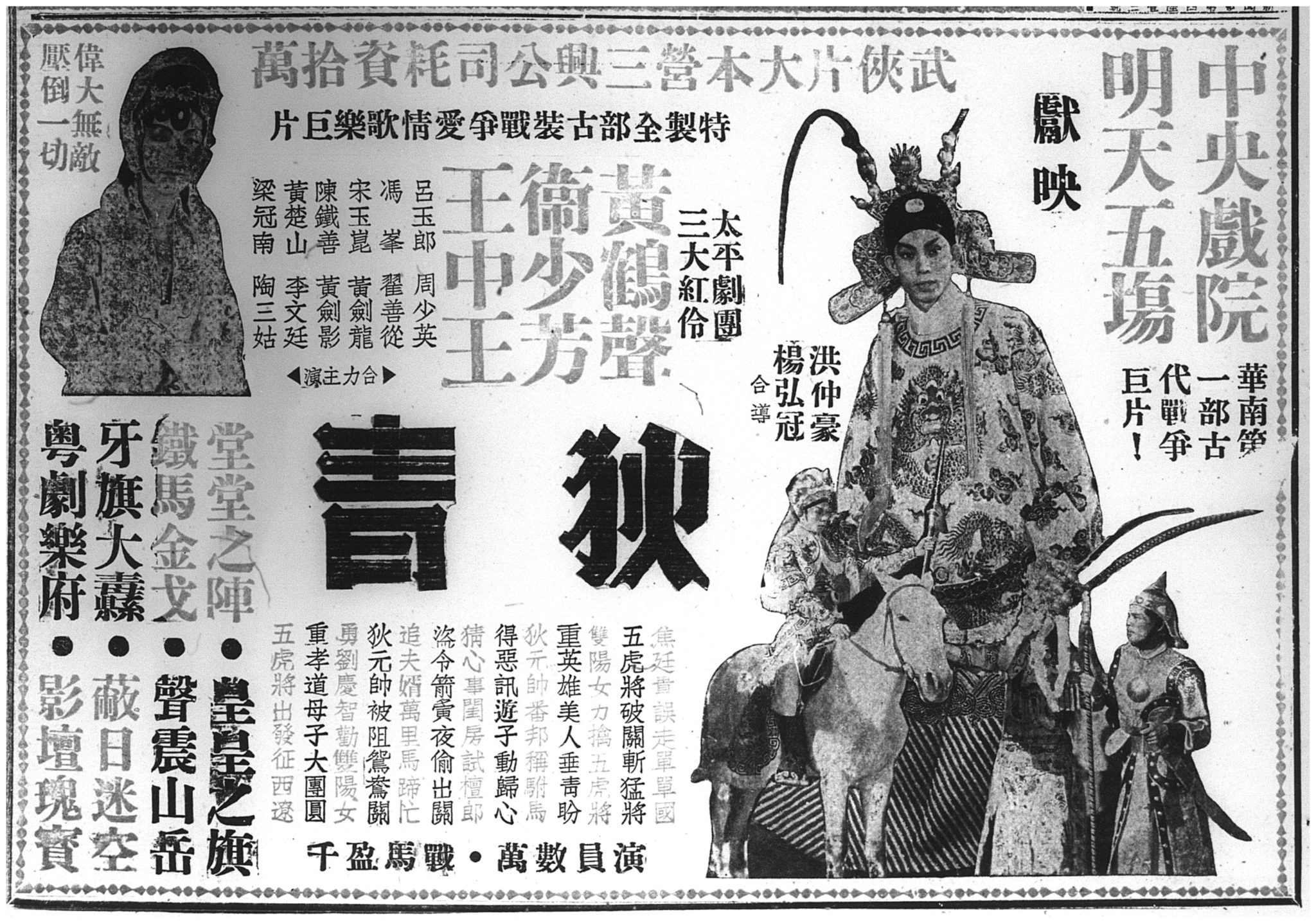
After the outbreak of the war in 1937, many working in Shanghai cinema moved to the south, including director Hung Chung-ho and his wife Chin Tsi-ang, a female martial arts star of the first generation. In Hong Kong, they watched a Cantonese opera with a lot of action scenes played by Sun Ma Si-tsang. Even though they did not understand Cantonese, they found it interesting. As a result, they invited Sun Ma Si-Tsang, who had no film experience at the time, to star in the production of Sanxing Trading Company, which they had founded. The Young Fighter was a big hit and created a craze for martial arts films, putting Sanxing at the centre of martial arts films.[4] In the midst of the trend in which opera performers participated one after another in film production, Wong Hok-sing, then a newly appointed wenwusheng, was naturally the perfect candidate for many major filmmakers. In the end, he chose to make his screen debut in Breaking Through the Bronze Net (1939), produced by Sanxing and directed by Hung Suk-wan, the younger brother of Hung Chung-ho. Breaking Through the Bronze Net was an adaptation of the famous martial arts novel The Seven Heroes and Five Gallants in which Wong plays the role of Bai Yu Tang, the Sleek Rat, a character of both good and evil. He then starred in Triple Flirtation of the White Chrysanthemum (1939; directed by Hung Chung-ho and Yeung Wang-kwun) produced by Sanxing, which is an adaptation of the famous martial arts novel Little Five Heroes. In the film, he played the role of White Chrysanthemum—a sex thief. So even if Wong is the protagonist, his role is not always as heroic as expected, but a slightly avant-garde villainous character.
Other than films based on martial arts novels, the fall of Guangzhou in 1938 led to another type of “martial arts film” in Hong Kong cinema. Facing Japan’s invasion, the Chinese at home and abroad were filled with indignation, but the Hong Kong government did not allow overt anti-Japanese activities. As a result, Hong Kong filmmakers made use of metaphors to allude to the present with past events, thus creating a wave of historical martial arts films.[5] Wong Hok-sing, who began his career as a xiaowu, played several famous generals in different historical martial arts films produced by Sanxing. For instance, he played Zhao Kuangyin, the founding emperor of the Song dynasty, in Farewell to My Lady (1939); Di Qing, the famous general of the Northern Song dynasty, in The Marrying General and The Five Generals (1940); and Xue Rengui, the famous general of the Tang dynasty, in Expedition to the East (1940). In these films, his martial arts skills are fully displayed. In 1940, Wong brought to the screen his renowned Cantonese opera creation, One Hundred Thousand Children’s Corpses, which was similar to Yuan zaju, The Orphan of Zhao. It was shot by director But Fu, who had just arrived from Shanghai.[6]
Besides The Twelve Widows, the other ten films in which Wong starred between 1939 to 1940 are all costume films, with most of the roles of heroic nature. Therefore his image of a hero was deeply felt by audiences. His film contracts were never-ending, at the same time, he was also one of the pillars of the Tai Ping Opera Troupe. His success in film and theatre was so great that many opera artists could only dream of such success, and it had even attracted some institutes and commerce in San Francisco, USA. He was then invited to perform in San Francisco for six months, just as the Universal Exposition was being held. He saw this as a unique opportunity to see the world, so he left all his work in Hong Kong and set off for the United States.[7]
Taking the Opportunity to Study Cinema while Stranded in the United States
While Wong Hok-sing was performing in the United States, he could not return to his home country due to the intensity of the war and had to stay there to continue performing. The local theatres did not show matinee performances, so he had a lot of leisure time to continue his work. He also met many foreign friends and reconnected with Joseph Sunn Jue (aka Chiu Shu-sun, the director of Grandview Film Company Limited.[8] Chiu was a local Chinese who, in 1939, left Hong Kong and returned to the United States to raise funds to realise his dream of producing colour films at Grandview Film in Hong Kong. Assisted by Skinner, the producer of his first Cantonese film in the United States, Blossom Time, Chiu made a partial colour film, The Light of the Overseas Chinese (1940).[9] Before coming to America, Wong had already participated in many film productions and was interested in photography, so he would take photos as a hobby during his leisure time. Having noticed Wong’s interest in photography, Chiu encouraged him to study at a photography school. Wong found a government-run photography school offering free photography courses, so he enrolled in it and studied photography and photographic processing for two years. His English was not good, so he went to Chiu for advice. Having noticed Wong’s interest in film, Chiu would teach him about cinema and its theory, and the two would meet to discuss films almost every day for several hours.
Due to the war, films produced in China could not be shipped to the United States, and the local Chinese could only watch re-released films repeatedly, so the audience lost interest. Therefore Chiu came up with the idea of organising a film studio to make films for the local audience and asked Wong to help with the filming. Chiu rented a warehouse, and together with Wong, they started working on some small productions, thus establishing the American branch of Grandview Film. Although Chiu was experienced in setting, filming, directing, and sound recording, the studio was small, and there were not enough lights. He then experimented with 16mm film and created Song of A Man’s Broken Heart. The film was directed by Chiu, with Wong, and Chiu’s wife, Lai Yee, starring in it. Wong also wrote the screenplay for the film and learned from Chiu about setting and sound recording. Tang Pui also helped to prepare the set. Therefore, the so-called American branch was run by only four production team members. Since the films were small independent productions, with no pressure of a deadline, Chiu soon asked Wong to be the director. Wong used the nickname he had as a student, “Wong Kam-yan”, as an alias when working as a director in the United States.
The films produced at the American branch were very popular among the local audience. Chiu had a feeling that colour films were not yet available in China, so when the production of black and white films began to settle, he asked Wong to return to the photography school to learn about processing colour films. After six months of study, Wong tried to develop 16mm colour films with Chiu, but they could only develop monochrome films due to inaccurate temperature. After a month of repeated testing, they finally developed full-colour films. At that time, Chiang Wai-kwong was also in town, so the American branch gained another director. Wong had stayed at the American branch of Grandview Film for six to seven years, working with Chiu and his team to produce a number of films about Chinese people living in America, which are mostly 16mm colour modern films[10], among which the story of White Powder and Neon Lights (1947) was even set in the Grandview Theatre in San Francisco, filming the glorious backstage scenes of troupe performers putting on makeup, practising, and burning incense to pray.[11]
Back to the Origin
In 1948, Wong returned to Hong Kong to re-establish Grandview Film. The first post-war film by Grandview Film was a colour modern film, A Baby for Everybody, directed by Wong under the name of Wong Kam-yan. The story is no longer based on Chinese people living overseas but instead based on popular comedy. The film took over forty days to shoot, and once finished, the negatives were shipped to the American branch for processing.[12] Unfortunately, Hollywood films in colour were already showing in Hong Kong. Moreover, in the post-war era, local audiences of Cantonese films could not afford to watch a film. There was also an influx of Cantonese films, which, when coupled with the high production and processing costs of colour films, meant that colour Cantonese films did not become the mainstream of Cantonese films until the mid-1950s when Cantonese opera films created a demand for colour films, it was then that Wong was again able to make the most of his studies in the United States. Wong knew how to adapt to the needs of the times and flow with popular culture. He was able to reinvent himself, pursuing his career in both cinema and theatre in post-war times. Under the name “Wong Hok-sing”, being able to act, direct and create made him an all-round creator, which was rare in the film industry.

After returning to Hong Kong, Wong’s first directorial work, A Baby for Everybody, still bears the name “Wong Kam-yan”, while the two Hollywood films released in the same period are labelled as full-colour works (Wah Kiu Yat Po, 1st January 1949).
[1] Cheang, M. (鄭孟霞) (Host). (1962). Xiju shengya: Huanghesheng (Performing life: Wong Hok-sing, 戲劇生涯:黃鶴聲) (Radio Programme). Hong Kong: Radio Rediffusion; Hong Kong Filmmakers Search. (n.d.). Wong Hok-sing. In Hong Kong Film Archive. https://www.filmarchive.gov.hk/documents/18995340/19057017/WONG%2BHok-sing_c.pdf; (1938, May 1). Ximi xinzhong de Huanghesheng (Wong Hok-sing in the heart of fans, 戲迷心中的黃鶴聲). Artland, (29).
[2] (1937, November 1). Wannianqing laxiang guo Annan (Forever Green Opera Troupe goes to Vietnam, 萬年青拉箱過安南). Artland, (17); (1938, August 1). Huanghesheng guigang xun (Wong Hok-sing back to Hong Kong, 黃鶴聲歸港訊). Artland, (35).
[3] Hong Kong Filmmakers Search of Hong Kong Film Archive stated that Wong Hok-sing joined Tai Ping Opera Troupe in 1940 (Hong Kong Filmmakers Search. (n.d.). Wong Hok-sing. In Hong Kong Film Archive. https://www.filmarchive.gov.hk/documents/18995340/19057017/WONG%2BHok-sing_c.pdf). Yet Wong Hok-sing said that he joined Tai Ping Opera Troupe in 1937 in a radio programme (Refer to Cheang, M. (鄭孟霞) (Host). (1962). Xiju shengya: Huanghesheng (Performing life: Wong Hok-sing, 戲劇生涯:黃鶴聲)). A 1 January 1939 article of Artland reported that Wong is a member of Tai Ping Opera Troupe ((1939, January 1). Yige congming de xiju zhanshi Huanghesheng qu Shanghai buyan wuyishi yingpian mianrenciyi (A smart play fighter Wong Hok-sing goes to Shanghai to avoid playing non-progressive films, 一個聰明的戲劇戰士 黃鶴聲去上海 不演無意識影片.免人疵議). Artland, (45)). Wong Hok-sing is also highlighted as the leading xiaowu of Tai Ping Opera Troupe in the advertisement of Farewell to My Lady (1939) in the cover page of Wah Kiu Yat Po (See (1939, November 15). Advertisement of Farewell to My Lady (《趙匡胤夜送京娘》廣告), Wah Kiu Yat Po). According to Artland articles, Wong Hok-sing was stranded in Vietnam in 1937. He returned to Hong Kong on 5 August 1938 to join Tai Ping Opera Troupe (See (1938, July 15). (望穿戲迷眼 黃鶴聲滯留赤道線). Artland, (34); (1938, August 1). (黃鶴聲歸港訊). Artland, (35)). As a result, author concludes that Wong Hok-sing joined Tai Ping Opera Troupe in 1938.
[4] Ng, Y. W. S. (吳月華). (2017, March 15). Yiwei bei lishi yanmo de mingdao (A famous director submerged in history — Hung Chung-ho, 一位被歷史淹沒的名導——洪仲豪). Hong Kong Film Critics Society. Retrieved August 18, 2022, from https://www.filmcritics.org.hk/zh-hant/%E9%9B%BB%E5%BD%B1%E8%A9%95%E8%AB%96/%E6%9C%83%E5%93%A1%E5%BD%B1%E8%A9%95/%E4%B8%80%E4%BD%8D%E8%A2%AB%E6%AD%B7%E5%8F%B2%E6%B7%B9%E6%B2%92%E7%9A%84%E5%90%8D%E5%B0%8E%E2%94%80%E2%94%80%E6%B4%AA%E4%BB%B2%E8%B1%AA.
[5] (1939, August 1). Huanghesheng zai yingjie you dewei zhihou Zhenghuoyou youyue yuren (After Wong Hok-sing with status in film industry Cheung Wood-yau has contract with film company, 黃鶴聲在影界有地位之後 張活游有約於人). Artland, (59).
[6] (1940, January 1). Huanghesheng yan shoubenxi Shiwantongshi (Wong Hok-sing play his renowned Cantonese opera, One Hundred Thousand Children’s Corpses, on screen, 黃鶴聲演首本戲「十萬童屍」). Screen Voice, 3(60); (1940, June 19). Shiwantongshi guanggao (Advertisement of One Hundred Thousand Children’s Corpses, 《十萬童屍》廣告), Wah Kiu Yat Po; (2020). One Hundred Thousand Children’s Corpses. In S. Wong (黃淑嫻) & C. Kwok (郭靜寧) (Eds.), Hong Kong filmography Vol I (1914–1941) (Rev. Ed.). Hong Kong: Hong Kong Film Archive, 167 (in Chinese).
[7] Cheang, M. (鄭孟霞) (Host). (1962). Xiju shengya: Huanghesheng (Performing life: Wong Hok-sing, 戲劇生涯:黃鶴聲) (Radio Programme). Hong Kong: Radio Rediffusion.
[8] Ibid.
[9] (1939, November 15). Jieshao Huaqiao zhi guang (Introducing The Light of the Overseas Chinese, 介紹華僑之光). Artland, (62).
[10] See note 8.
[11] Rao, Y. (饒韻華). (n.d.). Kuayang de yueju, guanzhong he wenhua liudong (Overseas Cantonese opera, audiences and cultural flow, 跨洋的粵劇、觀眾和文化流動). International Association of Theatre Critics (Hong Kong). Retrieved August 26, 2022, from https://www.iatc.com.hk/doc/106919?fbclid=IwAR2COqu9G7Y7S493v2Mlst_sVtR3-ViqAxiT9XzTp2_ilLwmttjAuuWKswI; (n.d.). White Powder and Neon Lights. Hong Kong Film Archive. Retrieved August 26, 2022, https://www.filmarchive.gov.hk/zh_TW/web/hkfa/pe-event-2021-ths-fs-film14.html.
[12] Yong, Y. (永一). (1948, February 8). Wujinxia zaimei zuo daoyan (Esther Eng being a director in US, 伍錦霞在美做導演). Gong Ping Bao; Ming, Y. (明眼). (1948, April 26). Lianshengguizi yunmei chongyin (A Baby for Everybody sending film to US for developing, 「連生貴子」運美沖印). Gong Ping Bao.