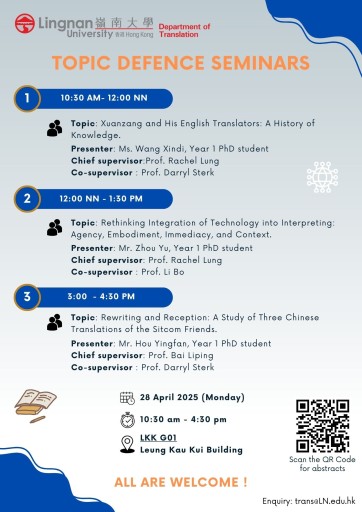


PhD Students’ Topic Defence Seminars
Dear colleagues and students,
We cordially invite you to participate in the Department of Translation PhD Students’ Topic Defence Seminars on 28 April(Monday). No registration is required. ALL are welcome to join the seminars.
Thank you for your attention.
Kind regards,
Department of Translation
Lingnan University
Xuanzang and His English Translators: A History of Knowledge
WANG Xindi
ABSTRACT
The Chinese opus Datang Xiyuji 大唐西域記(The Record of the Western Regions in the Great Tang Dynasty) constitutes a key to developing a history of knowledge respecting India, Middle Asia, geography, anthropology, religion, and language, etc. given its unique words on those aspects. Its English translations can equally form its own history of knowledge, as macroscopically speaking translation history must be contained in the voluminous history of knowledge and knowledge pertinent to the translational activities, be it before, in or after, can compose a microscopic history. This case study will juxtapose translation with knowledge and treat them as both research objects and methodologies. Based on Swiss historian Philipp Sarasin’s four analytical tools to the history of knowledge, namely, the order of knowledge, the mediality of knowledge, the actors of knowledge and the genealogy of knowledge, it is expected to answer how and why knowledge is affected by knowledge actors (viz. translational agents here) via their translational activities by both synchronic and chronological analyses. Conversely, whether translation theories can be employed or (re)conceptualised to describe those knowledge phenomena will be considered meanwhile, as an attempt at the “outward turn in translation studies” proposed by Susan Bassnett and David Johnston. As such, this project hopes to develop a history of knowledge in translation, by translation and with translation.
Rethinking Integration of Technology into Interpreting: Agency, Embodiment, Immediacy, and Context
ZHOU Yu
ABSTRACT
With the advent of ChatGPT 3.0 in 2022, artificial intelligence (AI) has increasingly rippled across many different disciplines including translation and interpreting studies. Although machine translation has been improved since scientists applied neural networks, a deep learning model which is similar to its counterpart large language models (LLMs), to machine translation, it still requires human-machine collaboration, e.g. post-editing machine translation (PEMT), to ensure translation quality. Scholars have deeply explored in human and machine translation, while the spoken translation, usually referred to as machine interpreting, remains less researched. Machine interpreting, also known as speech translation, spoken language translation, or speech-to-speech translation, is actually not a new development in recent years.
Typical speech translation follows a cascaded system, comprising speech recognition, machine translation and speech synthesis. Recently, an end-to-end system has been developed to balance quality and latency in real-time. While machine interpreting companies make exaggerated claims that it can produce high-quality and instantaneous outputs in many scenarios, the reality is that machine interpreting often produces errors and is easily influenced by noise, equipment and other physical factors. That is not to say that such exaggerated claims will never become reality in the future, but it requires a transition where human-AI coordination could serve as a feasible approach to facilitating cross-language communication effectively. First, this research is intended to compare human and machine interpreting based on authentic materials from both online and offline sources in terms of fluency, error rates, cohesion, and cultural nuances. After making this comparison, the research will seek to define modes in which technologies can be integrated into the human interpreting according to the three-dimensional model (agency, embodiment, and immediacy) proposed by Pöchhacker (2024), with addition of one important factor: context. Finally, the research aims to explore how technology affects the context in which interpreters operate, such as their working environment and clients’ opinions.
Rewriting and Reception: A Study of Three Chinese Translations of the Sitcom Friends
HOU Yingfan
ABSTRACT
Friends is one of the most renowned American sitcoms. It has three translated versions in China. In 2012, 搜狐视频 (Sohu Video) acquired the licensing rights to Friends and subsequently released a translated version on its streaming platform. However, in 2018, the series was removed from Sohu Video, reportedly due to the expiration of the licensing agreement. In 2022, Friends was reintroduced to Chinese market through some streaming platforms, including 爱奇艺 (iQIYI), 优酷 (Youku), 哔哩哔哩 (Bilibili), and 腾讯视频 (Tencent Video). Significantly, the version underwent substantial rewriting and deletion, which prompted considerable controversy upon its release. The extensive rewriting generated widespread criticism from audience, leading to heated discussions on Chinese social media. Following the release of the 2022 version, the so-called “uncut version” of Friends began to privately circulate within Chinese social media spaces, particularly among fan communities. This study operates on the premise that the extensive rewriting in the 2022 version played a pivotal role in stimulating the audience to seek alternative and uncut version through online platforms.
Accordingly, this research undertakes a comprehensive analysis of the three translated versions of Friends in China since 2012, with a particular emphasis on the version released in 2022. This research aims to systematically analyze the rewriting of the 2022 version of Friends. The specific research objectives include examining how the sitcom Friends was rewritten; exploring how the rewriting influence and reconstruct the meaning and effects of the source text; investigating the attitudes, interpretation, and feedback of Chinese audience toward the translation, particularly whether they exhibit oppositional behaviors due to dissatisfaction with the translation; and identifying the motivations behind the rewriting of the source text. Furthermore, if audience exhibits dissatisfaction and oppositional behaviors toward the translation, this study seeks to understand the motivations behind their reactions.