


Chapter 13 - Quality Assurance and Enhancement of Service-Learning
| 13.1 | Service-Learning at Lingnan University |
| 13.2 | Quality Assurance and Enhancement Structure |
| 13.3 | Quality Assurance and Enhancement Procedures |
| 13.1 | Service-Learning at Lingnan University |
| Service-Learning (S-L) is a pedagogy that combines rigorous academic study with meaningful service in the community. It is an effective teaching and learning strategy that aims to facilitate student learning in terms of academic knowledge and personal development. | |
At Lingnan University, S-L practices of students and faculties embody the University’s long-standing motto, “Education for Service”. | |
| For all undergraduate students, S-L is a graduation requirement. To fulfill it, each student must pass at least one course with an S-L element (see Appendix A for course criteria) before graduating. The types of courses with an S-L element are: | |
| |
| Details of each type of course with an S-L component are listed in Section 4 of Appendix A and the procedures for approval of S-L courses offered by overseas institutions are listed in Appendix B. | |
| 13.2 | Quality Assurance and Enhancement Structure |
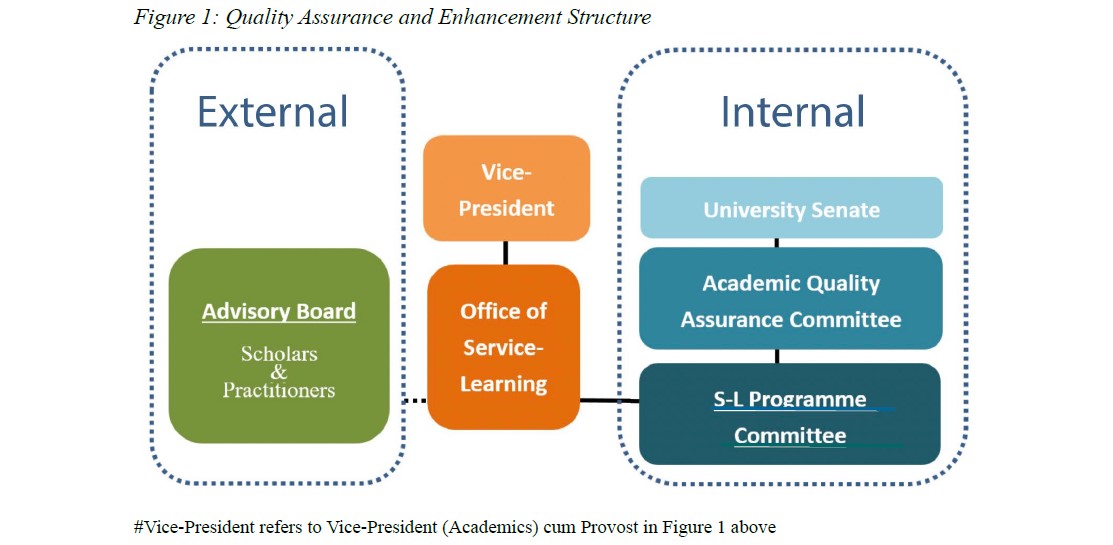
| The Office of Service-Learning (OSL) reports directly to the Vice-President (Academics) cum Provost2 . In order to assure the quality of the S-L programmes at Lingnan University, two committees have been established. | |
| |
| |
| The details of the structure can be referred to Figure 1. All terms of reference and membership are listed in Appendix C. | |
 | |
| 13.3 | Quality Assurance and Enhancement Procedures |
| 13.3.1 | Course/Programme Development and Approval |
| As one of the most important quality assurance mechanisms, courses with S-L as a newly-added element must go through approval procedures with the below steps: | |
| 1. | Courses with an S-L elementNote shall be endorsed by (a) the Programme Curriculum Committee/Department Board*, and (b) the Service-Learning Programme Committee to review the effectiveness, feasibility, and sustainability of each course with an S-L element. To speed up the review and endorsement process, the proposed courses with an S-L element shall be submitted to the above parties at the same time. |
Note The Department Head or faculty members can refer to the S-L best practices of other Universities in Appendix D; the criteria for a course with an S-L element and suggested course design guidelines for course instructors can be found in Appendix E. | |
| 2. | The finalised and endorsed proposal about courses with an S-L element will then be submitted by the responsible department to the: (a) Core Curriculum Committee (CCC) and then Academic Quality Assurance Committee for Undergraduate Programmes (AQAC) if the course is to be offered as a course in the Core Curriculum; or (b) AQAC, directly. |
| 3. | The AQAC approved courses will be submitted to the Senate for noting. |
* For more details of the endorsement authorities for major changes which include adding S-L element to a course, please refer to Section 5.2.4 of Chapter 5. | |
| 13.3.2 | Course/Programme Planning Implementation |
| In order to ensure a high-quality S-L programme, OSL facilitates and monitors the operations and outcomes of programmes, closely working with different stakeholders, namely faculty, agency partners, and students. Relevant activities in this regard include: | |
| |
| |
| |
| OSL coordinators who are in charge of the above task items are all at the grade of Senior Project Officer, with at least four years’ experience working at alike positions and settings. | |
| 13.3.3 | Programme Evaluation and Improvement |
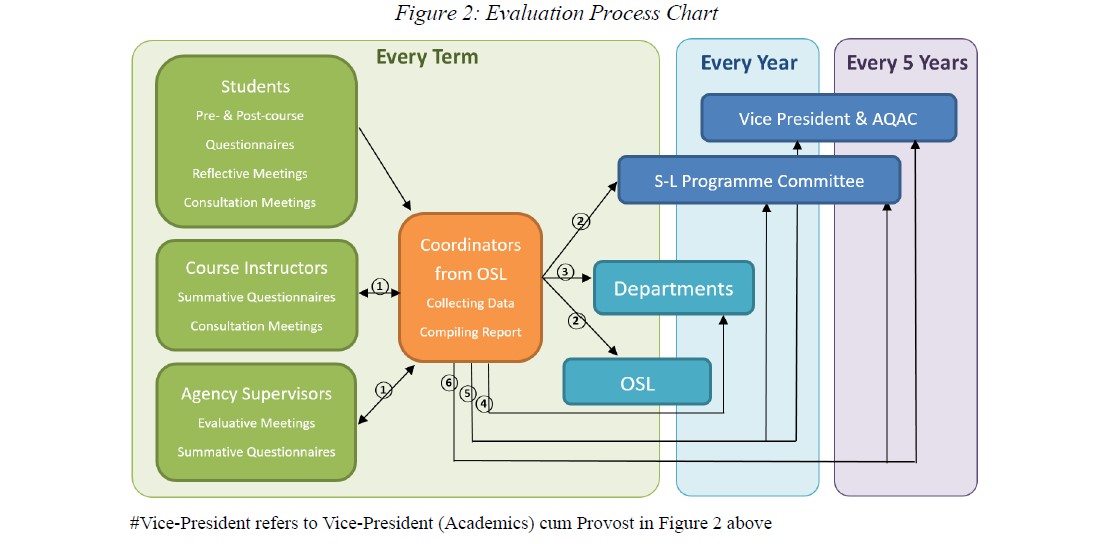
| At the end of each term, the coordinators from OSL collect feedback on the programme implementation from different stakeholders - students, course instructors and agency partners. Their perceptions and interpretations of the learning outcomes and programme effectiveness are obtained through questionnaires and/or focus groups. Based on collected data, three review reports (shown as ① , ② , and ③ in Figure 2) with different foci and coverage will be compiled and shared to the course instructors, agency partners, Departments, OSL as the course providers, and the S-L Programme Committee, respectively, for identifying best practices and future improvement. | |
| Every academic year, as with other units that are similar in nature (e.g. Office of Core Curriculum), the departmental annual programme review (shown as ④ in Figure 2) will be submitted to the Departments. An overall annual programme review report (shown as ⑤ in Figure 2) will be submitted to the S-L Programme Committee, the Vice-President (Academics) cum Provost, and AQAC in order to ensure the quality of the programmes. | |
| Every five years, a five-year programme review document (shown as ⑥ in Figure 2) on the S-L practices at Lingnan University as a whole will be submitted to the S-L Programme Committee, the Vice-President (Academics) cum Provost, and AQAC for overall monitoring and planning. | |
| For relevant practice, please refer to Figure 2 for details | |
 | |
| 13.3.4 | Student Learning and Development Measurement |
| To review student learning outcomes across different courses and departments, the OSL uses a fifteen domain framework to assess students’ performance grouped under the following four conceptual categories: To review student learning outcomes across different courses and departments, the OSL uses a fifteen domain framework to assess students’ performance grouped under the following four conceptual categories: | |
| |
| A set of rubrics has been developed for effectively assessing students’ performance. | |
| Several pre- and post-test questionnaires have been designed to evaluate students’ learning and development. Focus groups interviews are conducted by OSL at the end of each term to gather more in-depth data related to students’ learning experience and outcomes. Additionally, students’ reflective essays and reports are collected to triangulate the data from questionnaires and interviews for internal and future enhancement. | |
| The Business Intelligence (BI) keeps track of student performance records, and provides relevant information for the programme effectiveness review and quality enhancement suggestions. | |
| 13.3.5 | Community Partnership Maintenance and Strengthening |
| A sustainable community partnership among the OSL, academic departments, and community partners is essential for a high-quality S-L course/programme. Criteria for selecting an appropriate agency partner include the following aspects: | |
| 1) Being able to provide sufficient manpower to monitor the S-L experience with the students and course instructors; | |
| 2) Being able to provide 30 training/service hours for students to serve the community based on the proposed service experience; | |
| 3) Being able to jointly identify the community needs and understand the learning objectives of the course(s); | |
| 4) Being willing to serve as a co-educator contributing to student learning and providing guidance to students; and | |
| 5) Being able to take responsibility to maintain students’ health and safety during the SL experience. | |
| In order to maintain a reciprocal community partnership and facilitate the quality enhancement of S-L practice, the collaboration with agency partners will be regularly reviewed by the S-L Programme Committee and Advisory Board. | |
| 13.3.6 | Result and Appeal System |
| In order to fulfill the S-L graduation requirement, students have to: | |
| 1) satisfactorily complete the required S-L experience(s) as confirmed by the course instructor; | |
| 2) submit all relevant S-L documents; and | |
| 3) pass the course. | |
| The Registry will check the progress of each student’s S-L graduation requirement by combining the completion record of S-L project (from OSL) and academic results (from Departments). At the end of each term, students can check the updated record in Degree Works to ensure the fulfilment of the S-L graduation requirement. | |
| Students can appeal against the result by following the University policy and timeframe. | |
| 13.3.7 | Examination and grading of courses offered by OSL |
| The Director of OSL is the approval authority for matters related to examination and grading of courses offered by OSL (such as the issuing of Grade I) in those cases where this role would otherwise be fulfilled by the Head of Department/ Faculty/School Dean/Board of Examiners for courses offered by academic Departments. |
1 This types of course should be approved by either the Director of OSL (for SLP Courses) or by the respective Head of Department/Programme Director.
2 This is based on the updated Organisational Chart of Lingnan University.
Quality Assurance and Enhancement of Service-Learning (PDF)