


Chapter 2 - Quality Assurance and Enhancement, and Management of Existing Programmes
| 2.1 | Overview |
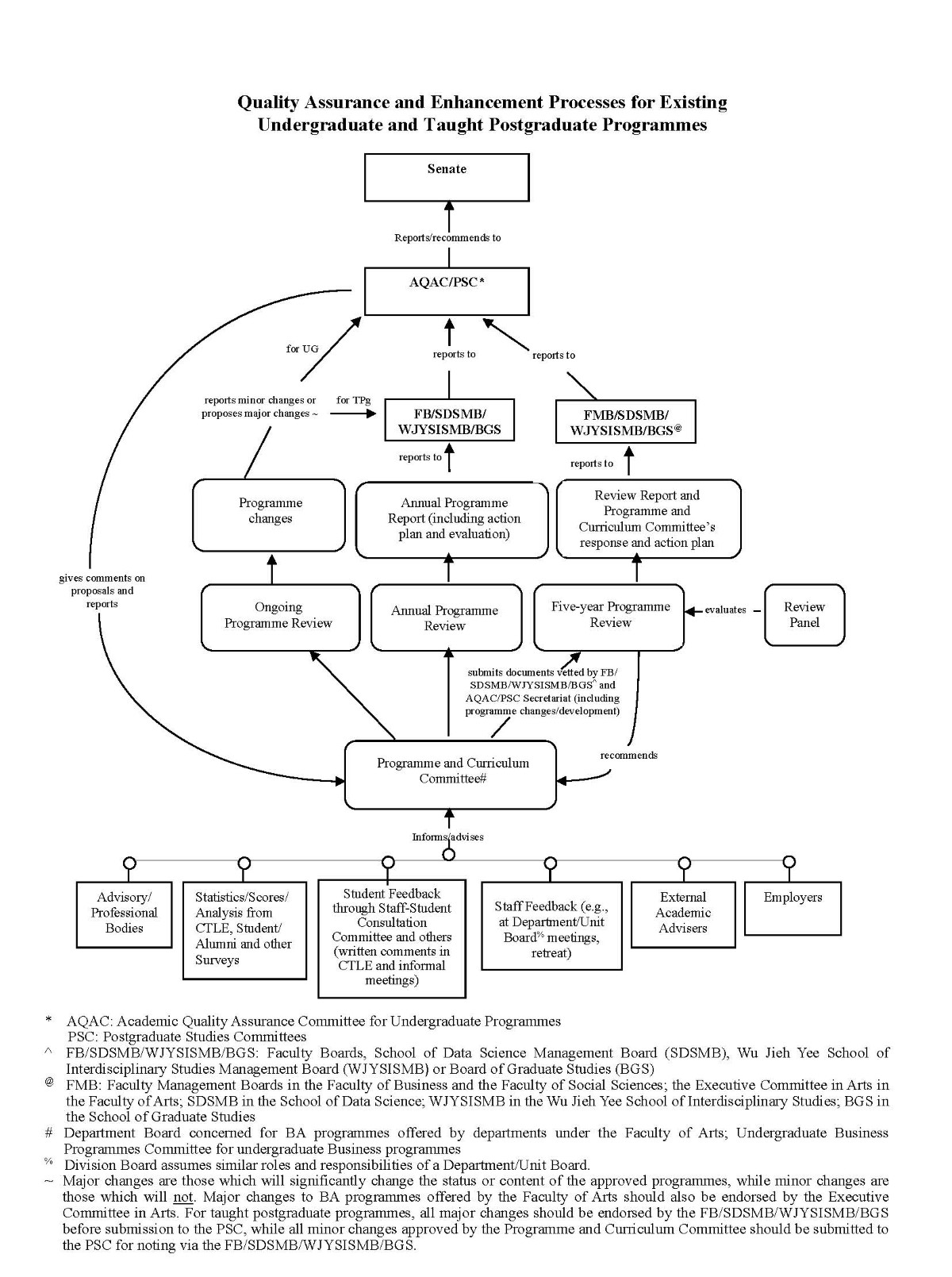
| The quality of undergraduate/postgraduate programmes is underpinned by a quality assurance (QA) and quality enhancement (QE) framework that embraces rigorous monitoring, review and enhancement processes involving structured committees overseeing different areas and at different levels, mechanisms to safeguard and enhance the quality of teaching and learning and student assessment, regular and periodic programme reviews, mechanisms for external advice and benchmarking, collection and analysis of feedback from various stakeholders. The framework is depicted in Figure 1. | |
 | |
| 2.2 | QA and QE Committees |
| 2.2.1 | The Senate, being the supreme academic body of the University, oversees academic quality of degree programmes via its two standing committees, viz. Academic Quality Assurance Committee for Undergraduate Programmes (AQAC) and Postgraduate Studies Committee (PSC), at the undergraduate and postgraduate levels respectively. The AQAC is the key committee which monitors the various levels of teaching and learning quality assurance and enhancement processes and supports the Senate in its decision-making on academic issues. The role of AQAC is to ensure that quality assurance and enhancement mechanisms are in place, and that the processes of evaluation and review are rigorous and sound, and that there is a reasonable degree of consistency across the institution. Adopting most of the guidelines set by the AQAC, the PSC oversees all quality assurance and enhancement matters related to postgraduate programmes. |
| 2.2.2 | Under the AQAC, there is a Sub-Committee on Teaching and Learning (SCTL) which supports the AQAC on formulating and reviewing policies, regulations and guidelines related to the quality assurance and enhancement of teaching, learning and assessment. It also oversees institutional evaluations/surveys on students’ experience of teaching and learning, and schemes and initiatives that support staff to engage in teaching development work (e.g. the Teaching Development Grant), recognise exemplary teaching of staff (e.g. Teaching Excellence Awards Scheme) and enhance teaching and learning quality. |
| 2.2.3 | Furthermore, the Undergraduate Admissions Committee (UAC), a standing committee under the Senate, oversees the formulation of the Regulations Governing Admission to Undergraduate Studies, and the development of admissions strategies for recruitment of quality students. |
| 2.2.4 | In relation to student assessment, the Undergraduate Examinations Board (UEB), a standing committee under the Senate, and the Board of Examiners (BoE) set up for each undergraduate and taught postgraduate programme oversee examination matters and maintain the academic standards of the programme at a level appropriate to the award of the degree. Policies and matters related to assessment for postgraduate programmes are overseen by the PSC. |
| 2.2.5 | While the Faculty Boards have been re-established from the academic year 2019-20 under the three Faculties as standing committees of the Senate to be responsible for the academic standards and quality assurance of the programmes and courses offered by the Faculty concerned, there are also some committees at the Faculty/programme/department levels which report directly to the relevant standing committees of the Senate on matters falling within their terms of reference. More details are given in Section 2.7 regarding management of academic programmes. |
| 2.2.6 | The terms of reference and membership of the Senate and its Standing Committees are detailed in the “Committee-related Information” webpage for public access. |
| 2.3 | Teaching and Learning |
| 2.3.1 | The University has adopted the outcome-based approach to teaching and learning (OBATL) which is central to the teaching and learning framework of the University. For details, please refer to Chapter 3 of this Manual. |
| 2.3.2 | Different measures have been adopted to safeguard the quality of teaching and learning. A system of appraising, promoting and enhancing teaching quality of academic staff is maintained, including the introduction of the ‘Supporting Learning and Teaching@Lingnan’ (SLT@LU) programme, the use of Course Teaching and Learning Evaluation (CTLE), Teaching Excellence Awards Scheme (TEAS) and a wide range of professional development opportunities. To facilitate sharing of good practices on teaching and learning, the documents/examples showing good practices in teaching and learning of undergraduate and taught postgraduate programmes have been placed on the University’s Portal for sharing among colleagues. For details, please refer to Chapter 3 of this Manual. |
| 2.3.3 | Feedback on individual programmes and courses is regularly sought from students, graduates, alumni and employers through various channels such as CTLE, Staff-Student Consultation Committee (SSCC) and surveys for continuous improvement and future planning. Further details are given in Chapter 3. |
| 2.4 | Student Assessment |
| 2.4.1 | The University has established processes and regulations to ensure fair, transparent and effective assessment. Please refer to Chapter 4 of this Manual for details on quality assurance and enhancement of student assessment. |
| 2.5 | Programme Reviews and Changes |
| 2.5.1 | Programme and course changes require the approval or noting by AQAC/PSC and by the Senate where necessary as detailed in Chapter 5 of this Manual. |
| 2.5.2 | Individual programmes need to be reviewed annually to ensure that the Department Board (DB)/Programme and Curriculum Committee (PCC)/Undergraduate Business Programmes Committee (UBPC) systematically analyses pertinent information and identifies areas where modifications are necessary or desirable in order to improve the programme. Further details are given in Chapter 6. |
| 2.5.3 | Each programme is subject to rigorous five-year programme reviews. In response to comments/recommendations given by the reviewers, the programme concerned needs to submit a response including follow-up actions for consideration by the FMB/SDSMB/WJYSISMB/BGS and then the AQAC/PSC. Further details are contained in Chapter 7. |
| 2.5.4 | Existing undergraduate programmes are subject to review as part of the processes in formulating the Planning Exercise Proposal (PEP). Deans will be invited to report on their review of programme provisions in their respective Faculties/Schools and propose three scenarios of student numbers (i.e. expansion, reduction and neutral). The Deans may involve the Faculty Board (FB) concerned/SDSMB/WJYSISMB to review the performance of programmes in the Faculty/School. The review is performed on the basis of the Annual Programme Reports (APRs) and the five-year programme review documents/panel recommendations/responses to the recommendations, with reference to the CEUP (Criteria for Evaluation of UG Programmes) statistical reports and the explanations and actions given on items that fall into the range for special attention in the APRs and the evaluation on meeting the manpower needs of the society in the five-year programme review documents. The AQAC shall advise on Deans’ reports in the light of feedback it receives from annual reports and five-year programme reviews, as well as the evaluation criteria approved by the Senate. The Deans’ reports and the AQAC’s advice will then be submitted to the Task Force on Triennium Planning Exercise (TFTPE) which will make recommendations to the Senate on retention/phasing out of existing undergraduate programmes, and redeployment of student places, if any. |
| 2.6 | External Advice and Benchmarking |
| 2.6.1 | The University attaches great emphasis to benchmarking its academic standards with local, regional and international comparator institutions. Measures have been put in place to solicit external advice and for external benchmarking. |
| 2.6.2 | Each discipline of an undergraduate degree programme normally appoints two External Academic Advisers (EAAs), one local and one non-local, whereas a taught postgraduate programme appoints either one EAA, local or non-local, or two EAAs, one local and one non-local. The non-local EAA (or either local or non-local EAA for taught postgraduate programmes), where possible, shall be from one of the benchmarking institutions of the University or the programme/discipline. The appointment of EAAs is intended to provide an external and impartial check that internal standards are being fairly and consistently applied, and that Lingnan’s standards in terms of the curriculum and assessment are comparable with those similar degree programmes at tertiary level in and outside Hong Kong. Relevant details are given in the Policy on External Academic Advisers of Undergraduate and Taught Postgraduate Programmes in Chapter 8. |
| 2.6.3 | To provide a better understanding of the performance of the University and where it stands in relation to the standards of the comparators, the University identified a cluster of appropriate institutions as its comparators. They are: (a) Ewha Women University of South Korea; (b) International Christian University of Japan, (c) London School of Economics of UK; (d) Pomona College of USA; (e) The University of Durham of UK; (f) Wellesley College of USA; (g) Williams College of USA and (h) Yuanpei College, Peking University of China. |
| 2.6.4 | Academic units also have the flexibility to designate programme level benchmarking institutions as appropriate in alignment with the University’s aspirations and development goals. In the five-year programme review document, relevant academic unit(s) should include a brief self-reflection with reference to the benchmarking performed in the review period with emphasis on results or findings that lead to development objectives and/or improvement to programmes/courses. |
| 2.7 | Management of Academic Programmes |
| 2.7.1 | Host Department(s) |
| A programme is usually based in a department/departments1, designated as the host department/departments, to provide administrative support to the programme, a focus for student interaction, the source of programme information, and easy contact between the Programme Director/Heads of Department(s) and students. The host department(s) will be the department(s) providing the major input to the programme. | |
| 2.7.2 | Programme and Curriculum Management |
| 2.7.2.1 | For BA programmes offered by departments under the Faculty of Arts, the DB of the host department is responsible for the delivery of the degree programme and its curriculum issues, while these responsibilities are taken up by the UBPC for undergraduate business programmes and by the PCC set up for each of the other undergraduate programmes and each taught postgraduate programme. The Core Curriculum Committee (CCC) plays the role of the PCC for the Core Curriculum. A PCC is also set up for English language enhancement (ELE) programme. |
| 2.7.2.2 | A DB2 is chaired by the respective Head of Department, while the UBPC is chaired by the Director of Undergraduate Business Programmes, and the PCC is chaired by the Programme Director/Coordinator concerned. The CCC is chaired by the Director of Core Curriculum. The terms of reference and membership of DBs, UBPC, PCCs and the CCC are available on the websites of respective Faculties/departments/programmes/office. |
| 2.7.2.3 | The PCC/UBPC will be in charge of only programme development and curriculum matters. It has to be responsible, among other things, for the quality of the programme and has to ensure measures are taken to achieve the aims and learning outcomes of the programme. As far as staff and personnel matters are concerned, they are the responsibilities of Heads of Departments. The Programme Director and the Director of Core Curriculum will work closely with the Heads of Departments concerned on course offerings for each year. Further details about quality assurance and enhancement of the Core Curriculum are contained in Chapter 11. |
| 2.7.2.4 | The Dean concerned normally is an ex-officio member of PCC/UBPC. By implication, the Dean will receive minutes of meetings of the PCC/UBPC even if he/she may not be able to attend the meetings in person. This will keep him/her informed of all important academic activities in the programme concerned. |
| 2.7.3 | Programme Director (responsibilities assumed by Department Heads in the case of the BA programmes offered by departments under the Faculty of Arts) | |
| The responsibilities of Programme Directors are: | ||
(a) (b) (c) | liaison with relevant Heads of Departments; coordination of course offerings in consultation with Heads of Departments; programme development and review; | |
| (d) | make appropriate arrangements to assure quality of the programme and ensure measures to achieve programme aims and learning outcomes are implemented properly; | |
(e) (f) (g) (h) | Chair of PCC/UBPC (exceptions will, however, be entertained so as to provide for flexibility); Chair of Board of Examiners, if any; admission of new students; and liaison with Advisory Board. | |
| 2.8 | Quality Assurance and Enhancement of Co-Curricular Education | |
| 2.8.1 | To help students develop the attributes of an ideal Lingnan graduate, the University places strong emphasis not just on students’ academic pursuits but also on co-curricular education that aims to instill in students a sense of civic duty and to cultivate skills, competences, sensibilities that enable graduates to pursue their goals in a rapidly changing environment. A document entitled Quality Assurance and Enhancement for Co-curricular Programmes offered by the Office of Student Affairs that guides the development of co-curricular education offered by the Office of Student Affairs is given in Chapter 12. | |
| ||
| 2.8.2 | Service-Learning is an integral part of the University learning experience. It offers students opportunities to contribute to the well-being of society as a whole, and aims to foster commitment to involvement in and service to the community, develop citizenship skills and knowledge, and cultivate other Lingnan University Graduate Attributes. From the 2016-17 intake, Service-Learning has become a graduation requirement for students under the 4-year system. Details on the quality assurance and enhancement of Service-Learning are given in Chapter 13. | |
| ||
| 2.8.3 | To maximise the international exposure of students and to enhance their inter-cultural experience on campus, efforts have been made including the increase in inbound and outbound student exchange opportunities, the fostering of interaction between non-local and local students and staff, and the promotion of cultural diversity. Chapter 14 gives further details on institutional aspirations for and approach to internationalisation. | |
1 Due to the interdisciplinary nature of programmes under the Wu Jieh Yee School of Interdisciplinary Studies, the programmes are housed under the School. As to the School of Data Science, the programmes are housed under divisions
2 In the School of Data Science, Division Boards take up the same role as Department Boards and are chaired by the Associate Dean who is in charge of the Division, who takes up the role of Department Head.
Quality Assurance and Enhancement, and Management of Existing Programmes (PDF)