


Invitation to the RPg Students’ Research Findings Seminars
12-03-2026
Dear Students and Staff,
We cordially invite you to participate in the Department of Translation Research Postgraduate Students’ Research Findings Seminars. No registration is required. ALL are welcome to join the seminars.
Thank you for your attention.
Kind regards,
Department of Translation
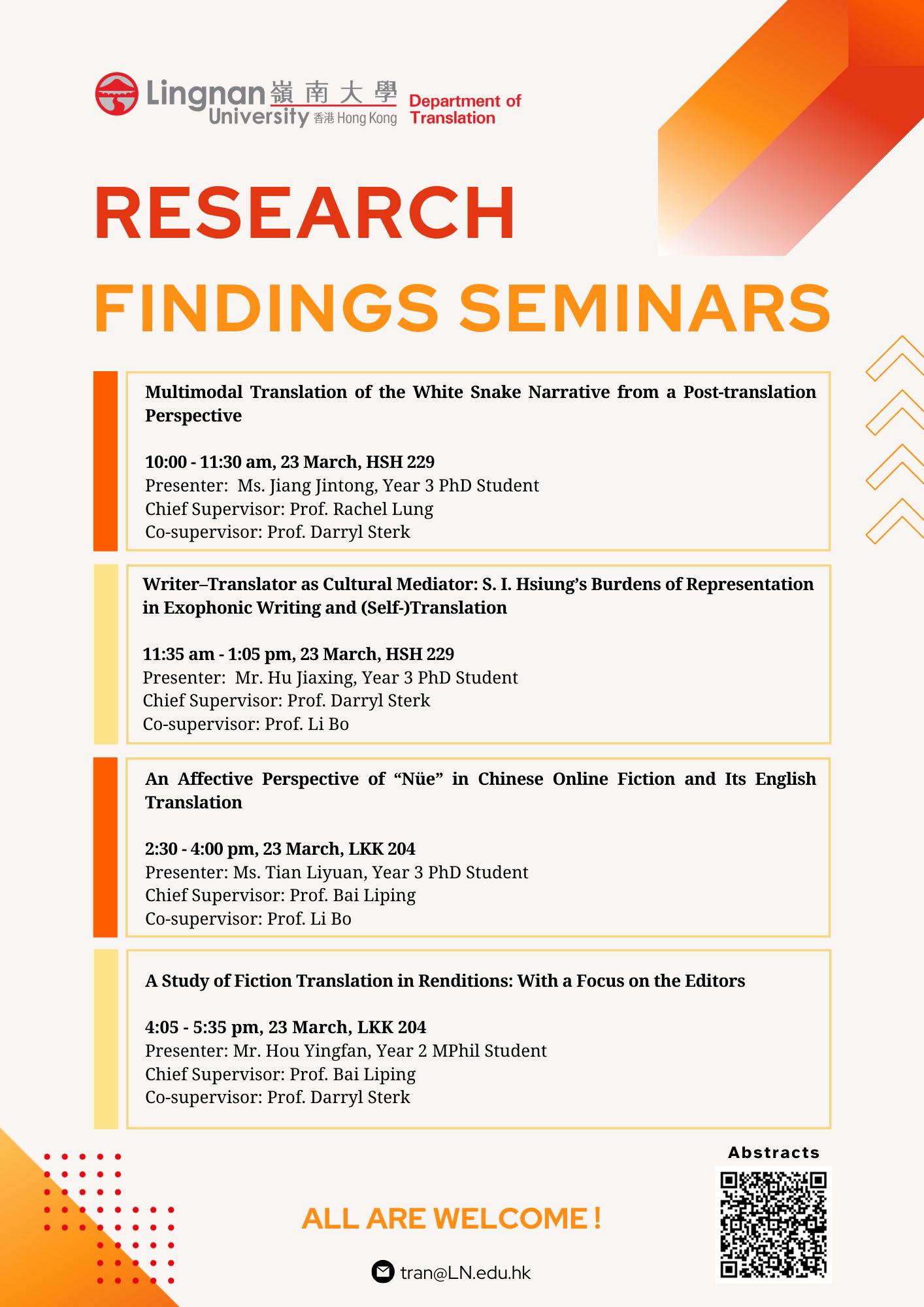
Multimodal Translation of the White Snake Narrative from a Post-translation Perspective
10:00 - 11:30 am, 23 March, HSH 229
Jiang Jintong
Abstract
Recent scholarship on translation has increasingly called for new tools and perspectives to move beyond text-centred and fidelity-based paradigms towards more interdisciplinary, open-ended, and multimodality-oriented approaches.
This thesis investigates the multimodal translation of the White Snake narrative into a trilogy that forms a cinematic universe as a case of post-translation, as this framework allows for an integrated examination of the diachronic formation of the source material, multimodal meaning-making, and subsequent consequences.
Drawing on the post-translation framework, this thesis adopts a threefold analytical structure of pre-translation conditions, translated works and translation processes, and post-translation effects. In the pre-translation phase, this thesis first investigates the major rewritings of the White Snake narrative and traces the diachronic formation, together with historical conditions that gave rise to each rewriting of the tradition by examining both the narrative and semiotic resources accumulated through successive rewritings and the historical conditions that gave rise to them. It then examines the contemporary social, political, cultural, and technological environment prior to the emergence of the White Snake cinematic translation, demonstrating that these conditions function as enabling forces for a modern multimodal translation. In analysing translated works and translation processes, the thesis divides each film into linguistic, visual, and sound subsystems. It approaches the cinematic texts through Systemic Functional Linguistics (SFL), visual grammar, and sound semiotics to examine each mode’s meaning-making functions. It then draws on the concept of storyworld to show how these modes collaborate in shaping the overall storyworld, which in turn structures the audience’s experience of the cinematic translation. The analysis reveals how each mode operates in accordance with its own abstract principles while being contextually realised within a cinematic piece, as well as the comprehensive effects achieved through multimodal coordination. In the phase of post-translation effects, this thesis unravels the short-term reception of the trilogy by looking at its industrial and institutional responses, along with the officially mediated and general audience reviews. It then examines the long-term effects by capturing the reactivation and reordering within the White Snake corpus and in the broader cultural context. Through a qualitative and discourse-oriented methodology, this thesis demonstrates how new translations extend beyond the narrative tradition into lived reality. Besides, it shows how the post-translation effects establish an embodied dimention by linking personal experience with nation-state identity.
This study is original in operationalising the post-translation perspective by combing it with multimodal analysis and narratology. It also sheds light on how translation, as a constitutive force underlying culture, exerts transformative aesthetic, ideological, and socio-economic effects.
Writer–Translator as Cultural Mediator: S. I. Hsiung’s Burdens of Representation in Exophonic Writing and (Self-)Translation
11:35 am - 1:05 pm, 23 March, HSH 229
Hu Jiaxing
Abstract
This thesis examines S. I. Hsiung, a prominent twentieth-century dramatist, writer, and translator. It combines Hsiung’s exophonic writing and self-translation through which he represented Chineseness, thereby bearing burdens of representation. By framing Hsiung as a cultural mediator, this thesis argues that Hsiung faced conflicting expectations: Western editors and audiences expected an accessible, exoticized but “authentic” performance of Chinese culture, while compatriots demanded a faithful and positive national representation. Moreover, working under exile or immigrant conditions and in a non-native language made the burdens all the harder to bear; outsiders like Hsiung are compelled to grapple with unbalanced power dynamics and structures. Consequently, cultural mediators like Hsiung must carefully curate their self-profiles and creative outputs to negotiate these competing demands.
Hsiung’s exophonic writing and self-translation provide an illuminating case for examining the burdens facing cultural mediators as they produce, promote, and transfer cultural products. Arguably the first playwright to write or adapt Chinese theatre directly in English and the first to direct plays on London’s West End and New York’s Broadway, Hsiung to some degree defined what constituted “authentic” Chinese theatre in the West through his most successful work, Lady Precious Stream. A “translation” of the many versions of Chinese opera “紅鬃烈馬” (“The Red-Maned Steed”) that Hsiung had memorised, Lady Precious Stream had no single original source, but was framed and advertised as a faithful translation of classic Chinese theatre for Western audiences. While many studies acknowledge its success and pioneering significance, some argue that Hsiung’s achievement relied largely on self-orientalism and catering to Western taste for chinoiserie. Drawing on multi-source archival materials, this thesis argues that Hsiung’s role was largely that of a puppet director, a symbolic figure whose presence guaranteed the play’s perceived authenticity. Working within constraints, he struggled to balance exotic appeal with undistorted Chineseness.
When Hsiung relocated to Hong Kong in the 1950s, he faced new burdens in renegotiating and repurposing his international reputation and experiences within the local context. Through self-translation, Hsiung attempted to reconstruct the Chineseness in Lady Precious Stream that had been orientalised and filtered through chinoiserie aesthetics. However, despite being a more polished and streamlined version, Hsiung’s self-translation failed both commercially and critically. Audiences steeped in Chinese opera traditions still dismissed it as a foreignized play and thus did not see it as able to compete with genuine Chinese theatre. This failure suggests that Hsiung’s burden of representation had shifted: it was no longer primarily a struggle over the authenticity of Chineseness, but rather a process of identity building as a Chinese-language writer within the Sinophone context.
Hsiung’s career and his strategic reworkings of Lady Precious Stream illustrates the multiple burdens of representation borne by cultural mediators. This thesis argues that while exophonic writing and self-translation granted Hsiung access to different literary arenas, they also imposed significant constraints and challenges. Ultimately, in addition to a nuanced observation of Hsiung, this study contributes to a deeper understanding of cultural mediators who attempt to negotiate the multiple burdens of representation.
An Affective Perspective of “Nüe” in Chinese Online Fiction and Its English Translation
2:30 - 4:00 pm, 23 March, LKK 204
Tian Liyuan
Abstract
This research investigates the translation of Chinese online fiction through the lens of affect theory, specifically focusing on the complex phenomenon of “Nüe.” Defined as a reader-perceived affective experience of suffering, “Nüe” is situated in this study as a paradoxical affective engine and narrative precondition that drives the potential canonization of Chinese online fiction. This thesis explores how “Nüe” functions as a dynamic system of energy transformation across the entire translation ecology. A composite framework is developed by integrating affect theory as the foundational layer, utilizing sympathy, empathy, and identification as the realization path, and adopting embodied cognition theory as the validation standard. This synergy allows for tracing the pre-cognitive intensities of “Nüe” alongside its culturally coded emotional structures. Adopting a mixed-methods approach, the research triangulates Netnography and autoethnography to discover affective phenomena, qualitative close reading to analyze textual nuances, and corpus linguistics for generalizable validation.
The analysis spans the translation process through a four-stage examination to demonstrate how “Nüe” functions within a dynamic affective cycle. In the pre-translation stage, the study examines the accumulation of virtual intensity and the differentiation of intervention impulse under platform mechanisms, establishing whether the translation is driven by affective overflow or affective debt. During the translating stage, the research focuses on the actualization of the affective contract within the translator’s creative space, transforming intangible intensities into tangible source texts and target texts. This is followed by a textual analysis of the translations that examines how “Nüe” is reproduced through specific textual carriers, including highlight sentences that encapsulate intense affect and possess the potential for memetic dissemination even when detached from their original context, as well as high-affect plots that serve as iconic scenes of suffering. Finally, the post-translating stage analyzes the socialization and interactive maintenance of the text in open environments, which serves both to maintain published content and guide future translation strategies. By mapping these transformations, the study argues that the translation of Chinese online fiction constitutes a continuous affective cycle that facilitates a spiral progression from mere textual production to broader discursive production, highlighting the value of an integrated methodology for understanding the symbiotic “call and response” relationship inherent in the translation continuum.
A Study of Fiction Translation in Renditions: With a Focus on the Editors
4:05 - 5:35 pm, 23 March, LKK 204
Hou Yingfan
Abstract
Since its founding in Hong Kong in 1973, Renditions has become an important literary journal devoted to the translation of Chinese literature for international readers. Through its long-term publication and operation from 1973 to 2024, the journal has developed distinctive translation principles and editorial policies shaped by its institutional setting and successive editorial leadership. This sustained development makes Renditions a valuable case for examining how translation is articulated and shaped within an ongoing institutional framework.
Existing scholarship has explored the journal’s institutional positioning, dissemination strategies, special issues, and the translation of particular authors or genres. However, less attention has been devoted to the relationship between editors’ articulated translation principles and the translation practices carried out under their supervision. In addition, literary editing research has largely focused on monolingual contexts and individual editors and has seldom addressed translation-based journals in which editorial mediation operates across linguistic and cultural boundaries. Against this backdrop, the present study turns to a more systematic examination of translation principles and editorial practice in Renditions.
Focusing on fiction translation, this thesis examines the translation principles and editorial policies articulated by four editors-in-chief, George Kao, John Minford, Eva Hung, and Theodore Huters, and considers how these principles and policies were reflected in representative translated works. It also investigates whether these principles and policies underwent change across successive editorial tenures. Adopting a qualitative and text-centered approach, the study reconstructs editors’ stated positions through systematic reading of Editor’s Pages and other related paratexts and evaluates editors’ corresponding translation practices through textual analysis. The thesis then conducts a comparative diachronic examination of the translation principles and editorial policies across successive editorial periods to identify patterns of continuity and changes.
In terms of the findings, the study reconstructs the translation principles and editorial policies of the four editors-in-chief and shows that their translation practices largely correspond to their declared positions. A diachronic comparison further reveals shifts in translation principles and editorial policies across successive editorial tenures. Through the analysis of the successive editorial periods in Renditions, this study provides a detailed account of the overall translation principles and editorial policies that have shaped Renditions throughout its long-term publication and development.