


9 OCT 2024
HK School Children Happiness has Risen Slightly But the Sense that Life is Worth Living has Declined to a New Low
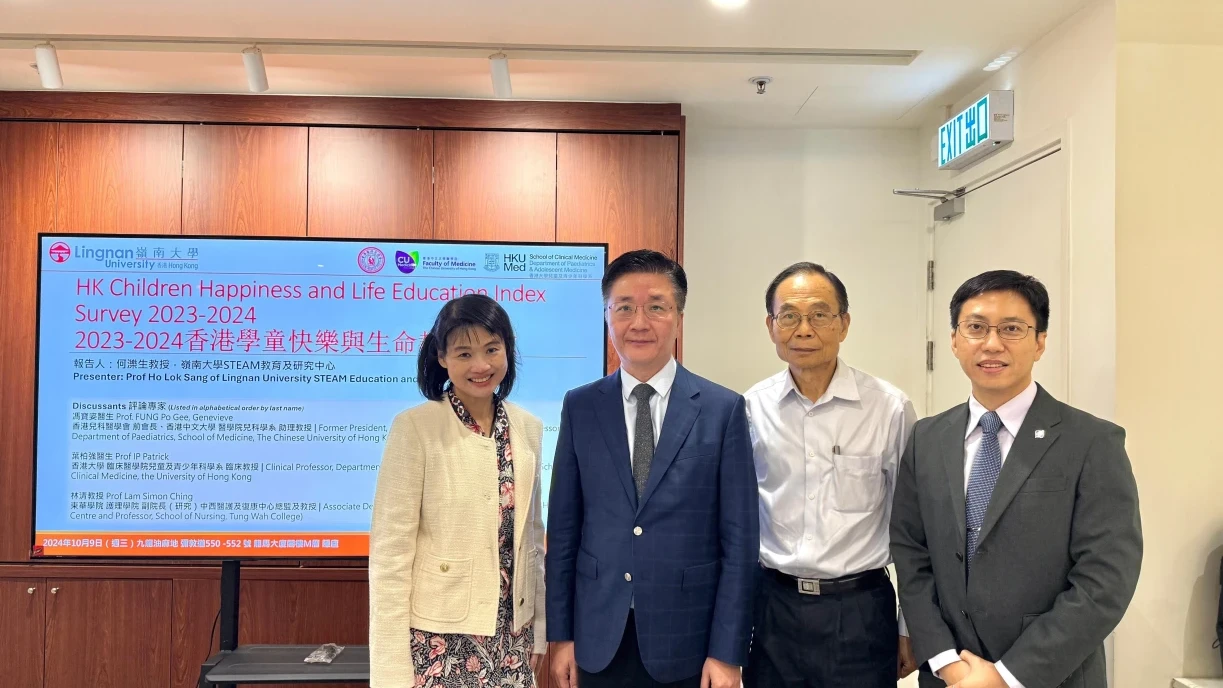
Lingnan University was commissioned to conduct a Hong Kong School Children Happiness Annual Survey in 2012. In 2017/18 this annual study was augmented by including a survey on life education in schools. Since last year, the Lingnan team was joined by the Department of Paediatrics and Adolescent Medicine of the University of HK, the Department of Paediatrics of the Chinese University of HK, and the HK Paediatric Society. The 2023/2024 study began with an invitation sent to all HK’s subvented schools in March 2023. We enlisted a total of 9 primary schools and 10 secondary schools in this study, covering 1503 primary school students, 2033 secondary school students, and 152 teachers.
The HK school children index is compiled using Primary 4 to Primary 6 and Form 1 to Form 3 students. Form 4 and Form 5 data are not included in the index but are included in some analyses and in a confidential, tailor-made school report for each school’s reference. This index is compiled by averaging the indices for different grades and then averaging across grades. It shows a small rise from 6.62 to 6.75 on the 0 to 10 scale. However, a worrying finding is that this year Hong Kong school children’s assessment of “Life is worth living” has fallen to the lowest since 2017. At 6.74, this index is 0.53 points from the high of 7.27 in 2017.
It is noteworthy that the School LIFE Education Index, which reflects the intensity of school activities in promoting the 4 LIFE mental capitals Love, Insight, Fortitude, and Engagement, fell significantly from last year’s 3.92 to this year’s 3.65, for a decline of 7.03%. All grades from Primary 4 to Secondary 4 registered large declines. Along with this decline, there is a significant increase in campus bullying and a significant decline in campus happiness at 2.43%. The No Bullying Index declined 2.75%, with a stark decline at 5.21% and 4.02 % in Primary 5 and Primary 6 respectively. About 1 in 4 students in Primary 4 and 5 reported having been bullied verbally and or physically. Although physical bullying is less prevalent than verbal bullying, it must not be assumed that verbal bullying is less harmful because it may diminish a person’s sense of self-worth. Campus happiness index fell for all grades from Primary 4 to Secondary 3, from 3.82 to 3.73 for a decline of 2.43 %. Happily, Secondary 4 and 5 saw the campus happiness index rising by an average of 2.5%. Coincidentally, the LIFE education scope index rose noticeably in these senior classes which also exceptionally showed noticeable increases in LIFE mental capitals.
Love mental capital has fallen sharply especially in primary schools. While Insight mental capital has held its place, it is nevertheless at a rather low level of 3.56 on the 1 to 5 scale. Fortitude and Engagement also recorded noticeable declines. The Family LIFE education index and the family happiness index among primary school students have also fallen. Encouraging is the fact that families with children in senior high schools are generally happier, along with stronger Family LIFE education index, even though the level of family happiness index is lower.
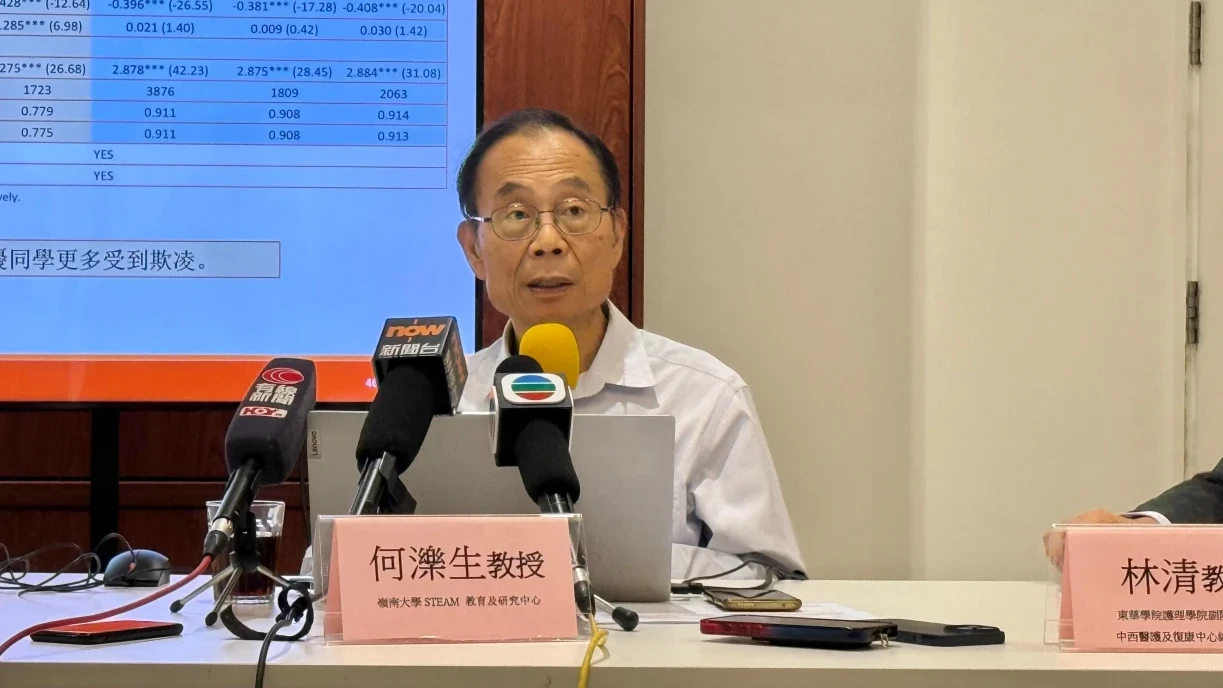
Regression analysis shows that LIFE education significantly benefits happiness and a student’s sense of self-worth, and is associated with less bullying. Pressures, whether from study or from activities, undermine Happiness and a student’s sense of Life is worth living. Our findings suggest students under a lot of study pressures are more likely to be bullied, while LIFE education tends to reduce these effects. Pressures from activities are associated with less bullying. The statistical goodness of fit is much higher, and estimated coefficients are also bigger, for verbal bullying than for physical bullying; and for boys than for girls. (slides 40-41)
Hong Kong students are generally happier and find life more worth living than their counterparts in Shenzhen. The respective indices for Life Worth Living for HK and for Shenzhen are respectively 6.74 and 4.42. However, strangely Shenzhen students reported higher LIFE education index (both School and Family Indices) and stronger LIFE mental capital. Moreover, regression results shows that the Life Worth Living Index in Shenzhen is even more strongly associated with LIFE education than in Hong Kong.
Finally, Hong Kong students appear to face stronger study pressures and activity pressures than their Shenzhen counterparts. Like Hong Kong, Shenzhen students find pressures from study or from activities a drag on happiness, but the effects are also far smaller.