


Bachelor of Arts (Honours) in Interlingual Communication and Language Technology

Programme Overview
The Bachelor of Arts (Honours) in Interlingual Communication and Language Technology trains bilingual professionals for a language industry being reshaped by AI. Students develop four core competencies: bilingual writing, oral communication, intercultural understanding, and language technology.
Translation and writing courses span academic, creative and professional genres. Public speaking training teaches students to present ideas clearly, engage different audiences, and adapt their message to the setting. Intercultural coursework builds the ability to work across cultures — a skill at the heart of translation and increasingly of every workplace. Throughout the programme, students work hands-on with AI-assisted language tools, learning where these tools help, where they fail, and how a skilled human adds value.
Programme Highlights
Core courses — Introduction to Communication and Translation and Introduction to Translation Studies — lay the conceptual foundation; courses in Chinese-English translation and interpreting build the practical skills employers expect.
From the second year, students choose one of two concentrations:
- Concentration A: Translation and Cross-cultural Communication
- Concentration B: AI and Digital Corporate Communication
The concentrations reflect where the language services industry is heading, and let students shape the degree around their own interests and career plans. Graduates leave with bilingual expertise, cultural awareness and the critical judgement to operate in complex, global communication environments, from the classroom to the boardroom.
Career Opportunities for Graduates
Hong Kong's biliterate, trilingual environment and sustained demand for cross-linguistic communication and localisation across Greater China and international markets give our graduates a wide choice of careers. Alongside translation and interpreting, recent alumni have gone into public and corporate administration, corporate communication, copywriting, media and journalism, marketing, public relations, human resources, academic research, and, last but not least, teaching. What they share is professional-grade language skill combined with critical thinking and cross-cultural communication — a combination that transfers across sectors.

Programme Structure
Academic courses will prepare you for postgraduate studies, if you want to go that route, while practical courses will prepare you for the job market and for life.
Students have to take compulsory courses within the first 4 years.
| Course Code | Course Name | Credits |
|---|---|---|
| TRA2001 | Introduction to Computer-aided Translation | 3 |
| TRA2101 * | Introduction to Cantonese-English Interpreting | 3 |
| TRA2102 | Introduction to English-Cantonese Interpreting | 3 |
| TRA2108 | Introduction to Communication and Translation | 3 |
| TRA3001 | Chinese Writing Workshop for Translators | 3 |
| TRA3203 | Introduction to Translation Studies | 3 |
| TRA3227 | English Writing Workshop for Translators | 3 |
| TRA4319~ TRA4320~ TRA4325~ | Translation Project (E-C) or Translation Project (C-E) or Translation Studies Research Project / Corporate Communication Project | 6 |
(Total 7 courses, 21 credits, to be taken from Years 2 to 4)
Students need to take at least 5 out of the 7 programme electives in one of the two concentrations (Concentration A: Cross-cultural Communication; Concentration B: Digital Corporate Communication) in order to fulfil the concentration requirement. Students have to take courses from both concentrations.
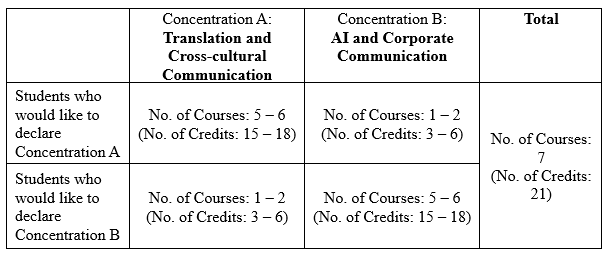
Concentration A: Translation and Cross-cultural Communication
| Course Code | Course Name | Credits |
|---|---|---|
| TRA2105 | The Sound of Language: Phonetics and Phonology | 3 |
| TRA2106 | The Structure of Language: Morphology and Syntax | 3 |
| TRA3002 | English through Subtitles | 3 |
| TRA3107 | Literature, Culture and Translation | 3 |
| TRA3204 | Translation Criticism in Digital Age | 3 |
| TRA3205 | Literary Translation | 3 |
| TRA3214 | Bilingual Communication Workshop | 3 |
| TRA3217 | Translating Cultures | 3 |
| TRA3221 | Topics in Bilingual Studies: Love in Chinese and Western Literatures | 3 |
| TRA3224 # | Introduction to Putonghua and English Interpreting | 3 |
| TRA3228 | Liaison Interpreting | 3 |
| TRA3238 | Cross-cultural Perspectives in Film: Thematic Comparisons | 3 |
| TRA3241 | Studies on Translators | 3 |
| TRA3242 | Translation and Sino-Western Cultural Exchange | 3 |
| TRA3244 | Translating Travel Literature | 3 |
| TRA4303 | Research and Writing | 3 |
| TRA4307 | Gender, Language and Translation | 3 |
| TRA4308 | History of Translation | 3 |
| TRA4329 | World Literature and Translation | 3 |
Concentration B: AI and Corporate Communication
| Course Code | Course Name | Credits |
|---|---|---|
| TRA2107 | Digital and Audiovisual Translation | 3 |
| TRA3208 | Digital Media Translation | 3 |
| TRA3209 | Bilingual Communication in Popular Culture | 3 |
| TRA3211 | Digital Translation in Creative Industries | 3 |
| TRA3213 | Bilingual Digital Publication Workshop | 3 |
| TRA3218 | Translation in the Hong Kong Context | 3 |
| TRA3222 | Business Writing Skills and Translation | 3 |
| TRA3223 | Financial Translation | 3 |
| TRA3239 | Corporate Communication and Translation | 3 |
| TRA3240 | Digital Marketing and Content Creation with AI | 3 |
| TRA3243 | Translation and AI Industries | 3 |
| TRA4310 | Translation for Science and Technology | 3 |
| TRA4326 | Conference Interpreting | 3 |
| TRA4327 | Eco-translation | 3 |
| TRA4328 | Translation of Court Documents | 3 |
Note:
* Students with insufficient proficiency in Cantonese may substitute the course with an alternative course, TRA3224 Introduction to Putonghua and English Interpreting. Details regarding this option will be disseminated in the email about Academic Advising, which is sent each February.
@ Students who have taken TRA4301 Advanced Interpreting (C-E) or TRA4302 Advanced Interpreting (E-C) are not allowed to take this course.
^^ Students who have taken TRA4323 Legal Translation (C-E) and TRA4324 Legal Translation (E-C) are not allowed to take this course.
# This course can be taken by mainland students whose mother tongue is not Cantonese as a core interpreting course in replacement of TRA2101.

We are grateful to Phrase for giving us free access to their platform, which is one of the Computer-aided Translation tools we use in our teaching.