

Master of Science in Smart City Technologies and Applications (MScSCTA)


The Master of Science in Smart City Technologies and Applications (MScSCTA) Programme is offered and managed by the Division of Industrial Data Science, School of Data Science, Lingnan University. The normal duration for this programme is one year full-time and the maximum period of study is three years. Lingnan University enjoys a strong international academic reputation and has performed excellently in various global university rankings, placing among leading institutions worldwide. For example:
Top1
10 th
10 th
10 th
10 -100
100 st
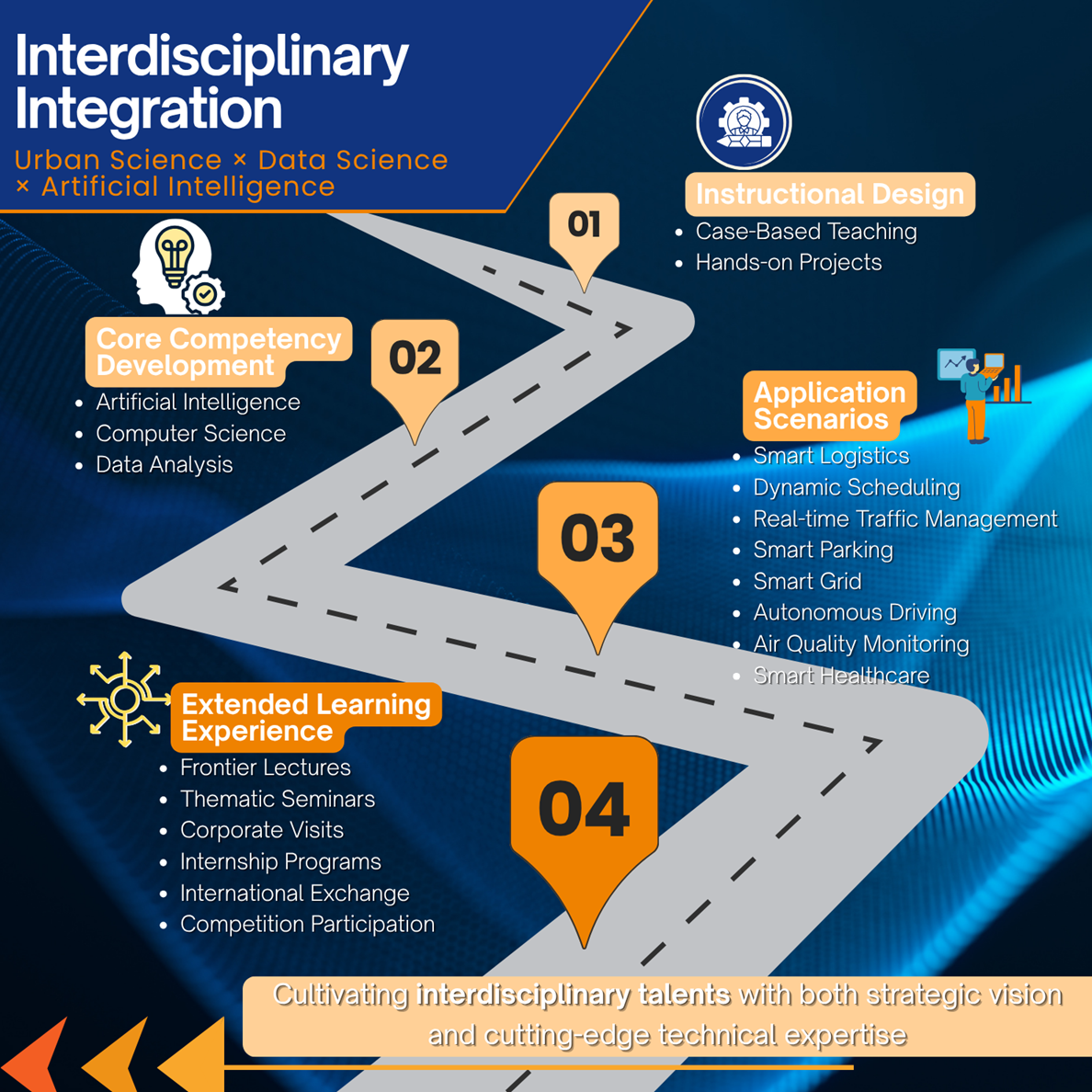
In addition, student will benefit from our regularly organized academic activities, cutting-edge seminars, workshops, and corporate visits, students will gain firsthand exposure to the industry and connect closely with top professionals, ensuring a seamless transition into their careers.
- Operational Research
- Foundation of Artificial Intelligence
- Introduction to Smart Cities
- Smart City Project
- Urban Data Science and Analytics
- Smart Connectivity and Fusion
- Smart Logistics
- Practical Application of Deep Learning
- Game Artificial Intelligence
- Blockchain-driven Applications
- Programming for Data Science
- Big Data Analytics
- Strategic Visual Data Analytics
- Healthcare Analytics
- Mobile Edge Computing
- Sensing the City
- Urban Design
- 3D Modelling and Animation
- Urban Computing and Spatio-Temporal Analytics
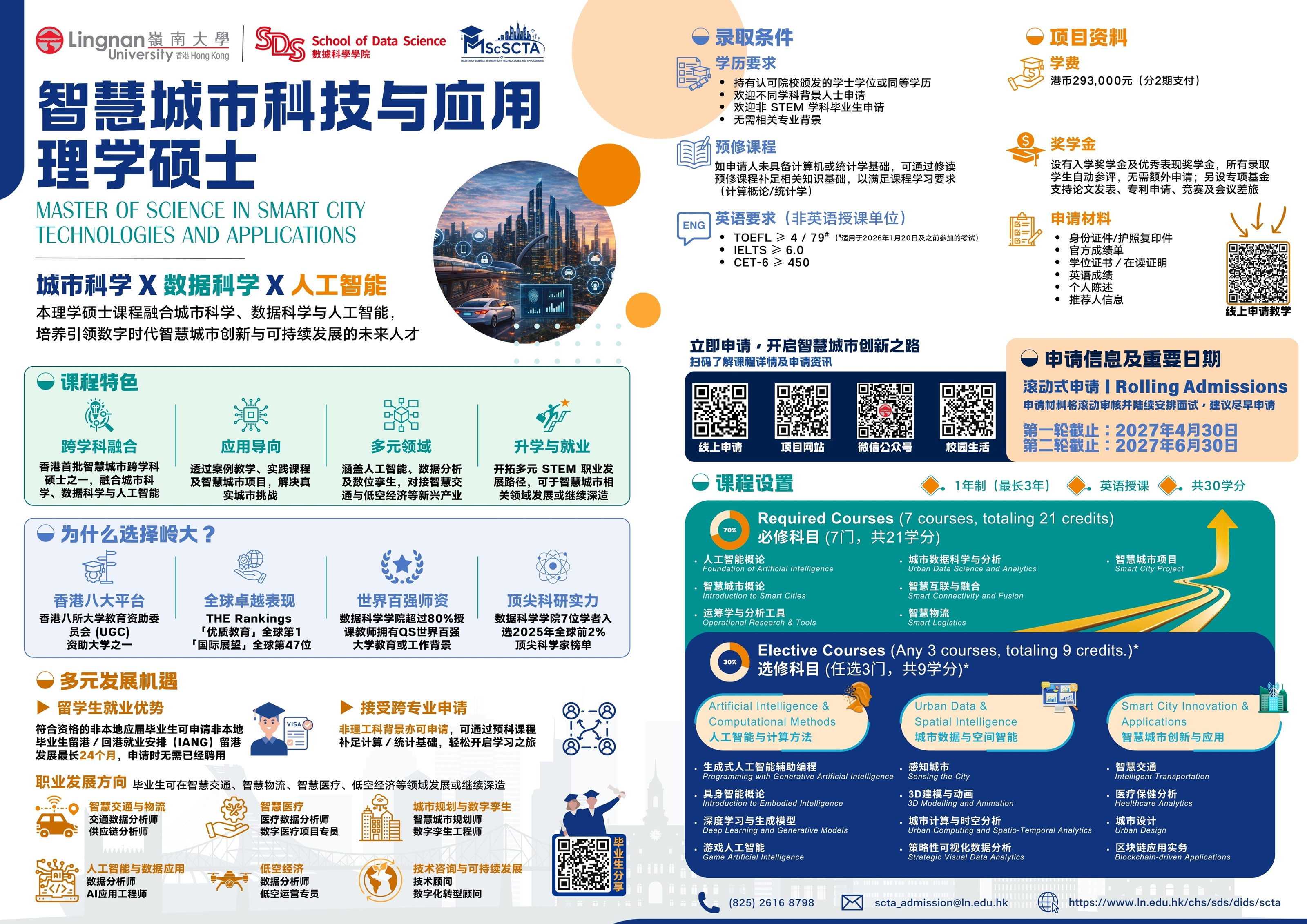
Please click the image below to view the programme leaflet, and gain an in-depth understanding of the curriculum structure, training objectives, and future career prospects.
We’re Here to Answer Your Questions

Q1: I don’t have an engineering or IT background — will I fall behind? What kind of applicants tend to stand out in this programme?
Not at all. Even without an engineering or IT background, you can confidently succeed in this programme. Our curriculum is centred on urban challenges, not technical training, and is intentionally designed for students from diverse backgrounds. Whether your undergraduate studies are in science, engineering, business, social sciences, or the arts, you will be able to integrate smoothly into the programme. You will start by building a shared foundation in concepts and analytical approaches. Assessment focuses on the ability to understand and apply cutting-edge technologies—such as AI and digital twins—to solve concrete, industry-specific urban challenges like smart logistics, real-time traffic management, and healthcare. Whatever your background, our rich academic and industry resources will empower you to bridge the gap, helping you stand out as a high-level talent with both strategic vision and technical application capabilities.
We are not simply looking for the “strongest” background, but for applicants who demonstrate the following qualities:
- Ability to clearly articulate and define problems
- Willingness to reflect on gaps and continuously learn
- Openness to interdisciplinary collaboration and communication
- Interest in understanding institutions and real-world constraints
Applicants with these qualities tend to thrive in the programme and are better positioned to create meaningful impact in complex real-world contexts.

Q2: What are the English language requirements for applicants?
Regarding English requirements, the programme is taught in English. Applicants are only required to meet the basic admission requirements (e.g., IELTS (Academic) 6.0 or above, TOEFL 79 or above, CET-6 score of 450 or above, or equivalent qualifications). These requirements are sufficient for successful participation in the programme.

Q3: I’m most concerned about career and further study—does a “problem-driven” approach really help?
Yes—and it is increasingly essential. The key strength of a problem-driven approach is its transferability. Whether you pursue a career in the public sector, urban technology firms, consulting, research, or further study, success depends on your ability to clearly define problems, develop complete solutions, and manage risks effectively. These capabilities not only help you adapt quickly across roles, but also enable you to clearly communicate your value and direction to employers and academic institutions.

Q4: The programme sounds highly interdisciplinary—will it be too broad and make it harder to position myself after graduation? What types of roles can I apply for?
Our interdisciplinary approach is not about being unfocused—it is about being strategically focused. Rather than confining you to a fixed job title from the start, we equip you with transferable core capabilities: defining problems, connecting technology with governance, and designing practical, implementable solutions. By graduation, you will be able to clearly articulate the types of urban challenges you can address—something far more compelling to employers than simply listing technical skills.
Upon graduation, you will be prepared for a wide range of career paths—particularly at the intersection of cities, policy, and technology. Examples include:
- Roles in urban-related companies (e.g. smart city / urban tech)
- Positions in public administration
- Consulting, strategy, and research roles
- Work related to data governance, platforms, or digital transformation
The programme’s emphasis on problem-driven and interdisciplinary capabilities will enable you to move across roles with agility and create meaningful impact in complex environments.

Q5: Where do the “urban problems” in the programme come from? Will there be many group projects? What if team members have very different backgrounds?
The "urban problems" focused on in this programme are directly aligned with the real-world, urgent demands for industry transformation and smart upgrading. We delve into complex challenges across critical domains such as public safety, healthcare, infrastructure, and energy management. These are translated into concrete application scenarios, including smart logistics, dynamic scheduling, real-time traffic management, smart parking, smart grids, autonomous vehicles, air quality monitoring, and smart healthcare. Rather than staying at abstract concepts, you will learn to deeply integrate cutting-edge technologies—such as AI, computer science, and mathematics—with these specific industries. Through case studies and hands-on projects, you will progressively build data-driven, practical solutions with high technical viability.
The programme includes a meaningful amount of collaborative, interdisciplinary work—by design. Real urban challenges require input from diverse fields, so you will learn how to divide roles effectively, integrate different perspectives, and communicate complex ideas clearly. Diverse team backgrounds are not a barrier, but an advantage—helping you strengthen your collaboration, communication, and integrative decision-making skills.

Q6: Will this approach make me learn a bit of everything, but not gain enough depth? What if I want to move into a more technical path later?
Not at all. The programme is not about learning a little of everything, but about developing deep methodological capabilities—including how to define problems, evaluate solutions, and make decisions under real-world constraints.
Rather than replacing technical training, the programme helps you understand the role of technology in urban contexts. If you choose to pursue a more technical path later, these capabilities will enable you to apply technical skills more effectively in complex, real-world situations—and create greater impact.

Q7: What if I’m not sure about my direction yet—is this programme suitable for me?
It depends. If you have no interest at all in solving "urban problems"—specifically, the deep integration of cutting-edge technology with industry domains like smart logistics, real-time traffic management, smart healthcare, and smart grids—this programme may not be the right fit. However, if you are simply unsure about your specific career path, this programme can actually help you develop a clear direction by focusing on these complex urban challenges. Through our hands-on projects, you will progressively discover the tech-driven career path that suits you best.

Explore Curriculum & Future Pathways

What Will You Learn?
Discover key knowledge and practical skills

Programme Brochure (AY2027-28)

Meet Our Faculty

School Life & Student Sharing

Career Prospects

Admission Requirements
Start Your Journey