


26 SEP 2025
HK School Children Happiness & Life Worth Living Indices rise slightly amid a rise in LIFE Education in 2024/25
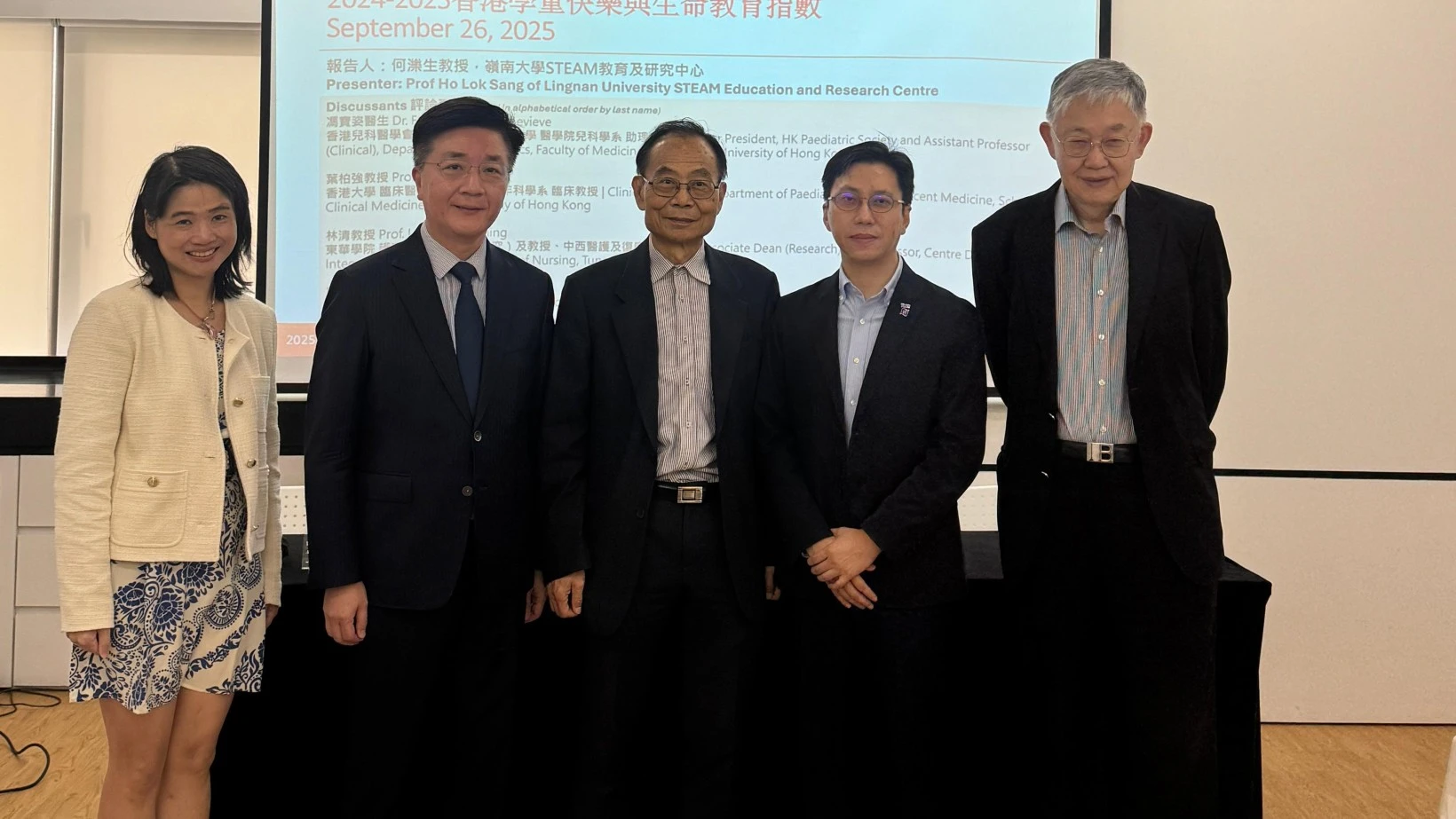
HK School Children Happiness & Life Worth Living Indices rise slightly amid a rise in LIFE Education in 2024/25. (From left: Prof Genevieve Fung Po-gee, Prof Patrick Ip, Prof Ho Lok-sang, Prof Simon Lam Ching, Mr Shih Wing-ching.)
Lingnan University was commissioned to conduct an annual Hong Kong School Children Happiness Annual Survey in 2012. In 2017/18, a survey on life education in schools was added, and in 2023 the Lingnan team was joined by teams from the Department of Paediatrics and Adolescent Medicine of the University of Hong Kong, the Department of Paediatrics of the Chinese University of Hong Kong, and the Hong Kong Paediatric Society. The 2024/2025 study began with an invitation to all Hong Kong’s subsidised schools in March 2023. Ten primary schools and eight secondary schools took part in this study, which involved 1,752 primary school students, 1,982 secondary school students, and 116 teachers.
The HK school children index is compiled from Primary 4 to Primary 6, and Form 1 to Form 3 students. Form 4 and Form 5 data are not included, but schools may ask to have these grades too. Results are included in some analyses and in the confidential, individual school report for each school’s reference. The indices average different grades and across grades, and show a small rise from 6.75 to 6.85, a three-year high on the 0 to 10 scale. Even more encouraging is that the Life Worth Living Index has risen to 6.90, a four-year high, significantly up from 6.74 the previous year.
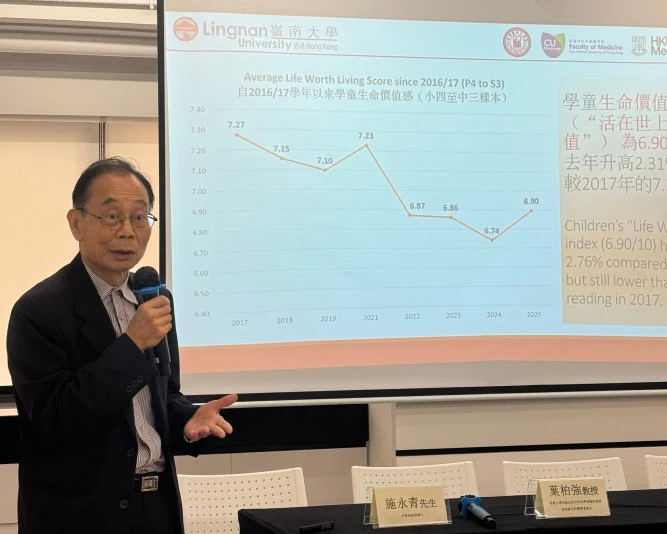
Prof Ho Lok-sang from the STEAM Education and Research Centre of Lingnan University said that it is worthy of note that the School LIFE Education Index, which reflects school activities supporting the four LIFE capitals Love, Insight, Fortitude, and Engagement, fell substantially last year in primary schools, but rose in general in secondary schools. The decline is especially serious in Primary 6, where the index fell by 6.2 per cent. This may have something to do with the cancellation of classes, and perhaps some schools closing. An alternative index, the LIFE Education Scope Index, which measures the percentage of responses agreeing or very much agreeing with five categories of activities organised by schools to promote LIFE, shows a similar pattern, with increases all round except in primary schools.
The No Bullying Index (3.72/5) rose by 0.9 per cent in 2024/2025 after dropping in 2023/2024. The only grade that fell (deteriorated) is Primary 6. The incidence of verbal bullying (23 per cent-29 per cent), is higher than that of physical bullying (20 per cent-25 per cent), and as many as 25.4 per cent of students in P6 reported having been physically bullied, while 28.7 per cent reported verbal bullying. For secondary school students, the incidence of physical bullying ranges from 13.5 per cent to 17.9 per cent, but the incidence of verbal bullying is lower, at 15 per cent to 20.1 per cent.
School happiness generally improves in 2025 with the exception of P6 and S4. The decline in P6 is especially notable, and there is only a small decline in S4.
LIFE scores generally rose in the year across all grades with the exception of P.6, which registered declines in all LIFE categories, the biggest being in the Fortitude score. LIFE scores reached a three-year new high or equally high levels in secondary schools.
The Family LIFE education index reversed the decline recorded in the previous academic year, and increased alongside the school LIFE education index. Again, the only exception is the small decline in P6 and S4.
Regression analysis shows that LIFE education greatly benefits happiness and a student’s sense of self-worth, and is associated with less bullying. Pressure, whether from study or from activities, undermines happiness and a student’s sense that life is worth living. Our findings suggest students under a lot of pressure to study are more likely to be bullied, while LIFE education and strong LIFE mental capital reduce bullying. Regression using grade-school specific bullying indices and life education as independent explanatory variables shows that less pressure may reduce bullying. When an interactive variable model was used, we found that pressure to study caused more bullying, while life education reduced it.