


Huang Baoqing: A “Connector” in the Health Technology Sector
“The School of Graduate Studies at Lingnan University offers a highly interactive and practice oriented learning environment that enables me to integrate my professional skills with community needs. It is precisely the ideal platform I have been pursuing to put knowledge into practice.”— Huang Baoqing, Master of Science in Health Analytics and Management (Class of 2025) | 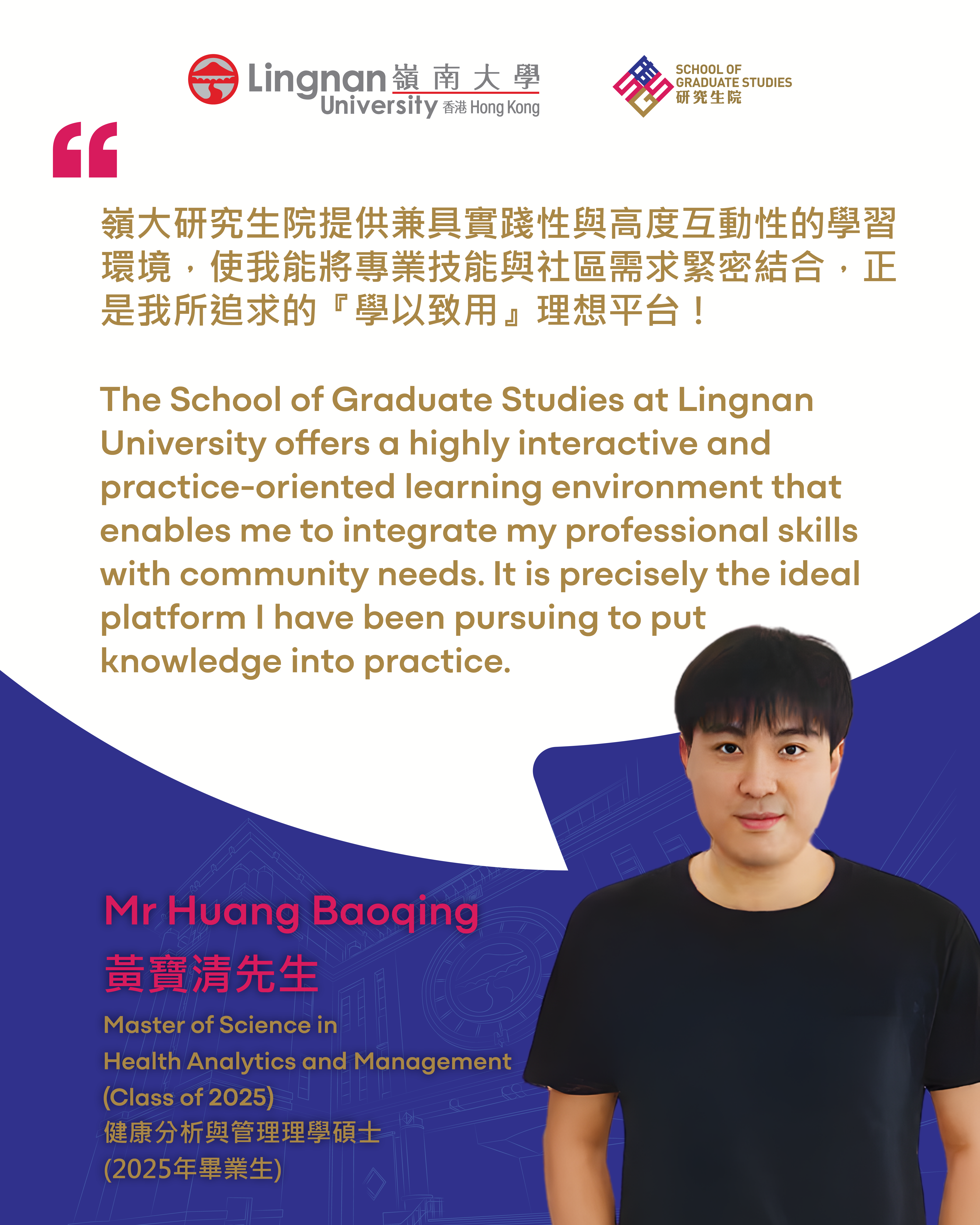 |
With a professional background in Computer Science, Huang Baoqing embarked on his postgraduate studies at Lingnan University (Lingnan)’s School of Graduate Studies (GS), completing the Master of Science in Health Analytics and Management (HAM) programme in 2025. For Baoqing, GS emphasises practice‑oriented and interactive learning, enabling him to integrate his professional skills with community needs, making it an ideal platform for putting knowledge into practice. He believes that studying the HAM programme was not only professional advancement but also a transformative experience that allowed him to take on a vital role as a “connector” in the health technology sector.
Baoqing has always aspired to use his expertise to improve people’s lives, particularly by addressing the healthcare needs of older adults. He shared that Lingnan’s steadfast commitment to liberal arts education closely resonated with his own learning aspirations, stating, “Lingnan emphasises not only academic development but also whole-person development and humanistic care. This has provided me with an ideal foundation for my personal and professional growth.”
During the HAM programme, Baoqing attended a variety of seminars and workshops and participated in a collaborative project between Lingnan and Pok Oi Hospital, evaluating the effectiveness of the Jockey Club Smart Geriatric Day Hospital Project. Operated by Pok Oi Hospital, the initiative lends tablet devices and other equipment to elderly participants, providing them with remote rehabilitation training that reduces the need for repeated journeys between home and hospital – an innovative telerehabilitation model.
Throughout the research, Baoqing worked closely with medical teams and technology companies, analysing the parameters and data of a rehabilitation mobile application to evaluate the project’s effectiveness. He said that GS provides a practice‑oriented and highly interactive learning environment, enabling him to integrate data‑analysis skills with the needs of the community — precisely the “learning through practice” platform he had been pursuing. “Implementing an innovative healthcare model requires close collaboration between data analysis, technology, and clinical application. The HAM programme has positioned me to stand at the intersection of these three domains,” Baoqing said. He looks forward to playing the role as a “connector” in the health technology sector.
In addition, Baoqing actively participated in the activities under the Learning Enhancement & Aspiration Pathways (LEAP) programme at the GS. By visiting various social welfare organisations, he engaged directly with older adults in the community. “I gained a deeper understanding of the healthcare needs of older adults and had more opportunities to better serve those with such needs,” he recalled. These valuable learning experiences helped Baoqing establish his career direction.
After graduation, Baoqing chose to remain in Hong Kong to pursue a career in health technology. He noted that the HAM programme provided direct and crucial support in his job applications in the field. “This learning experience has strengthened my systematic thinking about data, technology, and people, enabling me to ensure that the health technology solutions I develop are both effective and human centred — which is exactly what the market needs.”
Reflecting on his time at GS, Baoqing described himself as “fortunate” to have gained solid professional knowledge as well as a diverse and enriching growth experience. He encourages prospective and current postgraduates at GS to step beyond their comfort zones and actively embrace the “Lingnan experience” — for example, by participating in LEAP activities, engaging with peers and faculty from diverse cultural and academic backgrounds, and making good use of Hong Kong’s international resources. He emphasised, “Do not confine yourself to the classroom.” He believes that true growth often comes from interacting with people, the community and the city.