


Conference Confirms Vital Role of Digital Skills in Modern Society
Conference Confirms Vital Role of Digital Skills in Modern Society
During the Digital Universities Asia 2025 conference, held on July 8-9 and co-hosted by Lingnan University and Times Higher Education (THE), a series of panel discussions allowed expert speakers to share their views on the expected impact of new technologies on campus and far beyond.
The various sessions left no doubt that students and faculty members must be trained and prepared to make the best use of the tech tools now at their disposal, whether for teaching, undergraduate studies, research projects, or collaborating with partners around the world.
At times, it can still be hard to envision the potential scale of the change that is happening. However, two key moments during the first day of the summit helped to bring it all into focus.
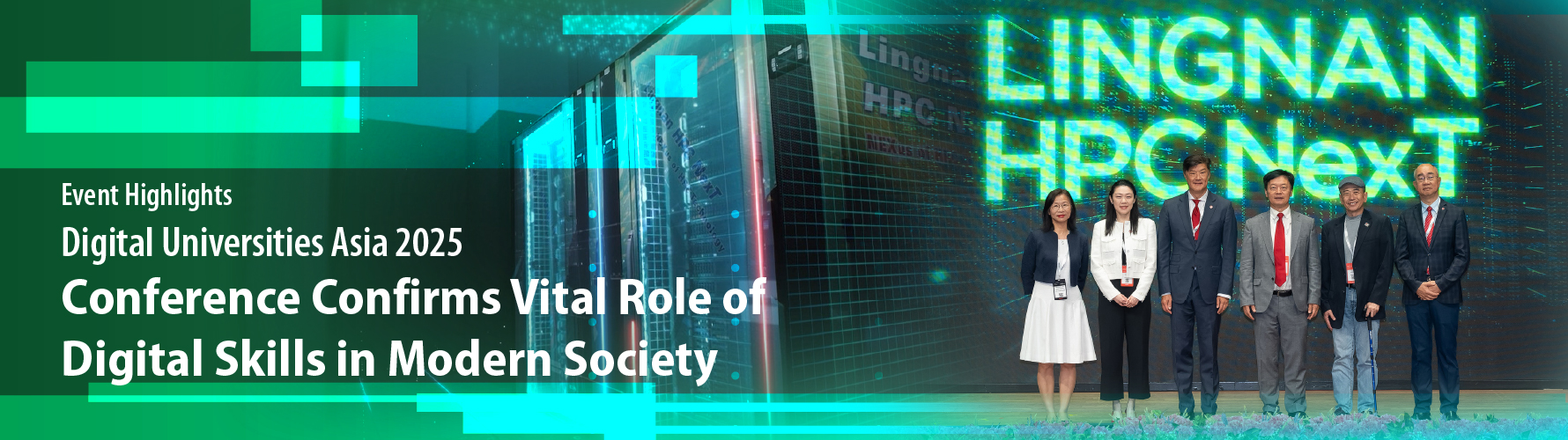
One was the official opening of the Lingnan HPC NexT, conceived as a hub to drive innovation in data science and capitalise on cutting-edge developments in AI and high-performance computing (HPC).


The other, immediately preceding that inauguration ceremony, was a wide-ranging panel discussion on the ways HPC is going to reshape and improve traditional approaches.
The distinguished speakers invited to take part were Dr. Simon See, Global Head of the Nvidia AI Technology Centre, along with two Lingnan University scholars: Professor Sam Kwong Tak-wu, Associate Vice-President (Strategic Research) and J.K. Lee Chair Professor of Computational Intelligence, and Professor Li Jia, Associate Professor of the School of Interdisciplinary Studies.
Serving as moderator for the discussion was Professor Raymond Chan Hon-fu, Lingnan’s Vice-President (Academics) cum Provost and Lam Man Tsan Chair Professor of Scientific Computing.
The first objective for the participants was to highlight the computational power of HPC through high-speed networks and large-scale data storage. This was already opening up all kinds of new possibilities for dealing with complex challenges, many of them interdisciplinary in nature.
It therefore brought a whole new dimension to the processes of problem-solving, decision-making, and applying the results of academic learning to real-world issues. That would directly affect the work being done in almost every field, ranging from finance and clean energy to the creative industries and social sciences.
The speakers outlined what this meant for universities, especially why it would be necessary to make access to HPC platforms an integral part of the curriculum to ensure students at every level could master the relevant skills.
Looking ahead, the panellists explored emerging trends such as next-generation computing and which held the most promise for transforming research and education in meaningful ways over the next few years.
In their exchanges, though, they also took care to emphasise the importance of critical thinking, human expertise, and ethical considerations. Such factors remain essential for making correct and effective use of the capabilities that AI and HPC can now offer.
Adding further context to these themes, subsequent sessions gave several Lingnan postgraduates and alumni the opportunity to share their perspectives on recent tech advances and what these changes mean for their studies.

For instance, the main area of research for Ma Xiaorui, a full-time PhD student in the School of Data Science, is Retrieval Augmented Generation, Large Language Models, and Fairness in LLM. Fellow PhD candidate HOWLADER, Md Hasan, in his third year at the School of Graduate Studies, is focusing on social media use and psychological distress among undergraduates.
Both have witnessed the university’s transition to digitalisation and expressed positive opinions about AI tools helping to promote active learning and the value of collaborative online courses. It was also undeniable that all companies will soon expect prospective employees to be digitally literate.

That point was confirmed in a follow-on panel discussion featuring three Lingnan alumni who are fully in touch with the latest developments in the world of work. The speakers were Dorothy Tong, a former supervisor at Lingnan Secondary School and Founder and Director, Heart of Gong; Andrea Fung, Senior Vice-President at Fubon Bank and Head of Strategic Planning & Business Management, Retail Banking Group; and Calvin Tang, Marketing Director of the North APAC Region for Alibaba Cloud.
Expanding on the topic “From Campus to Catalyst,” each of them shared personal stories and practical insights about what it takes to be a socially conscious leader in the digital age. In particular, they offered examples of how AI and other tech tools have helped to amplify their reach and influence, increasing the capacity for bringing genuinely transformative change for youngsters, charities, and less fortunate members of society.
“As an example, we helped an NGO develop a digital platform to receive donations via e-payments,” Tang said. “We have also been working with an AI start-up that has written some algorithms to help students with special educational needs. Via a smartwatch, it tracks their level of activity and reactions to different learning materials. The data is then sent to the cloud, and AI tools are used to recommend other suitable content that will help the students focus and learn better.”
For more information, please click here to view the event photos