


Highlighting Lingnan’s digital strengths at Asia-wide conference
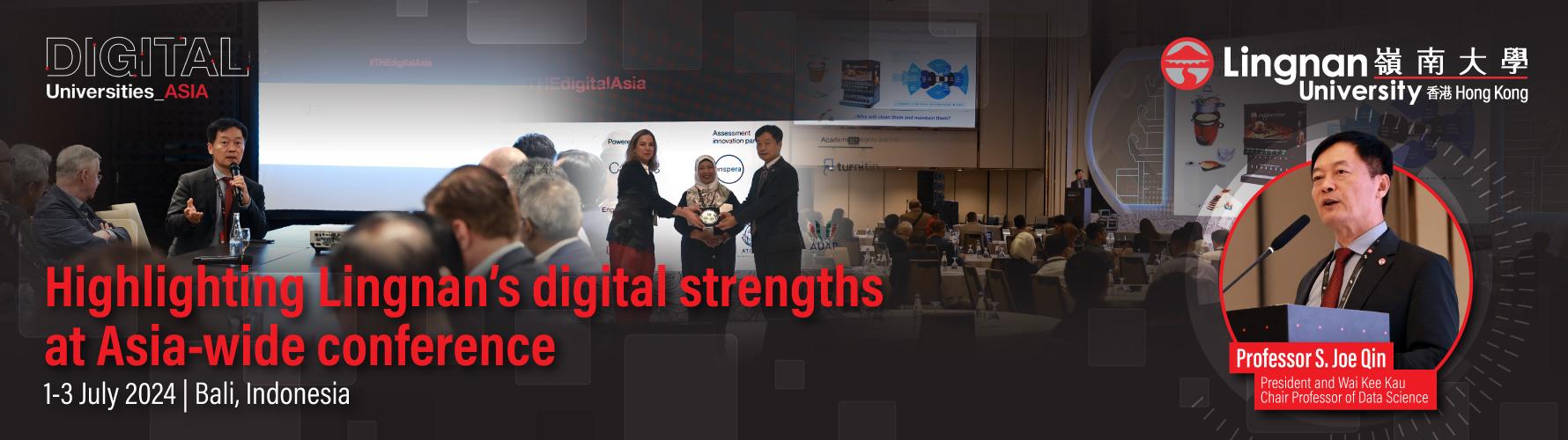

Lingnan University was well represented at a recent prestigious conference that brought together leading academics and policymakers from around the region. The focus of the Times Higher Education’s Digital Universities Asia 2024, which took place in Bali from 1 to 3 July, was the transformation now being seen in two important areas.
One of those involved the steps that academic institutions are taking to become more accessible and inclusive environments. The other centred on groundbreaking developments in the zone where education and technology intersect, and in particular, how innovative tools like generative AI are poised to reshape diverse aspects of university life.
In a keynote speech at the annual gathering, Lingnan’s President S. Joe Qin addressed the topic of “Reimagining Higher Education in the Age of AI”. This presented an opportunity to assess the evolving impact of the digital revolution and what it means for everything from curriculum content and teaching methodologies to research projects, essential skills, and the overall concept of comprehensive education in arts and sciences.
Professor Qin noted that AI is already capable of working on cognitive tasks, if not physical ones like cooking or cleaning. However, the rate of advances in autonomous driving, large language models (LLMs), and GPTs (generative pre-trained transformers) give an indication of what may be possible by gaining knowledge from data and using it.
More specifically, in May last year, when ChatGPT was asked what it can bring to the field of higher education, it produced a range of answers. Besides offering easy access from a web interface or app, these included use by individuals or groups to generate content such as essays, poems, summaries, lyrics and code based on user input and preferences. Also mentioned were the feedback, suggestions, and assistance given to improve content. ChatGPT claimed, too, that it can be integrated into liberal arts and AI courses and projects to enhance learning outcomes and engagement.
While acknowledging that, though, the key question for universities is whether such transformation will lead to some majors being reduced or discontinued and other programmes being created or expanded. There are also obvious implications affecting how students are taught, what is expected of them in terms of relevant skills, and what is still left for them to learn.

“We still want our students to build critical thinking skills, especially high-order thinking,” said Professor Qin, who is also Wai Kee Kau Chair Professor of Data Science at Lingnan. “When you use ChatGPT, you don’t need low-level thinking; it is done for you. We need the high-order skills and to instil our value system, so that we control AI, not the other way round.”
In looking to strike the right balance, in July 2023 the university committed to making ChatGPT and subsequent releases available for everyone on campus. It also encouraged proposals for several new undergraduate programmes in arts and social sciences with more digitally relevant content. Starting in September 2024, all freshmen will take a common core course on generative AI to ensure they have the basic know-how and apply it to good effect. The Faculty of Business will undoubtedly draw on an expanding stock of case studies to illustrate ways in which AI can increase productivity and efficiency in various industries.
Similarly important for Lingnan is a plan to promote the concept of digital humanities. The aim is to study the meaning and making of human culture with digital tools, with the prospect of finding new perspectives and insights through geographical information systems, data visualisation, network analysis, text mining, and generative AI.
“History, for example, will become a lot more interesting and accessible for our students and others,” Professor Qin said. “At the bottom, my message is that humans are at the centre of the post-AI world. We just need to co-live and collaborate with it. In higher education, we have to adapt; we cannot expect to teach things that AI will replace effectively and efficiently.”
Lingnan University has already been confirmed as a key host of the Digital Universities Asia 2025 event, which is set to take place next year on the main Tuen Mun campus in Hong Kong from 8-9 July, 2025.
Roundtable focuses on AI’s place in higher education

At the Digital Universities Asia 2024 event organised by Times Higher Education in Bali in early July, roundtable discussions were held to explore the challenges and opportunities that will define tertiary-level education over the next few years.
One particular discussion, focused on the subject of “Building a future-ready institution: leveraging technology to transform higher education”, directly addressed one of the most pressing issues.
With the rapid advancement of tools like generative AI, it is essential to have strategies in place to capitalise on the potential benefits for teaching, learning, research, and preparing graduates for the fast-changing work environment that awaits them. However, equal attention must be given to instilling core human values, ethical outlook, and critical thinking skills that remain crucial in any university education and that will shape our societies and communities.

The roundtable featured notable participants, including Professor S. Joe Qin, President of Lingnan University; Professor Shoichiro Iwakiri, President of International Christian University in Tokyo; and Professor Stephen Yong-Seong Park, Professor of Industrial Relations and Director of the Institute for Peace through Commerce of Kyung Hee University of Management. These leading academics from across Asia exchanged ideas and insights on navigating the new digital landscape.
There was a general consensus that a revolution driven by the latest technologies is taking place, and no institution can opt out or afford to be left behind. Throughout the discussion, speakers examined the approaches different universities are adopting to meet this challenge, with examples and case studies to illustrate the impact on teaching and learning plus effective uses of digital and blended delivery methods.
Naturally, emphasis was placed on the need for transformation, not simply for courses or departments but across entire institutions. This requires a careful reevaluation of current best practices and consideration of future workforce demands.
“This round of technology advancement is closer to us than, say, rocket science was in the past,” Professor Qin said. “It is something we can understand and use every day. Our arts and social science colleagues are very much welcoming the change and have proposed new programmes for undergraduates and graduates from the bottom up.”
He also noted that using ChatGPT campus-wide had helped individuals adapt and understand both the advantages and the downsides of such tools. However, he acknowledged that cultural issues may arise as people adjust to new tools and reassess what and how students need to learn.

Other participants in the session shared their own experiences and perspectives. For example, they discussed how AI could encourage faculty members to show more creativity in preparing course content and assignments while helping them to incorporate updates at an ever faster pace. It was also highlighted that universities should understand the expectations of today’s students, as well as the approaches taken by outside industries and the main priorities of prospective employers.
Going further, Professor Park raised the question of how universities can ensure AI is used for the benefit of humanity, which he described as a critical task for educators. Professor Iwakiri made the point that while AI can answer questions posed by humans, it lacks human experiences, feelings, and emotions, which are crucial in formulating replies. Therefore, all users must understand the potential, risks, limitations, and any possible mismatch between AI and long-established human values.
“One thing about the current version: there are a lot of guardrails,” Professor Qin said. “AI, though, is going to augment our ability. It can help us achieve what we want to do for sustainability and other good things. But teachers will need to give guidance on critical thinking skills, values, and the classics [of literature], so the next generation still values our current system and can tell when something is wrong.”


