


President Qin sets out Lingnan University’s vision for AI’s role in higher education
President Qin sets out Lingnan University’s vision for AI’s role in higher education

In almost every sector of society, the question is not whether AI will have a transformative impact, but rather how revolutionary this impact will be. The field of education is no exception, and Lingnan University is keen to position itself at the forefront of this important discussion.
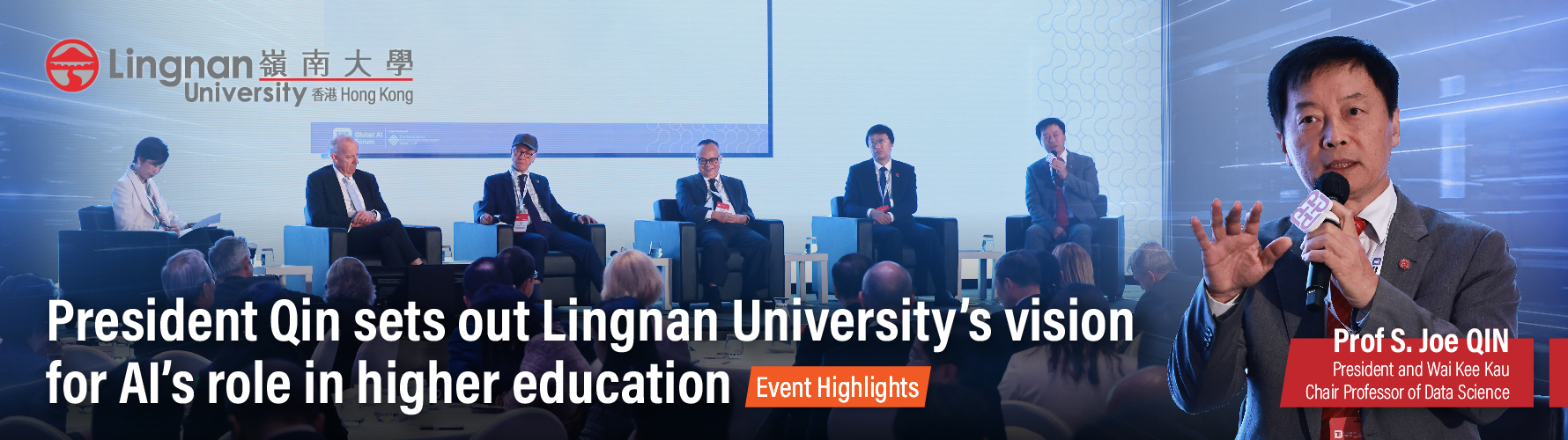
Professor S. Joe Qin, Lingnan University President and Wai Kee Kau Chair Professor of Data Science, was pleased to be a key contributor to the Times Higher Education Global AI Forum held in Hong Kong on November 29, 2024. The event, titled “Higher education in the AI era”, was organised jointly by The Hong Kong Polytechnic University and Times Higher Education.
The forum brought together an international group of academics, researchers, and thought leaders to discuss the current and potential roles of AI in higher education and how this technology can address societal change.
In the opening panel session, which set the context for the day, President Qin joined leaders from prestigious universities worldwide to discuss “AI in higher education leadership”.

In his opening remarks, President Qin emphasised the rapid evolution of AI, noting that ChatGPT was released almost two years ago, shortly before he became President of Lingnan University in mid-2023. “When I assumed Office, the first thing I did was to give everybody on campus free access to ChatGPT,” he said. “So instead of fearing it [AI], our staff and students are embracing it. They feel AI’’s power and its ease of use.”
With his background in data science and AI research, President Qin led Lingnan to establish the School of Data Science earlier in 2024. Under his leadership, AI has been integrated into every aspect of the university’s teaching, learning, and research. “We have a common course in AI and, since it's common core, every undergraduate student has to take it. I can say we are probably the first university to require generative AI for every undergraduate student.”
With funding from the University Grants Committee (UGC), Lingnan has collaborated with several peers to create an AI-powered platform called IDEAL. This platform allows instructors to design discussion classes in just 30 seconds — a task that previously took a full day — and make it available in multiple languages.
After each panellist shared their perspectives, the session opened to questions from the floor. President Qin took on a question regarding the skills universities should provide graduates to prepare for an AI-influenced job market.
“The most important thing now, beyond pedagogy, is to think about the new jobs that are coming and the old jobs that are disappearing,” he said, citing the demand for translators as an example.
“It is vital to recognise that graduates have to make a living, so we should consider the tasks that AI excels at and those it does not when shaping our disciplines and curricula. Right now, AI is very good at revolutionising the cognitive world in terms of anything humans can write, read, draw, or even sing. But if you deal with the physical world, AI is not very good.” President Qin used cooking as a case in point.
Another audience member asked if the teaching of traditional skills was still necessary.
“When revolutions come, you have to respond,” President Qin replied. “Say you’re a professional teacher or professor, you’ve taught the same thing for 20 years, and you’re very good at it; you’re very passionate, and you’re the best in the world. Would you still teach the same thing if you knew that, in five years’ time, the career opportunities for your graduates would have all but disappeared? Would that be professionally ethical?” he wondered.

After the panel discussion, Times Higher Education conducted an interview with President Qin.
When asked about training for staff and students, he explained that they participate in tutorials with external specialists and internal IT colleagues to enhance their understanding of AI.
In response to a question about AI and liberal arts, he said that for Lingnan, liberal arts education focuses on teaching methodology rather than specific disciplines, and the potential of AI aligns very well with Lingnan’s educational approach.
President Qin also highlighted the support and funding from the UGC for joint projects between universities, which fosters collaboration among AI innovators.
When asked to look ahead, President Qin noted that, from his background working in the US, he would say Hong Kong is better at adapting to new technologies. “And because Lingnan is a modest-sized university, it can adapt even faster.”
In the years to come, he suggested that Lingnan may offer more interdisciplinary programmes while phasing out some existing ones. “We want our graduates to have the skills needed by employers in the future, not those that will be obsolete in five years.”