


Rankings demand attention but are not the whole story
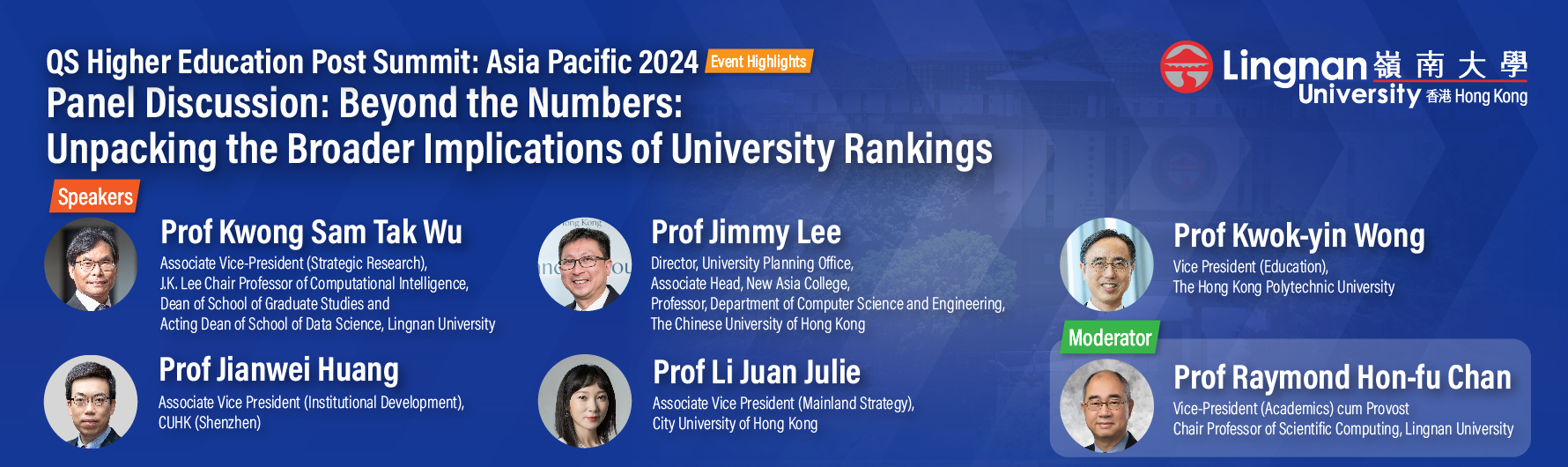
Rankings demand attention but are not the whole story

One of the in-depth panel discussions at the QS Higher Education Post Summit: Asia-Pacific 2024 tackled a subject about which almost everyone connected with the world of academia has something to say.
The given topic was “Beyond the Numbers: Unpacking the Broader Implications of University Rankings”, which gave plenty of scope for different perspectives and strong opinions.
And, as soon became clear from the comments and exchanges, many in the higher education sector are paying ever more attention to the various ranking lists, though still trying to interpret just how important they really are.

Prof Raymond Hon-fu Chan, Vice-President (Academics) cum Provost Chair Professor of Scientific Computing, Lingnan University (Right)
The moderator for the occasion was Professor Raymond Chan, Vice-president (Academics) cum Provost of Lingnan University, who asked the distinguished group of panellists to consider a number of key questions.
These included the issue of whether such metrics genuinely enhance the quality of education and outcomes or cause institutions to focus too much on areas and measures which can be expected to gain higher marks on the external scoresheet.
In addition, Professor Chan was keen to hear about the longer-term impact of rankings on a university’s policies and priorities, bearing in mind the way relative standings can influence not just candidate and employer perceptions, but also government funding, alumni donations, and research grants.
A further point for consideration was the possibility of using alternative metrics – and which ones – to gain a fairer reflection of the values and goals specific to each institution when assessing their all-round quality and competitiveness.
And behind all of this was the question of equity and access, in particular whether rankings help to improve diversity and inclusion within the university system or, conversely, tend to promote elitism.

Professor Sam Kwong Tak Wu, Associate Vice-president (Strategic Research) and J.K. Lee Chair Professor of Computational Intelligence at Lingnan University
Leading off, Professor Sam Kwong Tak Wu, Associate Vice-president (Strategic Research) and J.K. Lee Chair Professor of Computational Intelligence at Lingnan University, noted that rankings are here to stay, but complications inevitably exist because they seek to measure such a range of factors.
“It is difficult to optimise so many objectives to get, at the end, one number that shows how good you are,” Professor Kwong said. “Two things are particularly hard to capture in any system: the perceptual measure and the community engagement, which you might call diversity and inclusion. That leaves a lot open for discussion.”

Prof Li Juan Julie, Associate Vice President (Mainland Strategy), City University of Hong Kong
Fellow panellist Professor Julie Li Juan, Associate Vice-president (Mainland Strategy) at City University of Hong Kong (CityU), confirmed that rankings are indeed “a big deal” in higher education these days, and there is no sign that is going to change.
In CityU’s case, it was encouraging to see that a greater commitment to academic research, internationalisation, innovation and excellence had been duly recognised with an impressive move up in the latest QS Asia announcements.
“Rankings are not just a list,” Professor Li said. “They are a representation of the state of global education. They influence the choices students make and how universities are perceived. The impact goes beyond the number.”
More specifically it brings both competition and cooperation – and a push and pull between them – as institutions look for new ways to get an edge. The challenge in many cases is to find the right balance.
Latterly, there has also been greater attention focused on issues like sustainability and social responsibility, where universities are rightly expected to set an example for the wider community.
“Now, universities are not just being judged on academic excellence, but on how well they are helping to solve the big challenges like climate change and inequalities,” Professor Li said.

Prof Kwok-yin Wong, Vice President (Education), The Hong Kong Polytechnic University
For Professor Kwok-yin Wong, Vice-president (Education) at the Hong Kong Polytechnic University, rankings have definitely become a key element in establishing an external image and international reputation, which count for a lot when attracting students, research partners, and interest in starting joint programmes or simply sharing information and resources.
“If you want to improve, you have to look at the ranking agency metrics used for things like internationalisaton or diversity and inclusion and be ready to make changes,” Wong said. “At the same time, though, a university should not forget its mission and strategic objectives. It should still have its own metrics for assessing educational performance and research.”

Prof Jianwei Huang, Associate Vice President (Institutional Development), CUHK (Shenzhen)
For a younger university, however, the steps needed to get an initial ranking can be vague, according to Professor Jianwei Huang, Associate Vice-president (Institutional Development) at CUHK (Shenzhen), which was established in 2014 and now has more than 11,000 students and 600 faculty members.
One way to get noticed, though, is through overseas tie-ups, and the university already has around 150 international collaboration programmes, including summer courses and joint undergraduate and master’s degrees.
“If you look at the larger ranking systems, sometimes we show up as an independent entity, sometimes we don’t,” Professor Huang said. “Sometimes, they rely on data that is in the public domain, sometimes they rely on data we provide, but often it is incomplete because each ranking system has its own criteria.”
So, for a young university that is growing fast, the basic questions should be whether to look at current statistics or the trajectory and how to factor in size, potential and available resources.

Prof Jimmy Lee, Director, University Planning Office, Associate Head, New Asia College, Professor, Department of Computer Science and Engineering, The Chinese University of Hong Kong
Professor Jimmy Lee, Director of the University Planning Office and Professor in the Department of Computer Science and Engineering at the Chinese University of Hong Kong (CUHK), added that rankings undoubtedly helped in identifying areas for improvement, but it was important not to become too obsessive about them.
“Our university was established for a very good reason; we have our own goals and objectives,” Professor Lee said. “Also, as a public institution, we should not forget about the local context and social responsibility. Rankings are more of a global thing.”


