


Lingnan University Showcases Global Leadership in Humanitarian AI and Sustainability at GSDC 2026
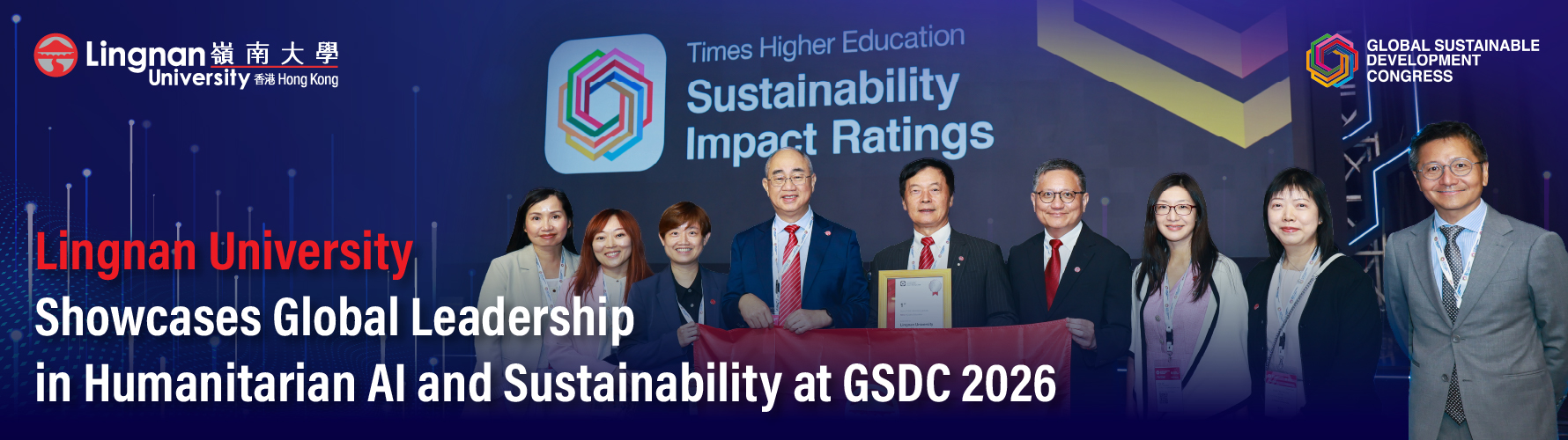
The Global Sustainable Development Congress (GSDC) 2026, held in Jakarta from 22 to 25 June 2026, brought together global leaders from higher education, government, industry and civil society to advance the United Nations Sustainable Development Goals (SDGs).

As an AI Partner of the Congress, Lingnan University played a prominent role in shaping critical conversations at the intersection of technology, sustainability and social impact. The University hosted two high-level panel discussions and delivered a thought‑provoking stage presentation. Lingnan also featured a dedicated exhibition booth showcasing several of its award‑winning research projects, highlighting the University’s impactful innovations in AI, sustainability and interdisciplinary scholarship.
On 23 June, Prof Paulina Wong, Associate Professor and Head of the Science Unit, presented “GeoAI for smart cities: Revolutionising urban mosquito-borne disease control”, showcasing how cutting‑edge GeoAI research can strengthen public health resilience in rapidly urbanising environments.

That same day, Lingnan convened the panel “From Research to Impact: Design‑Led Humanitarian Technology for the Global South”, highlighting interdisciplinary, design-driven solutions to pressing global challenges. Professor Raymond Chan, Vice-President (Academics) and Provost, was one of the featured speakers, and Professor Albert Ko, Director of the Office of Service-Learning, moderated the session.

Another panel discussion, “The Digital Future: AI and the Frontier of Education Quality and Equality”, featured President Joe Qin as one of the distinguished speakers was held on 24 June. The session examined how artificial intelligence is reshaping education globally, focusing on how AI‑driven tools and intelligent data systems can enhance quality, accessibility and equity. Speakers discussed leveraging AI to bridge the digital divide, personalise learning experiences, improve teaching effectiveness, and prepare both students and educators for a digital‑first future. President Qin’s participation underscored Lingnan’s commitment to advancing equitable, forward‑looking education in the AI era.

The Congress also provided a timely platform to celebrate Lingnan’s latest global achievements. In the newly released Times Higher Education Sustainability Impact Ratings 2026, the University reached a historic milestone, rising from the 101st–200th band to 63rd place globally—breaking into the top 100 for the first time and ranking third among Hong Kong SAR institutions. Seven SDGs were placed in the global top 100, more than doubling last year’s results. Notably, SDG 4: Quality Education retained its position as number one worldwide for the second consecutive year, while SDG 10: Reduced Inequalities surged to 11th globally. SDG 8: Decent Work and Economic Growth ranked 27th, and SDG 17: Partnerships for the Goals placed 55th globally.
To commemorate these remarkable accomplishments, Lingnan hosted a celebratory Drinks Reception on 23 June, welcoming more than 120 guests and partners to reaffirm the University’s shared commitment to sustainable and inclusive global development.


For more information, please click here to view the event photos